OED lists lightning as a verb and includes the past tense form lightninged:
Lightning, v.: = lighten v.2 6. Also fig
1903 Westm. Gaz. 16 Nov. 8/2 The two metal balls..thundered and lightninged as they delivered the message.
1926 H. Caine in Strand Mag. Jan. 20/1 Mr. Gladstone leapt to his feet, whereupon the air of the House thundered and lightninged for a short ten minutes.
1935 Z. N. Hurston Mules & Men i. i. 27 You know, when it lightnings, de angels is peepin' in de lookin' glass.
This is not some mere quotation from the entry of lighten, as you can see, it's listed explicitly as a separate entry, separate from the noun form, with a single sense. Here's it's entry profile:
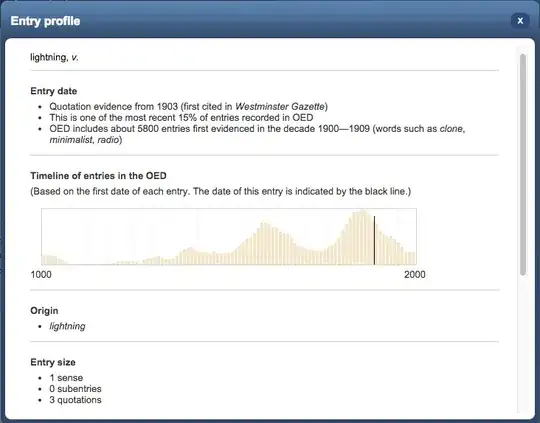
Contrary to people saying this is not a common form or inadvisable, I'm a native speaker, I use it, and can confirm that everyone around me (I'm in the US South) uses it. To me, lightened only has an inchoative meaning (that is, to become lighter) and I would never use it to refer to the electrical discharge and likely not understand it as such barring other context clues. Notice that the original citations are from England (although Edwin says it's unused in Britain these days), and the OED doesn't list it as being obsolete, literary, dialectal, rare. Curiously, for most (myself included), the present participle is invariable, although given that Urban Dictionary has several entries for it, it's possible someone uses it somewhere. Personally, if I did, since I normally pronounce -ing as [n̩], there'd be little perceptible difference between [lɑ̝ʔ.nə̆n] and [lɑ̝ʔ.nə̆n.n̩].
While I admit it may be more frequent in my dialect, it's certainly used in higher, academic registers. For example, looking at the linguistics article "What Rains?" (Bill J. Darden, Linguistic Inquiry 4.4 [1973]), the verb is used in line with other verbs in a linguistics article about a completely different topic:
Even in English there are problems that for the presumption that every sentence has a subject. In sentences such as (1), the it seems to have neither of the normal functions of pronouns:
(1) It rained (snowed, thundered, lightninged).
It is not deitic, nor does it refer to an entity named by another noun phrase.
Likewise, in another article, "Grammar and Existence: A Preface to Ontology" (from Mind, 1960, Oxford UP) we can find:
That it has just lightninged (causally) implies that it will shortly thunder. (p. 519)
In fact, you can even find a compounded past participle form of it in Judith Witt's review of two books in Modern Philology 90.2 (1992):
“A kiss is just a kiss, even when it is a great kiss,” cautions Susan Morgan of the white-lightninged climax of James's Portrait of a Lady (1881). (p. 285)
Even more recently, it was used in "June Twelfth" (Anatoly Naiman, American Poetry Review 34.4 [2005]:
Yesterday was sunny and warm, then a storm struck,
It thundered and lightninged, it poured, and then the sun came out again. (p. 39)
And also a figurative use from 1992 ("Gardening, The Professor", Jill P. Baumgaertner, The Centennial Review 36.3 [1992])
… These lumpy legs / he hangs from trellises next to the pond / lightninged with the fish
And a present simple usage since people still don't think the verb exists separately, from "Naturalism and Process" (Hegeler Institute, The Monist 64.1 [1981]):
- We now need to note the existence in the manifest framework of verbs which take dummy subjects.
- It rains
- It thunders
- It lightnings (p. 47)
According to Google N-Grams, lightning is the prefered verb in the phrase thunder and [lighten|lightning], though both clearly exist and are used.
Given that others seem to refute the existance of lightning[s|ed] as a verb even in spite of the clear evidence to the contrary, if you wish to use a past tense construction, your best bet is going to be to say that there was lightning avoiding the verbs entirely or use it was lightning which (I think) is acceptable spelling on both sides of the Atlantic. Besides, these days, it seems for the past few decades, most people use the "there was lightning" structure a lot more than any other form combined.


