18

Recently, I came across the verb to bathe written as bath in two English coursebooks used by Italian students. The first time I saw it, I dismissed it as a typographical error and told my private student that the verb was bathe, but when it appeared a second time, in a different textbook, I checked with an online dictionary and read the following definition with which I am most familiar.

Merriam-Webster

  1. bath verb: to wash (someone) in a container filled with water
    "to give a bath to (someone)"
    "to have a bath" : to wash yourself in a bath

But in a different dictionary I read this

Oxford Dictionaries
[WITH OBJECT] British
1. Wash (someone) while immersing them in a bath:
how to bath a baby

1.1 [NO OBJECT] Wash oneself while immersed in a bath:
a)there was no hot water to bath in
b)These are the people that quite happily let me shower and bath with no hot water for 10 days, because they couldn't be bothered to fix a tap.

I told my student that it appeared that to bath was a BrEng variation and that Americans probably didn't say or use it.

However, upon doing some research I found many websites that use bath and bathe indiscriminately, with the same meaning

  • How do I bath my baby? Netsmum.com (UK)
  • Read about how to bath your baby NCT.uk (UK)
  • In California it is illegal to bath two babies in the same bath at the same time. Stupid Laws.com (US) [this might be a typo]
  • But try not to bath more than once a day Raising Children.net.au (Aus)
  • You can bath the baby daily, but make sure… . Marhababy (Arab Emirates)

  • It’s not necessary to bathe your newborn every day Mother & Baby.com.au (Aus)
  • If it's easier for you to bathe the twins during the day... Parents.com (US)
  • The first time you bathe your baby, you may feel a bit nervous. Babycenter.in (India)
  • You don't need to bathe your baby every day... NHS.uk (UK)
  • What’s the best way to bathe my baby? InfaCare (UK)

The above shows the transitive use of the verb bath/bathe. I presume the age of the child or adult being bathed is not a key factor, it was just easier for me to search "bath/e your baby".

The phrase in one of my student's coursebook was using the intransitive form instead.

You'll visit onsen or thermal springs where we recommend you bath communally like the Japanese.

Questions: Apparently, both forms are acceptable but is to bath AmEng or BrEng? Is it grammatical? (I just find it so odd.)

Finally, if the pronunciation of the verb to bath is /bɑːθ/ (UK) and /baTH/ (US) does this effect the pronunciation of the past form bathed? i.e. /bɑːθt/ (I don't think it does, but I'd just like a confirmation)

Mari-Lou A
  • 91,183
  • Here is a usage note: http://www.oxfordlearnersdictionaries.com/definition/english/bathe_1 –  Nov 03 '14 at 11:22
  • @Josh61 Well, it helps a bit... – Mari-Lou A Nov 03 '14 at 11:33
  • 1
    In Britain either bath or bathe are acceptable as verbs. My sense is that the former is far more common, and the latter sounds a bit posh and even affected. Bathe, for most people, would suggest swimming. – WS2 Nov 03 '14 at 11:45
  • The British also bathe a wound. – WS2 Nov 03 '14 at 11:51
  • @WS2 blow me down, I would have sworn that Brits said "have/take a bath" and "give a bath". The wound bit, I knew. To bathe in the cool waters of .... sounds so much better too. – Mari-Lou A Nov 03 '14 at 11:51
  • 2
    @Mari-LouA well we do say 'have a bath'. But we also bath the baby, and sometimes 'bath' as often as once a week. 'Bath' is definitely used as a verb in Britain. My wife (who is Malaysian) talks about bathing and taking a bath even when she means showering. Though this sometimes confuses British people. – WS2 Nov 03 '14 at 11:53
  • @Mari-LouA I think you would be very unlikely to hear bathe (meaning bath) in the north of England. It would sound really effeminate and affected, a bit like drinking tea with your little finger sticking out. (They have, however, stopped using the aluminium ones in the living room!) – WS2 Nov 03 '14 at 11:59
  • @WS2 could it be that bath is more often said in the north of England? What about that phrase taken from the textbook? Is "we recommend you bath communally..." something you would say? – Mari-Lou A Nov 03 '14 at 12:01
  • 1
    @Mari-LouA If you are talking about something like a Japanese onsen then the British most likely would say bathe. It is an experience I had whilst in Japan, and I think we said bathe. – WS2 Nov 03 '14 at 12:13
  • 2
    Very few people in the UK would use either bath or bathe very often in speech. 'Have a bath' is far more colloquial. – Edwin Ashworth Nov 03 '14 at 12:14
  • @EdwinAshworth But we do bath the baby. – WS2 Nov 03 '14 at 12:15
  • 1
    @ WS2 We usually give it a bath, in my experience. – Edwin Ashworth Nov 03 '14 at 12:16
  • @EdwinAshworth In Norfolk they would, as I guess you would in Oldham. But I suppose I am corrupted by my years in the polite Home Counties where I think you will find the verb is more frequently employed. – WS2 Nov 03 '14 at 12:20
  • @EdwinAshworth so I'm not going crazy thinking to bath is highly "unusual". BTW Welcome back! You've been gone ages. – Mari-Lou A Nov 03 '14 at 12:24
  • 5
    @Mari-LouA Using bath to mean the verb bathe strikes me as unusual as would be dispensing with the terminal e's from verbs like bathe, breathe, clothe, lathe, lithe, loathe, scathe, scythe, seethe, sheathe, teethe, or writhe: the version the e at the end would devoice the th and become a mere noun, not a verb. I would read and say it wrong. – tchrist Nov 03 '14 at 12:39
  • 9
    I don't recall ever hearing "bath" used as a verb here in the US -- always "bathe". (Or at the very least, if someone said "bath" as a verb I would have interpreted it as part of their foreign accent.) – Hot Licks Nov 03 '14 at 12:40
  • @tchrist thanks to Edwin's bit of research I found (I think) an American citation "she does not know how to bath the baby or change a diaper" – Mari-Lou A Nov 03 '14 at 13:47
  • The book was printed in NY 2000 but maybe the author is a Brit. – Mari-Lou A Nov 03 '14 at 13:50
  • 1
    English has a whole class of these voiced-unvoiced pairs of words. See the answer to this question. – Thruston Nov 03 '14 at 16:12
  • @EdwinAshworth I should have placed 'polite' in inverted commas, indicating I was using the word in a sceptical or ironic sense. My apologies. I do not believe people in the Home Counties are genuinely any more 'polite' than in any other part of the UK. – WS2 Nov 03 '14 at 18:44
  • @Thruston thank you for the link. It does seem that the verb to bathe is more recent. Time for me to look at etymonline. – Mari-Lou A Nov 03 '14 at 18:55
  • Somewhat off-topic, but it seems like "have a bath" is more common than "take a bath" outside the US. It sounds odd to me in a very charming way. Also, do Brits call the clothes worn to go swimming a bathing suit? – Joel Anair Nov 03 '14 at 19:10
  • 1
    @JoelAnair it's a bit old fashioned, one piece swimsuits is more common, swimming costume, bikini for girls and swimming shorts/trunks for men. – Mari-Lou A Nov 03 '14 at 19:24
  • @JoelAnair - "Take a bath" is more common in the US because the place where you take one is Wall Street. – Hot Licks Nov 03 '14 at 20:05
  • @WS2~ my wife is Indonesian, and she baths under the shower too. – Roaring Fish Nov 04 '14 at 06:58
  • @RoaringFish After decades of marriage I find I have adopted the same idiom and often confuse people with whom we stay, who assume I want a bath rather than a shower. – WS2 Nov 04 '14 at 08:25
  • I found this blog article, written by an American (he uses American spelling) and in it he uses the verb to bath. "A laborer in the lumbermill operated a bath house at Barneston - providing a place for Japanese men returning home after a hard day's work to bath communally. In keeping with tradition, women and children could bath only after the men." – Mari-Lou A Nov 04 '14 at 09:55

9 Answers9

21

Those are not typos. Native speakers of British English do use bath as a transitive verb. Bathe on its own suggests swimming, and probably specifically seaside swimming — not even in swimming baths (which are swimming pools these days anyway).

Bathe is almost poetic: something might be bathed in light. Apart from bathe a wound, to hear it used literally rather than metaphorically is rare to the point of extinction.

In British English, the word bathed can be pronounced /beɪðd/ or /bɑːθt/ depending on its root.

Andrew Leach
  • 101,901
  • What about the phrase taken from the textbook? Would you say we recommend you bath communally was written by a British writer? Would you say or write a similar thing? – Mari-Lou A Nov 03 '14 at 13:10
  • 3
    @Mari-LouA "We recommend you bath communally" is standard British usage (apart from bathing communally, which isn't!) – Andrew Leach Nov 03 '14 at 13:18
  • 4
    BrEng here, bath reads incorrectly for me, I would use bathe, in fact, 'tis more likely I would use wash in the case of the baby, as that is the purpose of the act! I disagree with Andrew about the suggestion of swimming, but agree with the poetic and pronunciation points. – Sam Nov 03 '14 at 13:45
  • 10
    This must be a British thing, because bathe in the US I have never heard used to describe swimming. Taking a bath or bathing is the act of cleaning yourself in water; swimming is what you do in the ocean to move from point to point (or recreation) or in a pool for recreation or sport. – Andy Nov 03 '14 at 13:50
  • I've never heard this in the UK. – Lightness Races in Orbit Nov 03 '14 at 17:16
  • @LightnessRacesinOrbit Which bit of the above does the this in your comment refer to? – Andrew Leach Nov 03 '14 at 17:44
  • 1
    @AndrewLeach: All of it; the entire page. "To bath" is completely new to me. – Lightness Races in Orbit Nov 03 '14 at 17:52
  • 4
    I trust your evaluation of this as correct and common in British English, but you might add a note to your answer to the effect of this usage being rare and widely perceived as incorrect in American English (since the OP asked about both). – Chris Sunami Nov 03 '14 at 19:08
  • @Andy I also have never heard swimming called bathing, although when I go swimming I wear a bathing suit. – Joel Anair Nov 03 '14 at 19:15
  • 2
    Perhaps I should have been more explicit (although it's difficult to see how). Bathe, when it's used, which is not often, usually means sea swimming. It can have other uses (as I noted) but anything to do with a bath is unusual. Result: bathe is rare. Note that bathing meaning "swimming" is not pronounced the same as bathing meaning "taking a bath". – Andrew Leach Nov 03 '14 at 19:28
  • 1
    @ChrisSunami My answer is clearly BrE-orientated. I'm not qualified to say whether it's rare and widely perceived as incorrect in AmE. There's nothing stopping an AmE expert answering from an AmE perspective, although being categorical about a valid Britishism being a typo appears to be ill-advised. – Andrew Leach Nov 03 '14 at 19:58
  • 5
    @ChrisSunami What Andrew Leach has said is entirely borne out by the OED, which gives as the meaning of the verb 'bath': trans. To subject to a bath; to wash or immerse in a bath. Differing from bathe in having a more distinct reference to bath n.1 11, and in being always literal. One does not bathe primarily to wash oneself. It is for the pleasure of immersing oneself in agreeable waters, such as when we swim for pleasure. Notices abound on British beaches which say things like 'It is dangerous to bathe here', and 'No bathing'. (c. fwd) – WS2 Nov 03 '14 at 21:10
  • @ChrisSunami Sea bathing for pleasure only really began in Victorian England, perhaps after the very different American usage had already become established. – WS2 Nov 03 '14 at 21:14
  • In California, Texas, and Massachusetts, I have never heard "bath" used as a verb; nor have I heard of "bathe/bathing (always pronounced 'bathe-ing')" used to refer to swimming in anything other than a bathtub. – Doktor J Nov 03 '14 at 23:17
  • Yeah (somewhat oddly), you may get into your bathing (long A) suit and go out sun bathing, or go swimming, but in the US you don't "bathe" in the lake/river/ocean unless you're "roughing it". – Hot Licks Nov 04 '14 at 01:32
  • @JoelAnair Ha, yes you're right that is pretty common, just as common as swim(ming) suit I'd say. – Andy Nov 04 '14 at 02:26
  • 1
    Didn't realize I was so archaic using bathe as a verb to mean wash or stew around in a small pool. ("Swim" to me indicates a lot more movement, like in an athletic pool, lake or ocean.) "Go bathe" is what I tell my kids. They do it in the "bath". We "swim" in the ocean or the pool. "Bathe the mixture in ice" is a normal cooking instruction. Granted I was born in Texas but live in Japan -- I can't imagine things have changed that much, have they? – zxq9 Nov 04 '14 at 04:25
  • 1
    @zxq9 Those Americans who appear not to know that bathing is something done for pleasure in the sea or spa, have probably never heard of bathing machines, either. You can see these at any week-end at places like Brighton or Bournemouth. (Actually nowadays they swim nude from beaches close to where these will have been taken). but the Victorians considered it indecorous to be seen in their 'bathing costumes', so did themselves in these contraptions. https://www.google.co.uk/search?q=bathing+machine&num=50&tbm=isch&tbo=u&source=univ&sa=X&ei=339YVJyDGcWV7AbIuYGoAg&ved=0CC4QsAQ&biw=1280&bih=687 – WS2 Nov 04 '14 at 07:33
  • All this reflects the very different development of the 'seaside' in Europe versus 'the beach' in America. I once had this discussion with @Peter Shor (if you are out there Peter). He maintained that similar resorts to those found in Europe existed in New England and elsewhere in the 19th century. Did they not 'bathe' and have 'bathing machines'. – WS2 Nov 04 '14 at 07:41
  • @AndrewLeach My point was only that adding the note about American usage would make this a more complete answer, versus the current situation of having two correct answers to be upvoted separately. – Chris Sunami Nov 04 '14 at 14:21
11

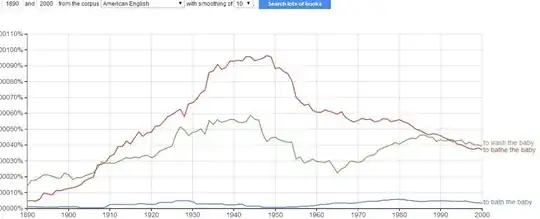
Just some observations and Ngrams. The results on the American English corpus indicate that the verb to bath is rarely used if at all. Whereas the expression to wash the baby seems to be overtaking its counterpart to bathe

AmEng corpus data

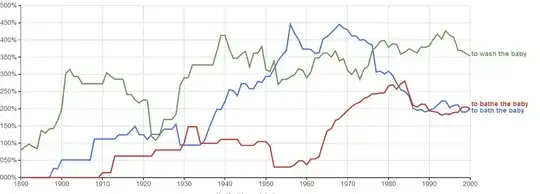
Meanwhile the British English corpus shows the slow upward trend for to bathe the baby which has been picking up momentum since the mid 1960s; but both bath and bathe are overshadowed by the expression to wash the baby

BrEng corpus data

This confirms Andrew Leach's claim (not that I would ever doubt his word) that

Native speakers of British English do use bath as a transitive verb.

Mari-Lou A
  • 91,183
  • 2
    I completely endorse everything in @Andrew's answer, but I'm also upvoting this one because you did specifically ask about *AmE. There will always be some BrE speakers who aren't actually familiar with our "verbified noun" usage, or who object to it on other (pedantic?) grounds. But I suspect many of the sceptical comments are from people more familiar with AmE usages. Which increasingly over my time on ELU I find to be relatively "conservative" in respect of current, ongoing* linguistic innovation. – FumbleFingers Nov 03 '14 at 18:55
  • I don't actually believe many of these Ngrams and am highly suspicious of how they are compiled. I have never heard of anyone in Britain who bathes the baby in order to wash it. – WS2 Nov 03 '14 at 21:19
  • @WS2 in the whole whole whole of Britain? How many inhabitants are there? 70,000000 give or take? There has to be at least one person who says bathe :) After all it's a multicultural society, American TV and movies are a huge influence and these factors/conditions/changes are reflected in the British English language. – Mari-Lou A Nov 03 '14 at 21:26
  • @WS2 if you think about it, when did American "TV" start becoming really big in the UK? In the 70s... – Mari-Lou A Nov 03 '14 at 21:28
  • 1
    @Mari-LouA Well I have not heard of an instance. Undoubtedly there are some, but the Ngrams would have us believe that to 'bathe the baby' was nowadays more common than 'to bath the baby'. That, I do not believe for one moment. – WS2 Nov 03 '14 at 21:48
  • 2
    @WS2 Ngrams has many merits and limitations, it needs to be used judicially and that includes checking the results posted at the bottom of the chart. I haven't done the latter, but I did find online many instances of to bathe the baby on British websites. I posted one link, the NHS one no less. – Mari-Lou A Nov 03 '14 at 21:57
  • to bathe the baby on the Brit Corpus. Now you'll have to look at the authors, check if they're Australian, British, American, N.Zealanders etc. Check to see in which country each book was published, etc. – Mari-Lou A Nov 03 '14 at 21:58
  • @ws2 I checked the first page, they are all books printed in the US or Canada. This despite my selecting the "British corpus"!! I am sure there must be a few British publications that use to bathe, but it's not that important. I wanted to find out if to bath was valid, which English variety it belonged to, and how common it was. I can now go back to my students and tell them it's not a typo. I'm not sure if I'll ever say to bath myself, to my ears to bathe sounds more refined, but I've learnt something today. I'm a happy bunny. – Mari-Lou A Nov 03 '14 at 22:19
  • 1
    @WS2 I've upvoted your comment :) Hopefully visitors will take note. – Mari-Lou A Nov 03 '14 at 22:23
  • 5
    I'm a little concerned that we are bathing our babies a lot less than we did in the 1940s. – Mordred Nov 03 '14 at 22:24
  • @Mari-Lou ~ printed in US or Canada does not mean US or Canadian authors. Many books have British editions and US editions with seperate ISBNs, and the difference can be as minor as the cover illustration, blurb, or intro. They may or may not convert to US spelling. I have heard rumours of characters changing, but I have never encountered that in a book though it happens frequently with TV shows. – Roaring Fish Nov 04 '14 at 07:04
  • @RoaringFish valid point, but in order to be doubly sure you'd still need to check the authors' nationalities, and then perhaps the proofreaders'; and the editors' argghhh! – Mari-Lou A Nov 04 '14 at 07:07
  • @Mari-LouA Thanks. I sense this is a repeated problem with Ngrams. – WS2 Nov 04 '14 at 08:18
  • @Mari-LouA The English distinction of the verbs bath and bathe is not unique. In French there is clear distinction between prendre un bain (take a bath), baigner (transitive for bathing babies etc. and the reflexive se baigner which refers to sea bathing. Thus the French at St Tropez or Biarritz bathe in the sea, but in a rather better climate than Skegness or Margate! Does the same distinction exist in Italian? – WS2 Nov 04 '14 at 09:55
  • @WS2 fare il bagno a mare literally "to have a bath in the sea". And faccio il bagno "I have/take the bath"= I'm having/taking a bath See Word Reference on how they translate the expression. There's a Briton who says "bathe"! :) – Mari-Lou A Nov 04 '14 at 09:58
  • There's also the reflexive: mi bagno "I bathe myself" But not "I bath myself". Here the person is perhaps just splashing themselves with sea water. (one of many possible interpretations) – Mari-Lou A Nov 04 '14 at 10:03
  • @WS2 see comment #11 in the link. Some interesting observations on the differences between to bath and to bathe. – Mari-Lou A Nov 04 '14 at 10:13
  • I have yet to see too many examples here of bath as a transitive verb in the UK. I did read fast. I'd like to see some real examples besides the one re communal bathing above. – Lambie May 31 '17 at 21:02
6

As you've discovered, it is a valid British usage. I would like to confirm that "to bath" is never used in any American dialect I've heard. If you're preparing students to speak American English, they can safely ignore that usage :)

  • 1
    On the other hand, American English certainly has had similar constructions in the past. For example, in the lyrics for "Miss Otis Regrets", the word "Lunch" is used as a verb meaning "to have lunch with someone". That was mostly an upperclass usage, which is why it appears in this song, in which the singer is playing the role of a servant is explaining why Miss Otis has been forced to change her plans for the day. – keshlam Nov 04 '14 at 04:47
  • 1
    I found this blog article, written by an American (he uses American spelling) and in it, he uses the verb to bath. "A laborer in the lumbermill operated a bath house at Barneston - providing a place for Japanese men returning home after a hard day's work to bath communally. In keeping with tradition, women and children could bath only after the men." – Mari-Lou A Nov 04 '14 at 09:53
  • I added the caveat "that I've heard", because I don't doubt that there are still people who use "bath" that way. They are in a small minority, though. – Stephen C Nov 04 '14 at 19:36
3

No, those are just typos. I have never heard a native speaker of American English use bath as a verb. It is bathe or take/give a bath.

(Indian English, at least, and so British English I guess, they do use bath as a verb.)

  • Do you not bath the baby in America? – WS2 Nov 03 '14 at 11:42
  • I presumed the .com referred to American websites. I've doubled-checked and you're right. The "to bath" examples are from British websites. – Mari-Lou A Nov 03 '14 at 11:43
  • 6
    You can't just put 'No, those are just typos'. Why shouldn't an Italian website employ British usage? – Edwin Ashworth Nov 03 '14 at 12:19
  • @EdwinAshworth The phrase is from an Italian "school" textbook, not an Italian website. I did some research online, hence the websites quoted. I don't know if the textbooks were written by British/American writers. I didn't think to check up on that. – Mari-Lou A Nov 03 '14 at 12:27
  • @Mari-Lou A (1) Thank you :-) (Blame my computer-repair-man) (but the break did alleviate some of the lumbar pains). (2) An Italian school textbook? Ah, that makes it far less acceptable as an authoritative source. If they're as bad as some of the English ones. It's another of these 'not incorrect, but likely to raise hearers' eyebrows in most places' usages. – Edwin Ashworth Nov 03 '14 at 12:32
  • @EdwinAshworth the rest of the passage was fine, just those two separate instances made me "sit up" and exclaim "that's wrong" but then I checked with ODO and... I don't know any more :( – Mari-Lou A Nov 03 '14 at 12:37
  • 14
    @WS2 - No, in the US you do not "bath" the baby. – Hot Licks Nov 03 '14 at 12:44
  • @Hot Licks Can't you verb any noun in the US? – Edwin Ashworth Nov 03 '14 at 12:49
  • @EdwinAshworth - Only "verb". – Hot Licks Nov 03 '14 at 12:51
  • 1
    These Google Ngrams seem to show that the expression 'bath the baby' is not taboo in the US. – Edwin Ashworth Nov 03 '14 at 13:06
  • 15
    @Edwin: while I wouldn't be too surprised if it's used regionally in the U.S., "bath the baby" sounds very strange to an American from the Northeast. It would be "give the baby a bath", "wash the baby", or "bathe the baby". – Peter Shor Nov 03 '14 at 13:38
  • 6
    @WS2 No, in the US you give the baby a bath, or you bathe the baby. Bath the baby sounds really strange and I've never once heard it said here. – Andy Nov 03 '14 at 13:51
  • 2
    @EdwinAshworth Why shouldn't they use American English? Sounds like you believe the American dialect is somehow inferior to the British one. – Andy Nov 03 '14 at 13:52
  • @Andy As there is no single standard of English, as a practical matter, Italians would probably be taught British usage— they're far more likely to encounter people speaking it. And by the same token, a Panamanian or Saipanese would be better off learning AmE. – choster Nov 03 '14 at 15:01
  • 4
    I didn't say 'They shouldn't use American English'. Your 'Sounds like you believe the American dialect is somehow inferior to the British one' is an unwarranted slur, saying rather more about you than me. My objection was to the answerer's implication that because this usage doesn't fit with their preferred style, there must be an error (typo) involved. – Edwin Ashworth Nov 03 '14 at 15:35
  • @Mari-Lou: Despite the fact that it is about Hollywood, the chapter you link to was written by H Mark Glancy, probably the same H. Mark Glancy who is a senior lecturer in history at the University of London. – Peter Shor Nov 03 '14 at 15:45
  • @Andy When you say 'the British one (dialect', you must be aware that there is no such thing. There are scores of dialects in the British Isles. Perhaps you meant to say 'the Received Pronunciation' which is a manner of speaking English which has been around a shorter time than the United States of America has been an independent country. – WS2 Nov 03 '14 at 18:49
  • @WS2 It looks like American English is also a collection of dialects as well, so I meant our generic variation (General American) as opposed to the British one (whatever the equivalent of General American is). – Andy Nov 04 '14 at 02:24
  • @Andy It seems ridiculous to speak of an 'equivalence' here. – WS2 Nov 04 '14 at 07:37
  • @PeterShor: Just come across this. Despite the fact that he lectures at a London university, anyone calling themselves "H. Mark Glancy" is far more likely to be American (the "I. Name Surname" style, using an explicit initial with a middle name and a surname, is rare-to-unheard-of in the UK - people who want to use their middle name virtually always just use "Name Surname", omitting the "I"). And indeed Amazon suggests he's from New Orleans :) – psmears Oct 10 '16 at 15:56
  • @psmears: A quote from H. Mark Glancy: "I undertook my undergraduate degree at the University of Lancaster and completed an MA and PhD at the University of East Anglia." An unanglicized American would never say "undertook my undergraduate degree". Even if he's originally from the U.S., he's been in the U.K. long enough to have absorbed some British locutions, including "bath the baby". – Peter Shor Oct 10 '16 at 16:27
  • @PeterShor: To be fair, "undertook my undergraduate degree" sounds pretty odd in BrE too! Yep, agree that he's not really a good data point either way - just wanted to point out that, despite working at a UK university, he's not a native BrE speaker, so shouldn't be taken that way either... – psmears Oct 10 '16 at 17:29
  • @psmears: I assumed that "undertook my undergraduate degree" was normal in British English, since it certainly isn't in American English. Most Americans I know who use their middle name just drop their first name, but a few in academia use "I. Middle Surname" on academic papers, although not in "real life". – Peter Shor Oct 10 '16 at 18:33
2

I'm American, and I have never heard Americans say "to bath." I have always heard "to give a bath" or "to take a bath" or "to bathe." I was just watching an Australian TV show and heard them say "to bath," which sounded so strange to me I googled it and it led me here. I have also lived a year in London (granted I don't know how often I talked about bathing with people but probably not much) and I didn't notice it there. I also have been living in Spain for 2 and a half years at a very international university, and I still have never heard it (again, I don't really talk about washing bodies with too many people).

Levi
  • 21
  • Not really an answer, but an interesting contribution from someone who has direct contact with three different dialects, nevertheless. – Mari-Lou A Nov 24 '15 at 07:28
0

This is another instance where looking at it as a BrEng versus AmEng issue simply confuses the matter.

You bath by dumping yourself in a bath of some sort specifically to get clean, as in the two dictionary entries provided by the OP. There is naturally a grey area on deciding what is or isn't a bath.

You bathe by cleaning yourself someother way. At a tap, or wiping with a damp cloth, or taking a shower. You can also bathe by immersing yourself in water (usually... it can be light, sunshine, glory etc. but you can't bath in those things) just for the pleasure of it. The sea, a river, a lake, or in some circumstances a bath if you do the candles + wine + a book thing. In a related way, bathe can be used to sound refined as Mari-Lou commented, the implication being that the individual didn't need cleaning, they were just in the bath for pleasure.

Hence, whether you bath the baby or bathe the baby depends on whether you immerse it in something that you percieve to be a bath, or rinse it under a tap etc. It is a pscholinguistic issue, not a BrEng or AmEng issue. This is also why 'bathe the baby' shows a decline in Ngram - because more people have showers rather than an old-fashioned bath.

As for bath versus have/take a bath, this is an issue of formality. "I am going to bath" is more formal than "I am going to have a bath".

Roaring Fish
  • 15,115
  • +1 but I don't think many parents would agree with giving a shower to their babies. It's nearly always a bath in a tub of water. – Mari-Lou A Nov 04 '14 at 07:00
  • Oh... I don't know. I have showered tiny babies under a hand-held shower. It feels safer - less chance of drowning! – Roaring Fish Nov 04 '14 at 07:16
  • Eeek! But what about the temperature? My shower is very unpredictable. – Mari-Lou A Nov 04 '14 at 07:19
  • 2
    Is not bath as a verb entirely transitive? That is, "I am going to bath Thomas"? "I am going to bath" sounds distinctly odd; "I am going to bath myself" scarcely less so. But you're right about bathe indicating "luxuriating enjoyably": I should have put that in my answer. – Andrew Leach Nov 04 '14 at 07:59
  • Your answer has prompted me this question: Would a thermal spring be classified as a type of bath? If we bath in order to wash ourselves, and we bathe when we are wading in the sea for pleasure. What do we do in a thermal springs? Bath or bathe? – Mari-Lou A Nov 04 '14 at 08:36
  • @AndrewLeach ~ what makes you think it is entirely transitive? I see no reason why it should be, as it is a self-contained expression in the same way that shower is. – Roaring Fish Nov 04 '14 at 12:21
  • 3
    To me this seems entirely wrong. The plain fact is that Americans rarely if ever use "to bath" in the same situations where the British apparently use it commonly. It has nothing to do with the different circumstances and everything to do with the different dialects. – Chris Sunami Nov 04 '14 at 14:19
  • @AndrewLeach America seeme unique in not having a word bathe in the English sense. French has se baigner, and many other nations bathe for pleasure. The Japanese do not use the bath to wash themselves. They make sure they are completely clean (using the bathroom tap and plastic 'saucepan') before getting in. The bath has a more relaxing and spiritual significance. Consider that in England we have a city called Bath, established by the Romans as a place to take the waters. I feel a bit sorry for Americans, forced to swim energetically, and deprived of the pleasure of bathing. – WS2 Nov 04 '14 at 19:11
  • 2
    This is a BrEng vs. AmEng issue. It is a little confounded by American history, but it is still firmly divided by geography, not psycholinguistics. – Stephen C Nov 04 '14 at 22:18
  • @Chris... we British hardly ever to bath either. We usually a bath: "I going to have a bath". Do Americans 'sunbath' or 'bath a wound' or 'bath themselves in glory'? If not, then they use bath and bathe pretty much the same way Brits do. I really don't understand the obsession with making everything an American versus British issue... – Roaring Fish Nov 05 '14 at 12:46
  • 1
    Ach... hate that 5 minute edit nonsense... one phone call or a knock at the door and your edit time is gone... Try again: - We British hardly ever use to bath either. We usually have a bath – Roaring Fish Nov 05 '14 at 13:02
  • 2
    @RoaringFish I'm taking AndrewLeach's word for it that bath is at least occasionally used as a verb in England. I have never heard it used as a verb in America, and if I did, I would consider it incorrect. – Chris Sunami Nov 05 '14 at 14:07
  • @ChrisSunami You say: It has nothing to do with the different circumstances and everything to do with the different dialects. It appears to me to arise from the fact that America does not have an expression that describes the recreational enjoyment of immersion in water, other than 'swimming' - which is something rather different. The British (along with most Europeans) bathe (se baigner) in the sea and elsewhere. Therefore a different verb is required to describe the process of washing oneself in a bath. That is how the verb to bath arises. – WS2 Nov 05 '14 at 22:48
  • @WS2 Unless you're arguing that Americans actually enjoy "swimming" less than the British enjoy "bathing", your point seems to be that Americans and the British use different terms for the same thing (and the same word for different things), which is exactly my point as well. – Chris Sunami Nov 06 '14 at 02:19
  • @ChrisSunami But swimming is a different thing to bathing. The American position is almost like having one word 'running' which covers both running and walking. A lot of those images of Victorian bathing machines which I posted earlier, were actually taken in America. Try Googling American bathing machines. If Americans bathed in those (it would have been impossible to swim in them), when did they stop 'bathing' in the sea? – WS2 Nov 06 '14 at 08:31
  • @ChrisSunami Take a look at the Wiki entry: http://en.wikipedia.org/wiki/Sea_bathing – WS2 Nov 06 '14 at 08:38
  • @WS2 ~ I have never heard anyone in my part of England (Yorkshire) use bathe for going into the sea, and if they did we would probably laugh at them for trying to sound high-class. We swim in the sea; paddle in the sea; play in the sea, etc. but bathe? No... we do that on the beach. – Roaring Fish Nov 06 '14 at 10:02
  • @ChrisSunami ~ a rough-and-ready Ngram says that Americans do use bath as a transitive verb (as in "I am going to bath the baby") in same way that British do. -> https://books.google.com/ngrams/graph?content=bath+the+baby&year_start=1800&year_end=2000&corpus=17&smoothing=3&share=&direct_url=t1%3B%2Cbath%20the%20baby%3B%2Cc0 – Roaring Fish Nov 06 '14 at 10:09
  • @RoaringFish Why does Yorkshire Radio speak of Filey's 'bathing water'? Are you telling me they are speaking a language that the locals don't understand? http://www.yorkshirecoastradio.com/news/local-news/1418391/work-starts-to-improve-fileys-bathing-water/ – WS2 Nov 06 '14 at 11:02
  • @RoaringFish And what is/was Harrogate's claim to fame? I see they still bathe there! – WS2 Nov 06 '14 at 11:14
  • @WS2 ~ Filey's water is not bathing in the sea, and Harrogate is not on the coast. The term 'bathing water', btw, is from the European Bathing Water Directive which I doubt was written by the good folk of Filey. – Roaring Fish Nov 06 '14 at 11:33
  • @RoaringFish So what is the generic term that covers all the activities you mention: swimming, paddling, playing in the sea etc? Answer - bathing. That is why there is a European bathing-water directive. I am not sure what you mean by 'Filey's water is not bathing in the sea'! And the fact that Harrogate is inland is irrelevant. It is a place where people went (and possibly still go) to bathe, the purpose being not to make themselves clean. The latter would requires them to 'bath'. – WS2 Nov 06 '14 at 11:51
  • @WS2... read the answer you are commenting on - I already said that a bath is to get clean and bathe is pleasure. I am not saying bathe as a generic term doesn't exist. I am saying that its use for frollicking in the sea is very rare in my part of England. I suspect it is because bathe implies relaxation (like sunbathing) while while swimming, paddling, surfing, boogie-boarding, etc are very active, but you say that in your part of England people do bathe in the sea. I am simply commenting that to by North English ears that sounds very odd. – Roaring Fish Nov 06 '14 at 12:03
  • @RoaringFish Are you telling me that at places such as Filey, Southport, Blackpool etc. there are no notices on or near the beaches which refer to 'bathing'? – WS2 Nov 06 '14 at 12:09
  • @RoaringFish https://www.google.co.uk/search?q=no+bathing&num=50&tbm=isch&tbo=u&source=univ&sa=X&ei=oWdbVILwBdSu7Aa9jYGwDw&ved=0CCIQsAQ&biw=1280&bih=687 Are all of these in the south of England, beneath a line drawn from the Severn to the Wash? And are these 'odd' to north of England eyes? https://img0.etsystatic.com/000/0/6454088/il_fullxfull.318587834.jpg – WS2 Nov 06 '14 at 12:23
  • @WS2~ for the second time I am not saying the word bathing doesn't exist. I am saying that people (not signs)in Yorkshire hardly use it. After a few seconds thought, I figured out that people who write signs probably find it easier to use bathing than to write out a long list of every activity a human could possibly do in the sea. As you are adamant that I don't know how my neighbours speak, and that they all say "I say old chap, I think I will go and bathe in the sea today" instead of "I'm off to the beach" I will leave you to your beliefs. You are being too argumentative for discussion. – Roaring Fish Nov 06 '14 at 12:35
  • @RoaringFish Check the Ngrams from Mari-Lou above (the comparative ones for "bath the baby, bathe the baby" are nearly the same as the ones she cites). On the American one, the "bath" usage is a tiny fraction of the "bathe" usage. On the British one they are nearly equal. I'm also personally attesting that after nearly 40 years of being a well-traveled native speaker of American English I have never once heard "bath" used as a verb. – Chris Sunami Nov 06 '14 at 14:12
  • @ChrisSunami Well, you can't have been very far then. As has been pointed out on these pages in the last few days when someone checked the detail for a British usage, the first page was made up entirely of American publications of British books. I pay very little attention to the supposed indications of Ngrams. (Who audits them?) I can honestly say that I have never heard anyone talk of bathe in relation to a baby. – WS2 Nov 06 '14 at 15:06
  • @RoaringFish If you think a working-class, northerner would not say 'bathing' (your stereotype, not mine) I find it difficult to accept you as a representative of that genre. Consider the following monologue of the late Stanley Holloway, delivered in a northern accent and idiom. it clearly refers to 'bathing'. http://allpoetry.com/King-John – WS2 Nov 06 '14 at 15:14
  • @WS2, RoaringFish - No one is questioning your mastery of British English --or the fact that the British apparently commonly use "bath" as a verb-- but what makes you experts in American usage? Have you ever heard an American use bath in that manner or are you just assuming that we must? – Chris Sunami Nov 06 '14 at 15:20
  • @ChrisSunami Personally I have never suggested that Americans do bath the baby. That idea has come from RoaringFish. I have taken issue with his other assertion, namely that northerners in Britain would not talk of sea-bathing. My only disagreement with you, is when you assert that the British sometimes bathe babies in a tub at home. – WS2 Nov 06 '14 at 15:25
  • @WS2 I don't recall asserting that – Chris Sunami Nov 06 '14 at 16:26
  • @ChrisSunami You said: On the American one, the "bath" usage is a tiny fraction of the "bathe" usage. On the British one they are nearly equal. I'm also personally attesting that after nearly 40 years of being a well-traveled native speaker of American English I have never once heard "bath" used as a verb. I took it that your claim to being 'well-travelled' included journeys outside the United States, and that you were saying you had never heard it in Britain. – WS2 Nov 06 '14 at 16:39
0

I first heard bath as a verb in Canada and assumed it was simply incorrect usage, since in the US we use the verb to bathe. While I have never heard someone from the UK use bath as a verb, it seems that it can be used as such there and in many commonwealth nations. I think it sounds stupid. As for the discussion of the use of bathe with respect to swimming pools, lakes and oceans, I can attest that in my childhood in the US I did hear this usage. I believe it is essentially dead now in the US, with the possible exception of using the term 'bathing suit' instead of 'swimsuit.'

0

To add my two cents, I'm an American with a Canadian mother. I always say "I'm going to bath the dog" rather than "bathe the dog" and my mum says that "bath" is incorrect. Where did I learn "bath the dog"? Not sure, but it sounds fine to me.

Molly
  • 1
0

My 2 pence. A bath is something you clean in or used as a verb to clean. To bathe means to be in a body of water.

So you would bath your kid. But you’d bathe in the local swimming pool/river.

You wouldn’t bathe your dog, you’d bath it.

Andi
  • 1