2

I'm a volunteer at the Zoo. I conduct excursions for the disadvantaged/terminally ill kids. My excursions are, like, interactive lectures where, among other things, I get the kids acquainted with proper names for animals, e.g. wolf is a common name for a lupid/lupine and such.

Today one kid put me on the spot and at a loss at the same time by asking, "Is there any difference between an ursine and an ursid?".

  • By the way, Ursid is just a fancy word for Bear (as in brown bear). –  Oct 11 '14 at 23:02
  • 7
    There's a biological difference; Ursid refers to any species (or individual of a species) that belongs to the Family Ursidae, which includes all bears. Ursine, on the other hand, refers to any species or individuals belonging to the Subfamily Ursinae of the Family Ursidae. The suffixes tell the taxonomic rank at a glance; there's regular morphology in biological taxonomics. – John Lawler Oct 11 '14 at 23:44
  • The 'Ursine' page to which John Lawler links is the Wikipedia page for Ursinae, which explains "Ursinae is a subfamily of Ursidae (bears) named by Swainson (1835) though probably named before Hunt 1998". The page makes no reference to the use of 'ursine' as a noun. – Erik Kowal Oct 12 '14 at 02:33
  • Well, then they better add to that page that "ursine" is sometimes a noun, because I sure do use it very Friday evening as a noun(and I'm not alone others at the Zoo use the same scripts as me as well). –  Oct 12 '14 at 03:04
  • As I commented under Jasper Locke's answer, sometimes it is you that is out of step, not the rest of the world. – Erik Kowal Oct 12 '14 at 03:11
  • Then tell me ,please, why can Feline be used as a noun and adjective, but Ursine can't? http://en.wiktionary.org/wiki/feline –  Oct 12 '14 at 03:22
  • 1
    It's just different; I don't know exactly why 'feline' is both noun and adjective, and 'ursine' is not. But this is really beside the point — English is full of hard-to-explain anomalies of this kind. The relevant point is how the words are used in practice, not how one might wish they are used. This is where dictionaries are a useful arbiter and record of usage — especially today, when there are large corpuses of data for lexicographers to draw upon. – Erik Kowal Oct 12 '14 at 03:32
  • Considering the fact that at least 150 kids each day hear "Ursine" used as a noun for a couple of months now and our scripts are unlikely to change and are rather likely to propagate to other Zoos we might yet see "Ursine" entered in the dictionaries as a noun someday. –  Oct 12 '14 at 03:41
  • I always thought "comprobate" meant to show wholehearted support for something. At least that's what I took it to mean when I came across it multiple times in philosophy textbooks. My philosophy professor used it profusely, too, to mean something like that. –  Oct 12 '14 at 03:46
  • Again, this is where the dictionary comes in. Sometimes a word doesn't mean quite what you think it means, especially when (as in the case of 'comprobate') the nuances are fairly subtle. As far as your championing of 'ursine' as a noun is concerned, go ahead. It's no skin off my nose. All I can tell you is that it is currently a non-standard usage in the English language, regardless of how many scripts your zoo has printed it on, or how many children hear it daily from your and your colleagues' lips. Merely wishing something into reality doesn't make it so. – Erik Kowal Oct 12 '14 at 03:52
  • I guess when my Prof. said: "Locke comprobated this school of thought" he meant something slightly different than what I thought it to mean. –  Oct 12 '14 at 04:03
  • 1
    https://books.google.com/ngrams/graph?content=ursine_NOUN&year_start=1800&year_end=2000&corpus=15&smoothing=3&share=&direct_url=t1%3B%2Cursine_NOUN%3B%2Cc0 demonstrates a non-negligible frequency of ursine as a noun going back to the 1800s. You can add feline_NOUN,equine_NOUN to add some context, and then add canine_NOUN to put it all in perspective. – Jim Oct 12 '14 at 06:52
  • @Jim - If you run the same Ngram for the period 1800-2000 but add the tag "ursine_ADJ" so as to display both adjective and noun usages, you'll find that for the year 2000 the adjective/noun ratio is 4.8:1. If you extend the date range to 2008 (the latest year available), the ratio in 2008 increases to 6:1, with a steady increase in the intervening years. – Erik Kowal Oct 13 '14 at 01:09
  • 1
    Sure, that's to be expected; The adjectival usage is clearly more prevalent. The point is ursine_NOUN is not negligible. – Jim Oct 13 '14 at 02:35

3 Answers3

3

They both relate to bears and the bear family. Each definition is thus

Ursid

A. adj. Of, pertaining, or belonging to the family Ursidae. B. sb. A mammal of this family.

Ursidae from Merriam Webster

a family of large powerful plantigrade carnivores including the bears and extinct related forms

Ursine from my OED2 again

Of or pertaining to, characteristic of, due to, a bear or bears.

So Ursine is an adjective while Ursid is both a noun and adjective. Ursid leans slightly to the classification whereas ursine leans to a bear's characteristics, e.g., size, power.

If I called a man who is big an ursine man/monstrosity, then I would be talking about his resemblance to a bear/having a characteristic of a bear. If I called him, figuratively an ursid, the same meaning is imparted. But if I said he had an ursid appetite, that wouldn't be very appropriate use because the appetite has nothing to with the family Ursidae

Ultimately, in this context, ursine and ursid are basically interchangeable because a bear does pertain to its characteristics and the family Ursidae.

Jasper Locke
  • 1,621
  • This thing is that Ursine and Ursid are both nouns in my context. The older woman who trained me while pointing at a Bear said: "This is an ursine ,wee lads, from the family of Ursidae". And my script has Ursid and Ursine mostly as nouns, too... –  Oct 11 '14 at 23:51
  • 1
    All I can say to that is that Ursine has been converted to a noun. Nothing wrong with that. – Jasper Locke Oct 12 '14 at 00:28
  • @user74809 - Trainer or not, I think the person who was coaching you was using 'ursine' incorrectly. If you look up both terms on the Onelook.com metadictionary, you will find that whichever individual dictionary hit you land on, 'ursid' is a noun, and 'ursine' is an adjective. The mere fact of working in a particular field does not guarantee that all its practitioners will use its specialized jargon in the standard manner. – Erik Kowal Oct 12 '14 at 02:18
  • I don't know, man, ursine as a noun raises none of my hackles just like opposite, belligerent, oppugnant and all the other latin-derived nouns/adjectives don't. –  Oct 12 '14 at 02:46
  • @user74809 - The point isn't whether your hackles were raised by the use of 'ursine' as a noun. Your question asked (more or less) what the difference is between 'ursine' and 'urside', and I've cited dictionary evidence to show that the former is an adjective, and the latter is a noun. So unless you're going to concede that you intend to continue using 'ursine' as a noun despite the evidence I've provided that this would be a non-standard usage, I think it is incumbent on you to disavow your trainer's faulty use of the word. Sometimes it is you that is out of step, not the rest of the world. – Erik Kowal Oct 12 '14 at 02:55
  • But by continuing using "Ursine" as a noun don't I as a native speaker of English approbate and comprobate Ursine as a noun at least to some however small extent? –  Oct 12 '14 at 03:13
  • @user74809 - Yes, but your usage remains non-standard unless lots of other people start (and continue) to use it in the same way as you do. The users of a language are the ultimate arbiters of what is considered correct/standard usage, but you won't achieve a consensus on that point without at least a significant minority of people using it the same way that you apparently want to. (BTW, nowadays 'comprobate' as a synonym for 'agree, concur' is an obsolete term.) – Erik Kowal Oct 12 '14 at 03:26
0

In comments, John Lawler answered:

There's a biological difference; Ursid refers to any species (or individual of a species) that belongs to the Family Ursidae, which includes all bears. Ursine, on the other hand, refers to any species or individuals belonging to the Subfamily Ursinae of the Family Ursidae. The suffixes tell the taxonomic rank at a glance; there's regular morphology in biological taxonomics.

tchrist
  • 134,759
-1

"Ursine" is an adjective (much like, say, bovine).

So, it's just a typographical error.

It's an important realization that, even in professional writing it is completely commonplace for typos to creep in. Here's a cartoon about the issue:
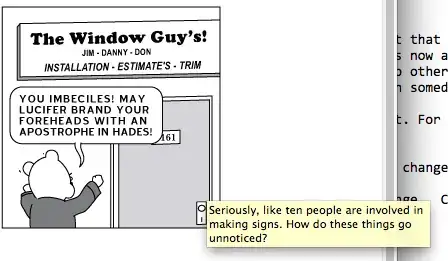
enter image description here

(Alert! Original contains vulgar language!)

There was a newspaper in the UK called the "Guardian" which was known in the trade as the "Gradian" because it had so many typos. I once saw cough Vulva for Volvo in the body copy of a newspaper ad for that fine brand, and that's in an expensive paid ad.


"scripts unlikely to change"

Nonsensical, commercial writing is edited continually, to remove typos.

"But by continuing using "Ursine" as a noun..."

No. It sounds exactly like the writer is uneducated. The situation couldn't be simpler.

(It's particularly embarrassing, if you will, when people "try to use fancy words" - and are clueless about them, particularly extreme examples such as: not even knowing if it is a noun.)

I'd simply read it out as Ursid, since it's a typo.

Note that it is totally commonplace for voice talent to simply correct a typo if you're reading from a script. Not even worth mentioning.

If the script said "I brought an ice cream at the shop," one would just read it out as "bought". You would never read the appalling mistake, since it's obviously nothing more than a typographic error.

Ditto, if a script has "aks anything you want" one would just read it as "ask".

Not a big deal right?

Fattie
  • 10,520