6

I've come across this one in Terry Pratchett's Discworld series. One character often used shouted "Good thinking, that man!" as a praise.

Is this a real English regionalism?

Dan Bron
  • 28,335
  • 17
  • 99
  • 138
  • 4
    My BrE is a bit fuzzy, but I think "good thinking that man" could be related to the regionalism "good thinking, that". In that sentence, the speaker is saying "that thinking is good". In "good thinking that man", he is (could be) saying "that man is thinking good". A Pratchettesque exchange might go something like: "Oy, why's that soldier got a spike on 'is 'elmet?" / "Why, he's been standing at attention for three days, sir. It's t'keep the pigeons off." / "Good thinking, that man." – Dan Bron Aug 12 '14 at 12:54
  • 1
    Can anyone confirm the punctuation is now exactly as in the printed book in question? Cheers! – Fattie Aug 13 '14 at 06:43
  • Hi MariLou, you misunderstand me. Notice I say "the punctuation". There was an earlier discussion about the comma in the phrase in question. Originally the OP typed it with no comma. Various people have claimed that in the book the comma exists is in various places. I want someone to post a screenshot showing the exact punctuation of the phrase seen in the printed books. That's all I was saying just here just now. – Fattie Aug 13 '14 at 07:52
  • @JoeBlow Why is the punctuation relevant? The Op is inquiring about the expression/catchphrase, not whether a comma is needed or not. – Mari-Lou A Aug 13 '14 at 09:27
  • 1
    Hey MariLou! I think it's odd to ask why the punctuation is relevant. if the comma is after "that" it suggests the first three words is a common phrase, and he is idly adding ", man" on the end (not unlike ", dude!" today). if the comma is after thinking, that slightly suggests the "batman" (puts "that man" together) interpretation .. and so on. Sure, it's important. – Fattie Aug 13 '14 at 09:46
  • I'm sorry for leaving out the comma – I've only listened to audiobooks. Yes, printed book confirms it's "good thinking, that man!", thank you for clarifying this. – Wojtek Kruszewski Aug 13 '14 at 10:25
  • Not enough attention? you mean your accepted answer is not exhaustive? –  Jun 07 '16 at 13:54

5 Answers5

11

The expression is rooted in the English class system, where a member of the upper classes would not necessarily remember (or even know, or care about) the name of someone from a lower class.

In the exclamation, "Good thinking, that man!" the speaker is exclaiming to the world in general that a man had had a good idea. He can't bring himself to talk to the man himself, because that would mean having to address him by name — even if just the surname, "Good thinking, Jones!", a name which he doesn't know. So instead, he announces appreciation to his peers, calling the underling "that man", "that man over there", and so avoids having to address him at all.

So yes: it is a real English saying, if rather dated. It wouldn't have been used in this way since the class system largely collapsed in the First World War.

It's become a caricatured trait, and these days someone might say it in appreciation instead of saying "Good idea, Bob" to his friend standing next to him.

Mari-Lou A
  • 91,183
Andrew Leach
  • 101,901
  • 3
    +1 for the explanation that the usage is tied to the social hierarchy. I didn't know that (and in retrospect, yeah, it is always the higher-ups that say in books). – Dan Bron Aug 12 '14 at 13:12
  • 2
    I've said something similar in he last couple of weeks, when applauding an exceptional catch taken by an opposing player (in a game of cricket), whose name I didn't know. I shouted "Well caught, that man!" in a slightly tongue-in-cheek way, as it's really quite an outdated phrase. – Phil M Jones Aug 12 '14 at 13:24
  • 3
    Do you have a source for this origin of the expression? – jfhc Aug 12 '14 at 13:38
  • @jfhc OED does mention the existence of "Brit. colloq. well done that man and variants," but there's a huge gap between December 2003 (when that use was noted) and 1926 (the last update on well done), and in 1926 it was probably a bit too soon after obsolescence set in for the expression to be noteworthy. – Andrew Leach Aug 12 '14 at 14:33
  • @Andrew thanks, I was more curious for sources on the idea that it came from rude people talking to their inferiors, since my main experience of it has been from my mother (who grew up in mid-Wales) who uses it more affectionately than anything else! – jfhc Aug 12 '14 at 14:56
  • 1
    @jfhc: Since the primary significance of the utterance is a facetious allusion to a cheesy/obsolete catchphrase, it's extremely likely to be used sarcastically. Not so much in the later movies, but in the original TV series, Batman's sidekick Robin is exceptionally dumb. He's inclined to effuse over how smart Batman is for figuring out things which are so blindingly obvious even the pre-teen viewers already know them before Batman points them out. So to some extent it's akin to "Tell me something I don't* know, genius!"*. – FumbleFingers Aug 12 '14 at 15:17
  • 4
    I think the idea that referring to someone as *that man* is somehow "rooted in the English class system" is completely ludicrous. And it's equally misleading to suggest that "Good thinking, that man!" is a "real English saying" that was common before WW1 - I venture to suggest that because such gerund use was extremely unusual in Victorian English, it would almost never have been said until *after* WW1 anyway. And without Batman, it would almost never be said even today. – FumbleFingers Aug 12 '14 at 15:55
  • 3
    @FumbleFingers: I half agree with your second comment, but ultimately I cannot agree that Batman is the prime reason for this statement any more than the class system. It's simply an exclamation of respect for an idea someone had when said person is not around. Since you would not say, 'Good thinking, Jim!' when the Jim in question is not present, you might say the above expression. It does require that you speak a more Brittish variant of English, of course. – Magus Aug 12 '14 at 17:44
  • 1
    I'm with @Magus on this one. (Disclosure: my name is Jim). Good commenting, that man! – jfhc Aug 12 '14 at 18:38
  • 1
    Looking through Google books for "well done, that man", it seems to me that this might have originated in the British army during the 2nd world war. As in your explanation above, an officer might easily not know the name of a soldier. – Peter Shor Aug 17 '14 at 15:51
  • I'd self identify as middle class, but suffer badly from lack of name recall, being so much better at general nouns, adjectives and verbs than proper nouns, and would love this sort of identifying to be widely used. – alan2here Feb 05 '16 at 00:44
  • I have always believed that "Well done, that man!" etc. originated in the British military forces, when NCOs wanted to praise an action by a private soldier whose name they couldn't remember. – dai hawkins Apr 17 '17 at 12:08
5

I found nothing to suggest that the phrase Good thinking, that man existed prior the 1980s and hence Andrew Leach's seductive opening statement that this form of utterance harks back to the British Empire era and its class system, although very appealing appears to be, at best, misguided.

The expression is rooted in the English class system, where a member of the upper classes would not necessarily remember (or even know, or care about) the name of someone from a lower class.

The following phrases while they do acknowledge that the construction Good thinking + old + noun predate and are not exclusive to Pratchett; they do not, surprisingly, predate the 1950s which frankly I had not expected.

Good thinking, old man. Trusts and Estates, Volume 96, New York City Fiduciary Publishers, 1957

Good thinking, old twin. A Trick of Light by Barbara Corcoran, 1972 (USA)

Good thinking, old buddy. Star Smashed of the Galaxy Rangers by Harry Harrison, 1974 (USA)

Good thinking, old girl Sights and Sounds, Scents and Savors of Maine by Harvey and Jean Howells, 1978 (UK)

Good thinking, old fellow. The Plains of the Sea by Niel Hancock, 1982 (USA)

Jolly good thinking, old chap. Kith and Kin by André Kaminski, 1988 (USA)

Good thinking, old thing The Doggone Years by Masood Hasan, 1996 (Pakistan)

Good thinking, old bean Royal Blood by Rhys Bowen 2010 (set in London, England, 1932; a story about a member of the Royal family who attends a wedding in Transylvania.)

The earliest instance of "Good thinking, that man" that I found on the Internet is dated February 1, 2001, not conclusive proof I agree but it is an indication that this expression is not some relic of the British upper classes but, au contraire, a well-oiled American English construction which is alive and kicking today.

If there was one English author who I would have thought used this expression in his body of work, it would be P.G. Wodehouse as Wikipedia points out

Wodehouse's main canvas remained that of a pre- and post-World War I English upper class society, reflecting his birth, education and youthful writing career.

The phrases "Good thinking, Jeeves" or any of their derivatives (e.g. "Good thinking, old man") simply do not exist in any of Wodehouse's novels.

Finally, @Fumblefingers assertion that the phrase is a derivation of Good thinking, Batman is legitimate and confirmed in A Dictionary of Catch Phrases By Eric Partridge. The famed etymologist states that the catchphrase Good thinking! didn't become a common British English expression until circa 1969 and...

The phrase came from the US, where it had arisen, c. 1950, among the advertising and publicity agencies of New York's madison Avenue and had, by the middle or late 1950s, become a US c.p.—not unassisted by the "Good thinking, Batman" of the Batman 'comic' strips.

Mari-Lou A
  • 91,183
  • "hence Andrew's seductive opening statement that this form of utterance harks back to the British Empire era and its class system, although very appealing appears to be, at best, misguided" .. I'm afraid I have to totally agree with ML. (Nicely put, too :) ) – Fattie Aug 13 '14 at 06:29
  • Talk about weird! I have to upvote both yours and Joe's answers, because they're so obviously right. But although they're both really just extended comments endorsing my own answer, they've already both got more upvotes than my original "lone voice in the wilderness". Maybe it would have helped if I'd found the backup from Partridge, or remembered the Status Quo track, but I don't see how my failure to do that could possibly excuse the collective ELU decision that my obviously true answer nets 1 vote, while Andrew's obviously false answer currently has 10 votes. – FumbleFingers Aug 13 '14 at 12:27
  • @fumblefingers unfortunately questions, and consequently answers, have a short shelf-life on ELU. But there are three answers contradicting Andrew Leech's one and his silence could be interpreted in several ways. – Mari-Lou A Aug 13 '14 at 12:49
  • @Mari-Lou: I remain quietly confident my answer will eventually turn out to be a "slow burner". Isn't there a badge for successfully overturning a strongly-endorsed answer months or years later? IWOOT! – FumbleFingers Aug 13 '14 at 13:36
  • 1
    I posted a question soon after this answer. The answer and its findings might convince users that Pratchett adopted and modified the catchphrase for literary/humouristic purposes. Batman vs. Maxwell Smart. Who said, “Good thinking, …!” first? – Mari-Lou A Jun 08 '16 at 18:48
4

It's Terry Pratchett, so I think we can safely say the primary "meaning" is a humorous variation on sidekick Robin's constantly-repeated adulatory...

"Good thinking, Batman!" (as "parrotted" by myself and playmates 50 years ago)

Thus it's no more a "regionalism" than saying some equivalent like "[That's a] good idea, John!" - it's usually just a witty allusion to a 60s catchphrase. But the words themselves are just normal English, so obviously they were/are/will be used without that allusion sometimes.

But it's not common. There are just 12 instances in Google Books, of which I can only read the text in 8 cases (half of which are from Pratchett's own books). If you do hear it "out in the wild", you might get a clue from the enunciation as to whether the speaker himself is aware of the Pratchett allusion by noting whether thatman is "slurred together" into a single word.


As regards "common idiomatic usages", it's worth noting that forms such as "Well done, that man!" and "Well said, that man!" are quite natural (there are over a thousand written instances of each, in those links). But whereas it's perfectly normal to use the Batman version (or the jocular allusion thereto) when there's only the "addressee" present, it's unlikely you'd use that man in any other context, unless there were other people present at the time (the ones you're really addressing).


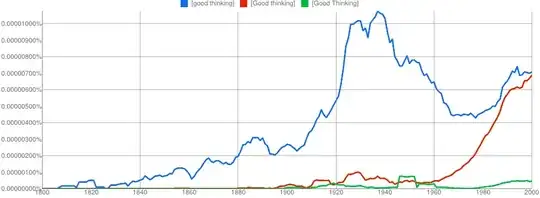
EDIT: Noting comments below (and the fact that a couple of people disagree with what I'm saying so strongly as to downvote it), I think it's worth considering the implications of this NGram...
chart

It's a reasonable assumption that some of the capitalised instances will arise in contexts such as "Good thinking is thinking that is properly guided by epistemological criteria", and some of the non-capitalised instances will be things like "That was good thinking, son", for example. But it's difficult to ignore two implications:-

a) This type of "gerund" usage was far less common in C19 than C20 (so it didn't "tail off" after WW1)
b) The capitalised (possibly satirical) "plaudit" version only really took off after the Batman TV shows.

FumbleFingers
  • 140,184
  • 45
  • 294
  • 517
  • @JoeBlow It could easily carry at least a little of both meanings. – Chris H Aug 12 '14 at 14:41
  • @Joe: Like I said, there's nothing inherently unusual about the "non-allusory" usage in the first place. But compare the thousands of Google Books citations for "Well said", "Well done" to the handful of "Good thinking" (only *two* of which are more than a decade or so old). But I agree there's a faint whiff of "military officer" in all such usages - I found a couple of dozen instances of "Good thinking, soldier" (but again, all within the last decade or so). Comparing that to over 1500 of "Well done, soldier", I stand by my assertion. It's primarily a mangled catchphrase – FumbleFingers Aug 12 '14 at 15:00
  • Hmm, you really feel that the times line up? So, at the time of writing / popular reading of the titles in question, "good thinking, batman!" was that popular a phrase? ok, I buy it! you know, I tried to find that catchphrase on youtube but did not. however I guess there's a "Status Quo" (how the hell old am I?!) song based on that catchphrase! – Fattie Aug 12 '14 at 15:25
  • (FTR, in spite of the OED, I've never ever heard "Good thinking, that man" in period stuff; it sound just weird to me; and the whole question is annoying as apparently the punctation is wrong, not matching the book!) – Fattie Aug 12 '14 at 15:27
  • 2
    @Joe: Pratchett is English, and more or less of my generation (he's 6 years older). So I'm sure he, like me, has used "Good thinking, Batman!" as a facetious catchphrase countless times over the years, starting from the 60s when he was a teenager. Sometime in later life he came up with the updated version, and obviously decided it was a good fit to the "larky" style of his books. But regardless of his customary self-deprecation, Pratchett is a very smart guy whose texts are absolutely chock-full of cultural/linguistic/scientific allusions. – FumbleFingers Aug 12 '14 at 15:47
  • 3
    I feel that this is one of those cases where trying to decide on commonality by doing a book search is not representative. This has always been more likely to pop up in street speech. – Lightness Races in Orbit Aug 12 '14 at 16:47
  • @Lightness: Obviously books aren't ideal resources here. But Pratchett is both my contemporary and fellow countryman, and I've read dozens of his books over the years. So I can say with pretty much 100% certainty why he would have used the expression in the first place. As to why American teenagers today might use it (to the minuscule extent that they do), I'm not sure that's particularly meaningful. Some might know the full backstory, some may be alluding to Pratchett's use. Others may simply be copying 2nd- 3rd-hand usages, or speaking "naturally" (it is ordinary English, after all). – FumbleFingers Aug 12 '14 at 17:00
  • 2
    @FumbleFingers: I don't see what "American teenagers" have to do with it; I am most certainly neither, and the same goes for this OP. All I'm saying is that I hear this phrase in Nottingham with regularity and your Book search indicates the contrary. Therefore, it is flawed. – Lightness Races in Orbit Aug 12 '14 at 17:05
  • Not conclusive but Google Ngrams has more hits for "good thinking" between about 1925 and 1945 than at any subsequent time. That significantly predates 1960s Batman. – David Richerby Aug 12 '14 at 17:50
  • 3
    @JoeBlow both x x, that man and good thinking, y sound natural to me (southern UK), though much more in (informal) speech than in writing, and not uncommonly with an ironic or patronising edge to them. – Chris H Aug 12 '14 at 18:27
  • 1
    -1 As I understand your answer, you accept "Well done, that man" is a common phrase and yet think "Good thinking, that man" refers only to Batman. Pratchett being the well rounded man that he is, he probably was parodying Batman/Robin also - but based on an original construction of "____, that man!" This is a common enough expression, albeit a jokey one mocking the English upper classes. You can substitute any verb you like for 'thinking'. – Mynamite Aug 12 '14 at 23:01
  • 4
    @Mynamite: I give up. The OP asked whether these specific four words represent a "saying" or "regionalism", which they obviously don't. Given he's only come across them in a Pratchett book, and I'm 100% certain I know why Pratchett used those words for humorous effect, it seemed only reasonable to point that out. David's obviously irrelevant NGram for the uncapitalised version has been addressed by my last edit. If people are still not convinced, I guess I'll have to leave them to their blissful ignorance. – FumbleFingers Aug 12 '14 at 23:22
  • 1
    +1 for you, sir! I too was sceptical of the Batman catchphrase, but your early childhood memories also jogged mine, I did some research and yours is the correct answer. – Mari-Lou A Aug 13 '14 at 06:13
  • @JoeBlow where is the link to OED that you mention in your first and most upvoted comment? Andrew Leech, as far as I can tell, provided no sources to back up his assertion. – Mari-Lou A Aug 13 '14 at 06:26
  • Ny God! the way this is going, we're going to LYNCH Andrew! :) Right, my initial gut reaction to the "posh british" theory was "that's crap", the only thing that got me going was the OED mention. But it was all just smoke. OMG! I'm deleting my OED-reference comment. – Fattie Aug 13 '14 at 06:32
  • As a curiosity, this question suffers from the "early momentum voting" problem often seen on these sites. (It often happens on very technical sites.) Sometimes, a competent, clear-sounding answer will get a dozen votes from early "passers-by" ("that looks about right, tick"). There's a different type of participant (say, me) who will form an ongoing investigation, will change his/her vote as new information and discussion comes to light. But the early momentum voters, there is just more of them than the "ongoing investigative" voters. – Fattie Aug 13 '14 at 06:42
  • @JoeBlow I don't want to "lynch" anybody! Initially AL's answer sounded very convincing, but it was FumbleFingers's answer which persuaded me that I acted precipitously. I am sorry I had to edit Andrew's answer, but after reading it carefully it was difficult for me to justify my upvote. That does not mean Andrew's answer deserves to be downvoted, he does explain the meaning and "history" behind the expression very well. – Mari-Lou A Aug 13 '14 at 06:55
  • instead of lynching it's better to get people drunk down the pub. i think it's not so much about downvoting, but like i was saying particularly on programming etc. sites you often remove your vote from one or the other - move your vote around - as information develops. I was just saying, in practice you get a bunch of early momentum voters who don't bother doing that – Fattie Aug 13 '14 at 06:59
4

I'm gonna offer a stunning piece of evidence which I mentioned briefly before:

http://www.dailymotion.com/video/x40av5_good-thinking-batman-status-quo-ins_music

There's a music track by then extremely popular band "Status Quo", which is indeed titled "Good Thinking, Batman."

If anyone with a different temperament from me, in to exhibitionistic detail, cares to research, you'll see the dates align precisely: they're all exact socio-economic contemporaries.

For me this is huge evidence that "Good thinking, Batman" is indeed, let's say was, a catchphrase of sufficient weight, in exactly the right temporal milieu, that it tremendously bolsters wot Fumble claims.

I have only been able to find other minor evidence to support the contention "'Good thinking, Batman' was a catchphrase of sufficient weight to support the claim in question" - for example, people have named their "pinterest" site thus, and so on. The Status Quo connection is the only really knockout one I've found. Perhaps others can do better.

So for me, I'm going to go ahead and answer: Answer: it's Pratchett riffing on a catchphrase of the day.

Fattie
  • 10,520
  • I have a comment under my answer saying "I hear this phrase in Nottingham with regularity" (the that man version, not Batman). Obviously it could be said "naturally", but it's hard to imagine that would happen often enough to merit the word "regularly", so I'm forced to suppose the Pratchett variant has acquired a degree of "catchphrase" status itself. – FumbleFingers Aug 13 '14 at 12:44
  • FWIW, here's a forum post discussing Batman Begins where someone posted "Good thinking, that man" back in 2008. But I guess the unbelievers will just say it was a natural usage, since no-one on the forum has actually posted "Good pun!" or "LOL". – FumbleFingers Aug 13 '14 at 12:47
  • And here's one from the Daily Mail in 2007, where a couple of sentences after Mr Johnson had gone for the grey look. Good thinking, that man! we have Mr Johnson, asked what he might do as Labour's second-in-command, indicated his desire to play 'Robin to Gordon Brown's Batman'. It's getting harder and harder to justify the idea that these are entirely "natural" usages, owing nothing to the erstwhile catchphrase. – FumbleFingers Aug 13 '14 at 12:53
  • that's a more or less definitive example (well, it absolutely proves that, at least, the particular journalists/editors in question see it in terms of the catchphrase solution). – Fattie Aug 13 '14 at 12:56
  • 1
    fascinating ephemera .. http://mgr-forums.com/viewtopic.php?t=4361&p=36314 http://www.comedy.co.uk/forums/thread/2106#P26203 (google for others!) – Fattie Aug 13 '14 at 12:58
  • Good thinking, mah man! It never occured to me to check for other "punny" variants like *fatman*. – FumbleFingers Aug 13 '14 at 13:54
  • Ephemera is a dying concept in this Age of The Googley-thingie: *Good thinking Ratman and Bobbin* – FumbleFingers Aug 13 '14 at 21:15
  • yes, that's a big insight. google categorises everything the same; "labels" that we traditionally attach to stuff ("this is the main final text" "this got published" "this was a draft" and so on) become less relevant in google-era – Fattie Aug 15 '14 at 07:49
1

To a native English speaker, this is, I think, natural despite being unfamiliar.

Whiten the nerdy, learned, and upper class culture of unseen university, where a lack of name recall would be socially much more acceptable than in the modern day mainstream, it seems particularly reasonable.

I'm surprised at the purely historical, and Batman reference tones of other answers, the term is as a whole rather unusual, but not that outrageous in all sub-cultures today.

alan2here
  • 768
  • I find it hard to imagine what "sub-cultures" you're thinking of, where Good thinking, that man! would be a "natural" thing for someone to say (as opposed to whimsical allusion to the Batman trope, or perhaps a stereotypical sergeant-major or Basil Fawlty type of character). – FumbleFingers Jun 09 '16 at 23:04