9

When it says:

You can apply for a visa up to 3 months before your date of travel to the UK.

Source: gov.uk

Does it mean the latest I can apply for a visa is 3 months before the travel date, or the earliest I can apply for a visa is 3 months before the travel date?

user38931
  • 111
  • 8
    At the level of English language the statement is ambiguous. Ask whoever wrote it, if the answer matters to you. ELU cannot help. – FumbleFingers Jul 22 '14 at 12:30
  • 4
    If it is so and the sentence is ambiguous, it is also an answer for the OP and there is no need to give him -1. I have had a strong feeling that once somebody here just does not like a question (and without GIVING or maybe even having an objective reason) they give minus points. I am not happy about this. I find this question useful, even if a clear answer cannot be given. I as a non-native English speaker feel this as arrogant from you native speakers. – Honza Zidek Jul 22 '14 at 12:36
  • @Honza: I haven't downvoted. Obviously in the real world I know that the intended sense is "You can't apply more than 3 months in advance". See "Applications received more than 3 months before your date of travel will be returned without a visa" – FumbleFingers Jul 22 '14 at 12:43
  • 2
    But at the level of language, the text is ambiguous, so the question is Off Topic Opinion-based. – FumbleFingers Jul 22 '14 at 12:44
  • 4
    No, the question is not off-topic. The question is perfectly answerable! The answer is: "Even for the native speaker the sentence is ambiguous and can carry both the given meanings". I understand "Opinion-based" differently. The question is not ambiguous! What is ambiguous here is the sentence under question which is perfectly OK! – Honza Zidek Jul 22 '14 at 12:47
  • 5
    As long as Usage in in the name of this site, I do not see this question as off-topic. This is Usage of the English Language, by none less than the government of the UK, and it is admittedly ambiguous. I don't see how a question about that would not be on-topic. – oerkelens Jul 22 '14 at 12:50
  • 6
    I am quite unhappy that the site seems to be turning into a kind of a snobbish arrogant native English club with members who reject questions just because they don't like them enough or because they consider them as too trivial. Without even bothering to state a clear reason - which makes their voting even more dubious. I am often completely confused why some questions are -1-ed or put on hold or closed, while they seem perfectly complying with the site policy.

    And an ambiguous text is not the same as an ambiguous question! I would expect at least this distinction from you "English seniors"!

    – Honza Zidek Jul 22 '14 at 13:37
  • 3
    @FumbleFingers why is it off topic? "The sentence is ambiguous and can be read both ways" is a perfectly valid answer. – terdon Jul 22 '14 at 17:18
  • @terdon: Imho it's OT because the syntactic aspects giving rise to that ambiguity are too basic for ELU, and thus not relevant to a site aimed at linguists, etymologists, and (serious) English language enthusiasts. Besides which, it seems pretty clear the OP isn't asking about the ambiguous syntax itself - he's hoping for an actual answer definitively telling him what time constraints apply to his visa application. – FumbleFingers Jul 22 '14 at 17:22
  • 1
    @HonzaZidek while I don't agree that this is off topic, you should realize that this site is not for people learning English. As you can see in the on-topic help page, this site is for "linguists and , etymologists, and (serious) English language enthusiasts". This is in no way limited to native speakers but the scope of the site does not include questions that any native speaker would know the answer to. Our sister-site, [ell.se] was created to deal with such questions. – terdon Jul 22 '14 at 17:23
  • 1
    @terdon: Any native speaker including the British government would know the answer? Or the British government is excluded? – Honza Zidek Jul 22 '14 at 20:47
  • @HonzaZidek I would not presume to speak for the British government. In this case, any native speaker would know the phrase is ambiguous. However, bureaucratese is a language unto itself. – terdon Jul 22 '14 at 21:00
  • 2
    @terdon: as you may see, there is at least one quite influential group of native English speakers who have the opinion that the sentence is not ambiguous :) Supposed we exclude the possibility that the British government does it on purpose to drive away those potential visa applicants whose ability to analyse the syntactic aspects giving rise to that ambiguity lies below the level expected by the ELU community :) – Honza Zidek Jul 23 '14 at 07:05
  • Fumb -- why not just click the "close off topic" button?? – Fattie Jul 23 '14 at 08:44
  • "I am quite unhappy that the site seems to be turning into a kind of a snobbish arrogant native English club with members who reject questions just because they don't like them" What a load of nonsense. This question is way too simple and should be on ESL. What's hard to understand about that? The problem on this site is everyone's too polite to close crap questions. – Fattie Jul 23 '14 at 09:18
  • 3
    @JoeBlow: apparently the question is is not so simple if the British government has problems with the sentence. – Honza Zidek Jul 23 '14 at 12:01
  • It should be noted that any native English speaker would have normally used "at least 3 months before" had the second meaning been intended. In ordinary conversation and writing this would be sufficient for disambiguation -- it's only the fact that this is legalese where a misinterpretation could be quite inconvenient/expensive (and where wording may have been subject to editing multiple times) that makes this truly ambiguous. – Hot Licks Nov 17 '15 at 08:22

4 Answers4

8

There are a number of ways in which the statement may be analysed.

You can apply for a visa up to 3 months before your date of travel to the UK.

The ambiguity is in the interpretation of up to: it could mean until or it could mean a maximum of.

You can apply for a visa until 3 months before your date of travel to the UK.
You can apply for a visa a maximum of 3 months before your date of travel to the UK.

In this case, up to should almost certainly have the second meaning. There's no point in applying for a visa years before you intend to travel, because your circumstances could change in the meantime. So the authority seeks to limit the possibility of changes by forcing you to apply fairly close to the date of travel.

Andrew Leach
  • 101,901
  • The British Government publishes processing times of up to 60 days, and the web page itself says "You should get a decision on your visa within 3 weeks," so it's certainly not three months to process an application. But I have flagged the ambiguity on that web page. – Andrew Leach Jul 23 '14 at 08:53
  • 1
    The web page has (at some point in the last six years) been amended to say "The earliest you can apply is 3 months before you travel," so it is the second of the possible interpretations. It's now a beautifully clear statement. – Andrew Leach Oct 15 '20 at 06:54
3

From a language point of view, this sentence can be parse in two ways:

1) You can apply for a visa up until a moment in time that is three months before your travel date.

2) You can apply during a period ranging from 0 to 3 months before your travel date.

Now, purely practical, the only interpretation that makes much sense in this context is the second one. Otherwise, nobody could apply for a visa unless they plan their trip more than three months in advance - and strict immigration rules may be one thing, but things like business trips (that stand to make the UK money indirectly) often come up on a shorter notice.

oerkelens
  • 36,622
  • 1
    downvoter, care to explain? – oerkelens Jul 22 '14 at 14:51
  • @JoeBlow nopes, but I'm in the EU. But I have some experience with immigration policies of several countries; and however big the bureaucratic workload, those policies are not designed to make ad-hoc travel impossible. Even from not-so-nice countries too much money flows in :P – oerkelens Jul 23 '14 at 09:05
0

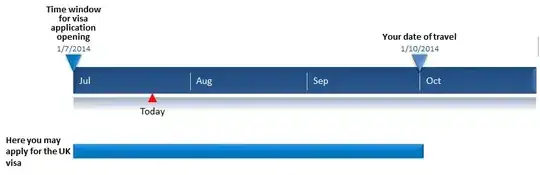
Although from the language point of view the sentence may be ambiguous, I am pretty sure that in the given context the correct meaning intended by the immigration office is the second - you may first apply for the visa 3 months before your travel.

The sentence structure is like this:

  • up to 3 months = 0 to 3 months, but not more
  • up to 3 months before the date = 0 to 3 months before the date

enter image description here

Honza Zidek
  • 4,025
  • 4
    That is not necessarily the case. The other interpretation is perfectly valid, too, in which you can apply for a visa up until a point in time that is three months before the date of travel, but not after that. The phrasing is ambiguous. – Janus Bahs Jacquet Jul 22 '14 at 12:34
0

The emigration office is imprecise and ambiguous. It should be "no sooner" or "no later" than 3 month before date of travel.

In addition, the regulations also say that the office has 30 days to process the application, so it cannot necessarily be that we can apply at any time during the three-month period before the date of travel (e.g. two days before departure).

tchrist
  • 134,759
Wojtek
  • 1
  • 1
    Hello, Wojtek. 'The [instructions are] imprecise, ambiguous.' This answer has been given already. The rest of your comments, while probably quite valid, do not address the title question but (a) suggest a sensible replacement (as other answers have done) and (b) suggest how further information not directly supplied by OP in the actual question may suggest (but not force) one rather than the other of the two possible interpretations. But this does not answer the original question as presented. ELU was never intended to be an interpretation service: way beyond remit. – Edwin Ashworth Nov 29 '19 at 16:20