34

Sometimes, when I watch a (real good) movie, I feel like the movie "sucks me into the screen". I feel that I am really inside the movie, really watching real persons acting in real situations. I do not really see what happens around me anymore, I get some kind of tunnel view and see only the screen. It's like being in John Malkovich's Head, just not seeing the borders that are around me from that weird cave.

I wanted to know if there is a word or longer expression for this kind of experience. Also, I'd like to know if there is a word for "re-gaining" reality. After a few seconds or minutes in this weird state, I feel like my field of vision is growing larger and larger (just as if I was about to leave Malkovich) and then I'm "back in reality".

It's a hard to describe experience for me, not only because my mother tongue is not English but German, but also because, as far as I know, German lacks words for this, too. But when I have the English words, I believe, I may find the German ones as well.

user70037
  • 451
  • 1
    'Pathetic fallacy' unless you really part company with reality, when it's psychosis. – Edwin Ashworth Apr 21 '14 at 22:24
  • 2
    Escapism is the normal term for this. http://en.wikipedia.org/wiki/Escapism – 7caifyi Apr 21 '14 at 22:51
  • 5
    I lose myself in a good movie. – Gary's Student Apr 21 '14 at 23:20
  • 6
    Disagree strongly with 'pathetic fallacy.' Storytelling is the probably the oldest form of entertainment (right alongside violence, I suppose). You're really missing out if you've never lost yourself in a good film, book, or play. +1 to you, user70037. – Patrick M Apr 22 '14 at 04:21
  • 7
    @PatrickM: Your response suggests you misunderstand "pathetic fallacy" as a put-down (via the everyday meanings of the words "pathetic" and "fallacy"). See http://en.wikipedia.org/wiki/Pathetic_fallacy. – echristopherson Apr 22 '14 at 04:58
  • 8
    @echristopherson I certainly did misunderstand. My apologies! Never heard that term before. I still disagree that it applies. The coinage of the term makes it sound like a dressed up, derogatory term for anthropomorphism, which I feel can't be applied to an interactive experience like storytelling. Also, "to attack the sentimentality that was common to poetry" and "original definition is “emotional falseness”" both seem really off the mark from an engaging, engrossing fiction. – Patrick M Apr 22 '14 at 05:16
  • 5
    I've always referred to it as 'immersion in the story'. A story that punctures my suspension of disbelief will interfere with that immersion (as will distractions like people using their phone). – Glen_b Apr 22 '14 at 11:38
  • I always considered this part of my ADHD. Although, most of the time, I'm still aware of what's going on around me, I'm simply unable to respond. For me, however, I know this extends from self taught behaviour growing up. I had trouble playing video games or watching anything because I was so easily distracted, thus I taught myself to become so immersed I couldn't react to the world around me. Though the "non-reaction" was more of a side effect. – SpYk3HH Apr 22 '14 at 13:47
  • I've never heard of such a concept. I've certainly never experienced it. – Boann Apr 23 '14 at 16:03
  • I often felt this after watching a good movie, e.g. the first Matrix movie - then walking out of the theatre I'd be walking with a different gait, looking at the real world as if with new eyes. "Immersion" is the best term for it. – Jeffrey Kemp Apr 24 '14 at 07:18
  • Aristotle wrote about "catharsis"... https://en.wikipedia.org/wiki/Catharsis – GEdgar May 20 '22 at 21:05
  • But catharsis is quite different, only relates to tragedy, and doesn't require immersion (indeed Greek theatre was highly un-immersive). – Stuart F May 20 '22 at 22:51

16 Answers16

73

Consider immerse.

My role is to make people completely immersed in the movie.

gachonherald.com

In fact, some "Avatar" fans, better known as "Avatards," have become so immersed in the movie that they suffer from withdrawals when it ends.

My Daily News

The word for "regaining" reality is "emerge."

When we finally emerged from the movie we re-enacted the commercial.

amiright.com

Elian
  • 43,007
  • 13
    Yes, this is common terminology for this effect. The noun form is immersion. – Bradd Szonye Apr 21 '14 at 22:50
  • 1
    I think immersion became a much more popular word for this experience ever since video games became more popular. It is much easier, (for me anyway), to get that feeling from games where you are taking part in the action rather than movies where you just watch. – DoubleDouble Apr 22 '14 at 16:32
  • @OP Sounds like you've found the English answer to your question. Please mark it as answered, and let us know if you think of the German equivalent! – user7626 Apr 23 '14 at 21:03
  • 1
    I've always interpreted "emerged from the movie" as referring to the physical act of leaving the theater, but maybe that's just me. – JLRishe Apr 24 '14 at 08:14
  • +1 In our mother tongue (Kannada), We use a word with similar meaning "ಮುಳುಗು". – Keshava GN Apr 24 '14 at 10:45
21

In psychology, this experience is known as spatial presence or spatial immersion.

Briefly, spatial presence is often defined as existing when “media contents are perceived as ‘real’ in the sense that media users experience a sensation of being spatially located in the mediated environment.”

The idea is just that a game (or any other media from books to movies) creates spatial presence when the user starts to feel like he is “there” in the world that the game creates.


Also, there is a newly coined term called "experience-taking" which roughly means losing yourself in a fictional character. This phenomenon specifically occurs when you are reading.

Researchers at Ohio State University examined what happened to people who, while reading a fictional story, found themselves feeling the emotions, thoughts, beliefs and internal responses of one of the characters as if they were their own - a phenomenon the researchers call “experience-taking.”


Re-gaining reality and leaving the spatial immersion (or the thing causes this) is usually called "immersion-breaking". This term is usually used in gaming world.

You can also use "snap out of immersion" or "snap back to reality"

snap out of something Fig. to become suddenly freed from a condition. (The condition can be a depression, an illness, unconsciousness, etc.)


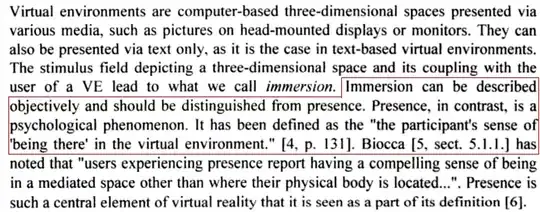
Furthermore, here is explained the difference between immersive experience and spatial presence: (from the book "Handbook of Digital Games" edited by Marios C. Angelides, Harry Agius)

enter image description here


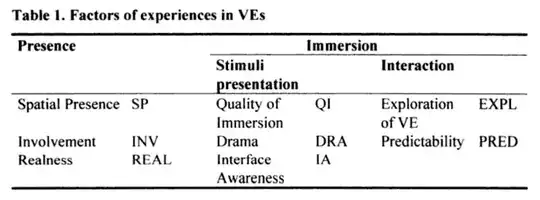
Additional information from the book "Visual Representations and Interpretations edited by Ray Paton, Irene Neilsen":

enter image description here

enter image description here

ermanen
  • 62,797
20

One criterion for judging the quality of a movie, at least from your perspective, is the degree to which the movie helps you "suspend disbelief," if only for a short time.

When we are really enjoying what we consider to be a good movie, we know, of course, that what we are seeing is not real. If, however, all the pieces (however you define them) come together in a pleasant (or even unpleasant) way for us, then we have effectively suspended disbelief and consequently enter into the story. Call it identification, if you will. We identify with what we are seeing portrayed for us.

I say "unpleasant" because for fans of horror movies, they may in fact become very uncomfortable and frightened by what they see on the big screen, but some folks like the horror genre precisely because they enjoy being scared!

For fans of other genre of films, they may be looking for sheer escapism, laughs, the romantic warm and fuzzies, satisfaction when the "bad guy" is caught and punished, relief when the underdog is triumphant, and so on.

rhetorician
  • 19,383
  • 2
    +1 for "suspension of disbelief". Happens for books and plays too. – keshlam Apr 22 '14 at 02:29
  • 1
    The opposite extreme from suspension of disbelief is self-referentialism and breaking the forth wall, both often for comedic effect. See also the tvtropes.org for those terms. A lesser effect than breaking the forth wall is dramatic irony, if it causes you to stop and reflect on the storytelling itself (particularly if it's done poorly). – Patrick M Apr 22 '14 at 04:18
  • 5
    Suspension of disbelief is the act of overlooking obvious flaws in the realism of a story (i.e., whether the story is consistent with reality, not the same as whether you can't differentiate between the story and reality). It has nothing to do with being immersed in the story. – Canis Lupus Apr 22 '14 at 04:39
  • 1
    @Jim: You may be right. If, however, one does not suspend disbelief, the pathway to almost total immersion in the story will be effectively blocked. Call it a mindset, if you will. I see only two-dimensional images on a screen, but through the suspension of disbelief I can view something "fake" and still overlook it temporarily so as to be entertained, or amused, or whatever I've come to the film to experience. The argument could be made that a purely critical viewing of a film bypasses SOD, but if the critic enjoys the film, giving it thumbs up, well, didn't he suspend belief just a little? – rhetorician Apr 22 '14 at 15:17
  • 4
    Suspension of disbelief has been identified as one of the prerequisites for becoming immersed in the reality of the medium; it is not the state of immersion itself. – SevenSidedDie Apr 22 '14 at 16:01
  • @SevenSidedDie: Admittedly, ermanen's answer is much better than mine. Feel free to downvote me for failing to answer the question if you like, but I did say in my comment above that SOD is the path to immersion. Let's just say SOD is a prerequisite for immersion (or "spatial presence.") Don – rhetorician Apr 22 '14 at 19:55
  • 2
    @PatrickM - "fourth wall", not "forth"! – AAT Apr 23 '14 at 12:56
8

You can say:

I was so completely absorbed by the movie that when it finished it was like being thrown back into the real world.

8

Becoming engrossed:

  1. having all one's attention or interest absorbed by someone or something. "they seemed to be engrossed in conversation"
Waggers
  • 7,298
7

The first word I thought of was mesmerized.

hold the attention of (someone) to the exclusion of all else or so as to transfix them.

Google has tons of pages for the exact match "mesmerized by the movie".

RyeɃreḁd
  • 16,833
2

The changes in perception and attention you describe are consistent with trance states. One word to describe the experience is entrancement, an altered stat of consciousness involving heightened focus on limited stimuli--the movie--and reduced attention or awareness to other stimuli. The sometimes sudden shift back to normal consciousness can be called reorienting to reality. Another term for very intense focus is engrossment.

GMB
  • 5,529
2

The most common description of your experience is called "suspension of disbelief." It refers to the state of surrendering your knowledge of how the world works (or more specifically, doesn't work) and accepting what the author/director/whatever puts before you.

J. R. R. Tolkien held a different view, called secondary belief. In his description of why he developed this separate idea, he states that the moment that disbelief even appears, you've already lost. In secondary belief, it is the writer's (or whatever) goal to create a world so immersive, not that you suspend your disbelief for its sake, but rather that you mentally enter into it and actively believe it. It's a more powerful statement on the role of the imagination in viewing art.

Further reading: Suspension of Disbelief Secondary Belief

Travis
  • 173
2

You can use this word - captivated

captivate - attract and hold the interest and attention of; charm.

like in,

I was so captivated by the movie.

I've experienced same feeling as yours and I normally use sentences like this,

I was completely engaged by the movie.

I was entirely absorbed by the film.

And I've observed using the word "engage" in many instances like,

Engage the audience in some way.

1

Dereism: Fantasy, condition of being lost in

Fantast: Fantasy, person indulging in; to the exclusion of reality

-Reversicon: a medical word finder. . Schmidt, J. E. (Jacob Edward), 1903-

Third News
  • 7,502
1

What about being totally engulfed in a movie?

user70579
  • 131
1

I would say that rapt describes exactly what you are describing:

  • Deeply engrossed or absorbed
  • Transported with emotion
  • Carried off spiritually to another place, sphere of existence, etc.
dotancohen
  • 3,011
1

transfixed? I would think the experience you describe is being transfixed.

edn13
  • 67
1

Transported [to another time / place]

From Cambridge Dictionary:

If something transports you to a different time or place, it makes you feel as if you were in it:

  • The film transports you back to the New York of the 1950s.
bhinojosa
  • 328
0

( virtually Transferred ) into the movie probably can define in reality what you experience, like the expression in fiction movies transferred in time by a time machine like the movie (back to the future) that we all remember. You are remounted and virtually transferred by the involved mind senses into the movie.

-2

In my opinion, suspension of disbelief is the best name for it. Cheers.

mlc
  • 1