22

I was shopping the other day when I decided to buy some Cranberry juice - you know, juice from cranberries - so I picked up what I thought was exactly that. It was only when I got home that I realised I had bought a Cranberry Juice Drink. This drink contains the minimal amount of fruit, tons of sugar and, of course, water.

Here is my question: Is there a word for telling the truth, yet trying to mask it in some way? This clever bit of marketing can be seen everywhere now, you really have to look twice at the label. The seller can't get in trouble because technically they advertised the product for what it is, yet we all feel cheated when we realise we bought the wrong thing.

I guess there's the phrase "bending the truth" but I am looking for alternatives.

turnip
  • 495

16 Answers16

33

In the larger context it is deceptive advertising.

In this specific example I would use the term skirting though. In the US and most countries there are very specific laws based on what can be said on a food label. For instance you would have to have a certain amount of pure fruit juice to NOT put the word drink on the end - this even differs by type of juice. See the FDA's website for the 1000s of laws.

Advertisers work diligently to find a way around these regulations and skirting is a good term for it.

There is also a term for the word "drink" in this context - mouseprint.

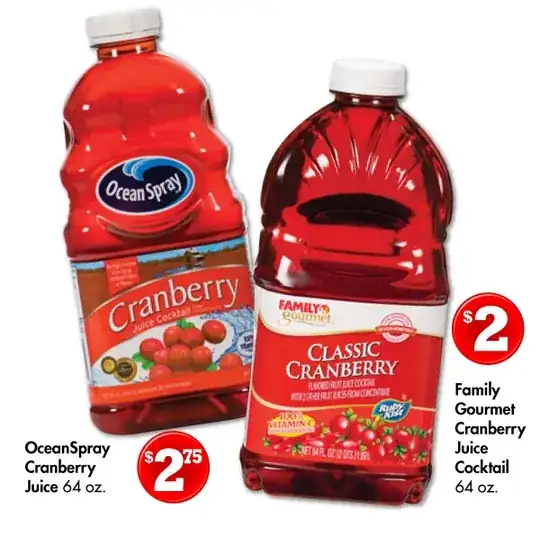
enter image description here

First let's understand the cranberry juice isn't the best example. You cannot really drink pure cranberry juice.

Examples of mouseprint on the ads are Juice Cocktail and Flavored Fruit Juice Cocktail.

Side note: Looks at Family Gourmet's 100% Vitamin C. They use the 100% to associate their drink with being 100% natural. They also did a great job of leading the consumer to 100%. It falls right below the capitalized C's in the title. (And what the hell is Classic Cranberry? Is Ocean Spray modern cranberry?)

RyeɃreḁd
  • 16,833
  • 5
    That's why you have cereals like "frOOt loops" -- it's not just an attempt to sound 'cool', it's a CYA against false advertising claims. – Shadur-don't-feed-the-AI Apr 08 '14 at 08:40
  • 12
    @Shadur - are you trying to tell me they aren't made from real froot? – RyeɃreḁd Apr 08 '14 at 20:45
  • 1
    It's not deceptive advertising or skirting. In the UK, where the OP is, the term denotes a drink that contains less than 25% fruit juice. – David Richerby Apr 08 '14 at 21:00
  • @DavidRicherby - What you are talking about is what my answer is explaining. The FDA (not sure of the UK equivalent) has created rules based on a products nature. The FDA is constantly updating these rules because companies skirting them. Putting the word drink in a different font, different color, smaller, whatever. The average consumer has NO IDEA all of these rules so the companies use the most deceptive words possible while staying within the guidelines presented to them (often using mouseprint). – RyeɃreḁd Apr 08 '14 at 22:57
  • 1
    @RyeɃreḁd The OP doesn't complain that the word "drink" was too small to read or otherwise typeset so they didn't notice it. – David Richerby Apr 08 '14 at 23:01
  • Have you drank pure cranberry juice? I have … once … – David M Apr 09 '14 at 06:17
  • 1
    +1 for pointing out that you don't want to drink pure cranberry juice. – Rob Church Apr 09 '14 at 09:21
  • 1
    @DavidRicherby's objection is correct. Appending the word "drink" is not marketing, it is a legal requirement intended to restrict marketing. If the marketers had their way, the product would simply be called "Cranberry juice". –  Apr 09 '14 at 13:27
  • 2
    @Shadur, That may also be a consideration for the trademark. "Fruit" is not something that can be trademarked, while "Froot" is. – Brian S Apr 09 '14 at 14:27
  • 1
    @OrbWeaver - No, more than likely with true labeling it would be labeled - Cranberry flavored water. The word drink has to be in there because they use the word juice. If they don't use the word juice then they don't have to have "drink". – RyeɃreḁd Apr 09 '14 at 14:35
  • @RyeɃreḁd No, again. In food labelling, "Cranberry-flavoured" means that it contains cranberry flavouring but not actual cranberries. This is a drink made from the juice of cranberries: hence, it is a cranberry juice drink. – David Richerby Apr 09 '14 at 17:54
  • 1
    Alas, you can buy (and drink) 100% cranberry juice. Same with grapefruit juice. But these products are rather bitter and can be hard to find in supermarkets. They are generally sweetened with sugar (and called cocktails or juice drinks) or blended with other juices (such as apple or grape). – J.R. Apr 09 '14 at 17:58
  • The stuff on the right doesn't even have cranberry juice in it, or only contains a small amount. Flavored. – Robert Harvey Apr 09 '14 at 20:03
17

Contrary to what you may believe, this euphemistic labeling is not the work of marketing geniuses. Rather, it is the work of the bodies that determine labeling (in the US, it would be the Food and Drug Administration). There are very specific rules about what labeling a beverage must contain, and how that labeling must look.

Per the FDA's website:

J5. Should my product be labeled as a “drink” or a “beverage?”

Answer: Beverages that are 100% juice may be called “juice.” However, beverages that are diluted to less than 100% juice must have the word “juice” qualified with a term such as “beverage,” “drink,” or “cocktail.” Alternatively, the product may be labeled with a name using the form “diluted __ juice,” (e.g. “diluted apple juice”). 21 CFR 102.33(a)

J7. What statement of identity is used on a mixed fruit or vegetable juice beverage?

Answer: When stated, names of juices must be in descending order of predominance by volume, unless the label indicates that the named juice is used as a flavor. Examples:

“Apple, Pear and Raspberry Juice Drink”
“Raspberry-Flavored Apple and Pear Juice Drink” If the label represents one or more but not all the juices (except in the ingredient list), then the name must indicate that more juices are present. Examples:

“Apple Juice Blend”
“Apple Juice in a Blend of Two Other Fruit Juices”
When one or more, but not all, juices are named and the named juice is not the predominant juice, the name of the beverage must either state that the beverage is flavored with the named juice or declare the amount of the named juice in a 5% range. Examples (for a “raspcranberry” beverage that is primarily white grape juice with raspberry and cranberry juices added):

“Raspcranberry Raspberry and Cranberry flavored Juice Drink”
“Raspcranberry Cranberry and Raspberry Juice Beverage”
“10-15% Cranberry Juice and 3-8% Raspberry Juice”
21 CFR 102.33(b), 21 CFR 102.33(c), 21 CFR 102.33(d)

J8. What type sizes must be used in naming juices?

Answer: The term “from concentrate” or “reconstituted” must be no smaller than one-half the height of the letters in the name of the juice. The 5% range information generally should be not less than one-half the height of the largest type appearing in the common or usual name (may not be less than 1/16th inch in height on packages with 5 sq. in. or less area on the PDP, and not less than 1/8 inch in height on packages with a PDP greater than 5 sq. in.). 21 CFR 102.5(b)(2), 21 CFR 102.33(d), 21 CFR 102.33(g)

As I see you are in the UK, here is a link to some of their relevant labeling policies.

The moral of the story: Look before you buy.

David M
  • 22,515
  • 4
    +1 Caveat Emptor. Alternatively, as they say on pharmaceutical ads in the UK, "Always read the label". – smalltown2k Apr 08 '14 at 15:35
  • 2
    The labels are the way they are exactly because of "marketing geniuses". The food companies negotiate back and forth yearly on what phrases are allowed and so on. Usually because they found a loophole to confuse users or if an interest group comes up with enough money to combat big food. I was in the ad industry first few years out of college and this is how it works. You have a few examples - and what is funny is the amount of infighting with each food sector. I am sure Tropicana (100% OJ) made sure others got called blends, drinks, or whatever. – RyeɃreḁd Apr 09 '14 at 02:15
  • 2
    Did you take the lobbying of "marketing geniuses" at the FDA into account? – Volker Siegel Apr 09 '14 at 02:50
  • 2
    This is part FDA, and part deceptive marketing. For example, notice how this can of fruit cocktail is labeled. No Sugar Added makes it looks so wholesome. It practically takes a magnifying glass to see that "No Sugar" = "Sucralose". The label is within regulation, but it doesn't take a genius to see that the marketing dept has a hand in the label's design. – J.R. Apr 09 '14 at 18:02
  • @J.R. wait - within regulation ? That reminds one of within the letter of the law as suggested by Wayfaring Stranger . – n611x007 Jan 18 '16 at 12:53
12

I've always liked the term weasel word when describing situations like this.

A weasel word (also, anonymous authority) is an informal term for equivocating words and phrases aimed at creating an impression that something specific and meaningful has been said, when in fact only a vague or ambiguous claim has been communicated.

Given your example, I'd refer to the word Drink as a weasel word.

10

This is an example of a half-truth.

7
  • subterfuge M-W

the use of tricks especially to hide, avoid, or get something
1: deception by artifice or stratagem in order to conceal, escape, or evade

Late Latin subterfugium, from Latin subterfugere to escape, evade, from subter-
secretly (from subter underneath; akin to Latin sub under) + fugere to flee

Example of usage:

The FTC fined the makers of Ab Circle for promoting strong weight loss claims in the form of subterfuge advertising

  • Another suitable expression to describe this type of advertising is misleading

Nutella is a popular spread that combines hazelnuts with cocoa and skim milk. In early 2011, a mother in California sued Ferrero, the company that owns Nutella, alleging that it made misleading health claims by suggesting the product was a healthy breakfast option despite its high saturated fat content. Ferrero eventually settled the class-action lawsuit for $3 million.

Mari-Lou A
  • 91,183
  • No, it's a UK semi-legal term for "Something containing less than 25% fruit juice." – David Richerby Apr 08 '14 at 21:04
  • 1
    Hmmm... @DavidRicherby if I read orange juice drink on a label I will presume that the drink consists of orange juice. The fact that "drink" is by your own very admission, a semi-legal term, suggests that it is misleading, inaccurate and ultimately a deceptive ploy, to entice consumers into believing that a fruit juice drink is healthier than a fizzy one. I really don't see your problem with the answers posted so far, the OP asked: Is there a WORD for this clever piece of MARKETING? – Mari-Lou A Apr 08 '14 at 21:40
  • Sorry, "semi-legal" was vague. I didn't mean that it's borderline-illegal. I mean that it's verging on legalese. There's no legal definition of what "juice drink" means but you can't use any other term for something that doesn't have at least 25% juice in it. – David Richerby Apr 08 '14 at 21:41
  • The companies could easily rename the drink Cranberries squash but they don't. Why? Because squash has generally an "unfavourable/negative" reputation in the UK. http://en.wikipedia.org/wiki/Squash_(drink) – Mari-Lou A Apr 08 '14 at 21:42
  • No. A squash is a drink concentrate that is intended to be diluted; a juice drink would be drunk straight from the bottle (essentially, a pre-diluted squash). Calling it a squash really would be misleading. – David Richerby Apr 08 '14 at 21:44
  • @DavidRicherby But "juice" is not? Only 25% of fruit content printed on the back in small letterings is not misleading? By virtue that a company sticks a generic term like "drink" the consumer immediately understands the contents? – Mari-Lou A Apr 08 '14 at 21:47
  • It can't be called just "juice" because it's not pure juice or juice reconstituted from concentrate. But the product contains juice so it doesn't seem completely unreasonable to include that word in the name. – David Richerby Apr 08 '14 at 21:50
  • "Juice drink" is a completely standard term in the UK, used by all products of this kind. Probably most people don't know exactly what it means but it is the legally accepted way of describing this kind of product. It's absolutely not this one company trying to screw consumers. – David Richerby Apr 08 '14 at 21:53
  • With that logic call the drink "sugared water with added juice" That's accurate, truthful and consumers will know exactly what they're spending their money on. Would you buy a drink called sugared water with enhanced flavourings. Companies worldwide are interested in making business, money, not in consumer welfare. – Mari-Lou A Apr 08 '14 at 21:53
  • "Kranberrie" with real cranberry juice" I wonder if that would be accepted legally? – Mari-Lou A Apr 08 '14 at 22:11
6

I think deceit might be what you're looking for.

Deceit - the action or practice of deceiving someone by concealing or misrepresenting the truth.

What they did isn't a lie, but they've made every effort possible to conceal and misrepresent the truth while still "displaying" the truth in small print.

leigero
  • 492
  • No, it's a UK semi-legal term for "Something containing less than 25% fruit juice." There's no attempt at deception whatsoever. – David Richerby Apr 08 '14 at 21:06
6

The word that best describes this type of marketing is "marketing".

"Misdirection" is also a term that could apply.

  • No, it's a UK semi-legal term for "Something containing less than 25% fruit juice." They'd call it something better if they could. – David Richerby Apr 08 '14 at 21:07
4

Dissemble?

Dissembling is a fancy word for being tricky, slippery, and deceitful. -Google

Alpo
  • 41
3

Prevarication: to stray from or evade the truth; equivocate

3

There are many many phrases for the assorted kinds of lying. "shaving the truth," "spin," "white lie," and for many people "marketing," and "pr."

Advocates for consumer, public health, and quality in markets struggle to regulate and standardize labels, measures, etc. and if you poke around you'll find that they have lots of terms for this. Misleading is the most common. For example it's amusing to look up exactly how much the term "free range" varies across species. But disputes about trade dress are another venue where this arises.

That said, I think you've identified a failing in the language. We deserve a short catch turn of phrase for misleading labeling. I've often heard the term "packaging crime" used to refer to packaging designed to make it appear you are going to get a lot of something but once you unpack the product you discover only a tiny quantity. That's popular for boxes of chocolates.

This answer is gluten free.

Ben Hyde
  • 161
  • It's not "packaging crime": in fact, calling it almost anything else would be illegal. The term refers specifically to something containing less than 25% fruit juice. – David Richerby Apr 08 '14 at 21:10
  • 1
    @DavidRicherby I suppose the 'crime' is a too strong word here for us poor souls. I assume Ben means that the deceit is made consciously, is planned, designed specifically with the purchaser's erronous misconception in mind, which from the law cannot or just won't defend the purchaser. In the lack of that, it's a moral question. It might be very hard to prove that this little formulation is correct, should someone think it is, it can be seen how it is morally similar to a robbery. Compare how corporations try to sue alleged copycats. Do individuals have funding like that for self-protection? – n611x007 Jan 18 '16 at 11:45
2

I think the opposite of this concept is being undeceptively truthful, which is to say "forthright." So "unforthright" might be appropriate here. BTW, some dictionaries allo "unforthright" some do not, so you might prefer "not forthright."

I know because when I was a kid I was called in the principal's office to be told that there is a difference between "not lying" and "not being forthright." Long story...

Fraser Orr
  • 16,783
2

Here's the title for your question:

Is there a word for this clever piece of marketing?

You are referring to buying a drink with the label "Cranberry Juice Drink". The deceptive part is the word Juice.

Pulling, again, from my business education (in this case, business law) we would call this strictly puffery. Here's Business Dictionary's definition of puffery:

Advertising or sales presentation relying on exaggerations, opinions, and superlatives, with little or no credible evidence to support its vague claims. Puffery may be tolerated to an extent so long as it does not amount to misrepresentation (false claim of possessing certain positive attributes or of not possessing certain negative attributes).

That is, under this framing, no reasonable person (subject to legal interpretation) today would believe that they were purchasing 100% Cranberry Juice unless they carefully inspected the bottle and found the precise phrase to that effect.

I am not a lawyer, but why don't you advertise your case to see if one will take it and find out if you are a reasonable person or not? You might be able to launch a class-action suit that would change these misleading labelling practices.

1

You might want to consider "mistruth."

http://chuckcowdery.blogspot.fr/2012/01/mistruth-in-alcoholic-beverage.html

https://norrie.wordpress.com/2009/01/16/

http://www.becomingminimalist.com/superbowl-ads-mistruth/

E.g.

If it's not a lie, but a mistruth, is it slightly less false?

An opinion can most certainly be a mistruth when presented as a fact.

The next question will be: "Have you ever used any mistruths, bent the truth a bit, planted a false suggestion in order to make a confession?"

Elian
  • 43,007
1

NLP calls this sleight of mouth which is a play on words for a magician's "sleight of hand".

I also think "weasel word" is a good description, as another answer noted. There are so many of these in marketing like "up to".

Enjoy your sugar syrup :-)

paj28
  • 519
1

This seems to be -: expedient ( google's definition -straight from Oxford dictionary).
1.a means of attaining an end, especially one that is convenient but possibly improper or immoral. ( as a noun ) Ex:"the advert is a marketing expedient".
synonyms:trick,ruse,ploy

2. (of an action) convenient and practical although possibly improper or immoral.
"either side could break the agreement if it were expedient to do so" synonyms:convenient, advantageous

Argot
  • 298
  • 1
    The expediency is that you're not allowed to use any other term in the UK if your product contains less than 25% actual fruit juice. It's not really the manufacturer's choice of term. – David Richerby Apr 08 '14 at 21:08
1

It could be considered one example of Slant Technique in Advertising, or the use of persuasive rhetoric that manages to comply with Federal Trade Commission truth-in-advertising laws.

slant: to distort (information) by rendering it unfaithfully or incompletely, especially in order to reflect a particular viewpoint