I used to say "sharp sign" to refer to the # sign.
Today a friend told me that the correct term is number sign or hash sign or even just hash.
What is the difference between these options and what's the correct usage of the names for this sign?
I used to say "sharp sign" to refer to the # sign.
Today a friend told me that the correct term is number sign or hash sign or even just hash.
What is the difference between these options and what's the correct usage of the names for this sign?


In What Is the Real Name of the #?, a good explanation of this sign is given. Technically, it's called the octothorpe.
Called the pound sign, number sign and more recently the hashtag, it actually developed as a scribble for the abbreviation of pound in latin: lb, where lb is an abbreviation of libra, itself a shortened form of the full expression, libra pondo - literally “pound by weight” in Latin (though the Roman pound was only 12 ounces, not 16.)
Libra for a pound is first found in English in the late fourteenth century, almost at the same time as lb started to be used.*
If you look at how scribes scribbled lb, you might recognize the sign (in the first example) amongst the scribbled and attached lines. The reason they continued the 'b' to make it into a cross stroke was to indicate that letters were left out (i.e. it was an abbreviation.) The more careful rendition also has the cross stroke indicating abbreviation.

That is still how it's scribbled: I do it myself when recording the weights of babies in pounds and ounces (though we are finally moving to kilograms).
The phrase “number sign” arose in Britain because “pound sign” could easily be confused with the British currency. The # symbol is sometimes spoken as the word “number” ("number two pencil"). Another abbreviation for libra pondo became the standard symbol for the British pound in the monetary sense. Written "£", it is an ornate form of L with a cross-stroke, the way medieval scribes marked an abbreviation (from which, incidentally, we get our apostrophe). The link between pound weight and money is that in England a thousand years ago a pound in money was equivalent to the value of a pound of silver.
It appears on telephones. The name octothorp was coined by someone working for a phone company. It refers to it's eight (octo) points + thorpe (derivation questionable and possibly a joke by the person who coined it.)
Hash tag (the twitter name is twittertag) comes from its use (along with the ampersand) in IT as a tag to group information. The term twitter tag was coined by Chris Messina and popularized in a column by Stowe Boyd.
It is sometimes called the octothorn, an alternate (mis)pronunciation of octothorpe.
Sometimes it is called the tic-tac-toe sign because of the vertical and horizontal lines drawn in a game of tic-tac-toe are similar pattern to that used in #.
The sharp is slightly different in that the vertical lines are straight up-down and the cross strokes are inclined. calling # a sharp is a misnomer for the pound, or number sign.
But from the 1300s, it has been known as the pound sign, or, in England, the number sign.


Hashtag
WikipediaThe use of the hash symbol in IRC inspired Chris Messina to propose a similar system to be used on Twitter to tag topics of interest on the microblogging network. He posted the first hashtag on Twitter:
“how do you feel about using # (pound) for groups. As in #barcamp [msg]?" —Chris Messina, ("factoryjoe"), August 23, 2007
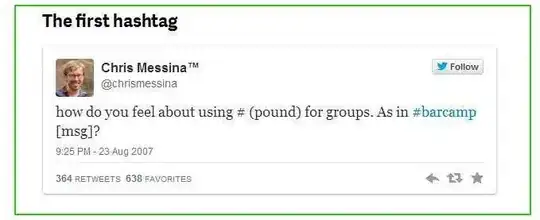
The first use of the term "hash tag" was in a blog post by Stowe Boyd, "Hash Tags = Twitter Groupings," on 26 August 2007, according to lexicographer Ben Zimmer, chair of the American Dialect Society's New Words Committee.
Beginning July 2, 2009,Twitter began to hyperlink all hashtags in tweets to Twitter search results for the hashtagged word (and for the standard spelling of commonly misspelled words). In 2010, Twitter introduced "Trending Topics" on the Twitter front page, displaying hashtags that are rapidly becoming popular.
According to an article in The Guardian, the term octothorpe was invented by engineers at Bell Laboratories in the early 1960s. They wanted a name for one of two non-number function symbols on the first touch-tone keypads (the other was the *, which they called a sextile). The term was practically unheard of among the general public until Twitter arrived.
Oxford Dictionaries claim hash has its origin in the 1980s: probably from the verb sense of hatch, altered by folk etymology, meaning 'to cut, engrave, or draw a series of lines'.
The earliest recorded usage of the octothorpe symbol as an abbreviation or shorthand for pound, as in weight, is dated 1923 by the OED:
1923 W. E. HARNED Typewriting Stud. II. 29/1 Special Signs and Characters..#..Number or pound sign; # 10 (No. 10); 10# (ten pounds).
On a survey on keypad terminology conducted by the University of Edinburgh it was noted that the most common names for Keys to the Right of Zero were: square, hash and gate
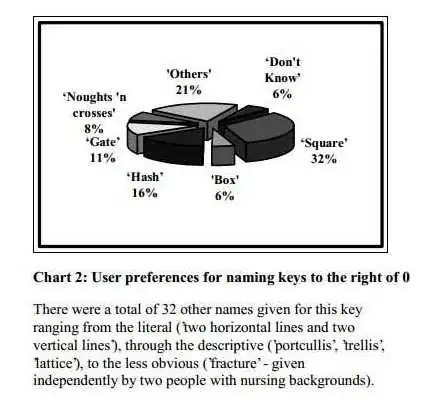
Other names for the octothorpe


The sign has multiple names and meanings:
The symbol is a Number Sign in North America with Pound Sign making in-roads as a name.
Outside North America it has always been called a Hash Sign.
With the advent of Twitter, hash or hashtag (named for the act of tagging with a hash sign) has become very popular in North America, too.
The Sharp Symbol in music is extremely similar, but usually looks like a hand-written version.

#define), "star hash one hundred hash" (*#100#), "To go to the main menu, press hash." etc. However if it really was something as abstract as a cloud shape, "hash symbol" or "hash sign" would be more likely.
– starsplusplus
Apr 16 '14 at 17:19
Octothorpe/Octothorp
Not to be confused with the Chinese character 井 (well), the sharp sign (♯), the viewdata square (⌗), or the numero sign (№)
Number sign is a name for the symbol #, which is used for a variety of purposes, including the designation of a number (for example, "#1" stands for "number one").

As others have said the number sign is technically called on octothorpe. Not that anyone would know what you were talking about if you used it. Number sign, pound sign, or hash/hashtag would be more generally understood. Almost all automated phone systems will use the term 'pound' if they want you to press it on your phone.
"Sharp" is a completely different symbol to the octothorpe. Using the term "sharp" is related to music and musical notation. The terms are not interchangeable, as they look different from each other. "Sharp" looks kind of like a number sign in backwards Italics.
Compare the octothorpe (number/pound sign): #
to the sharp sign: ♯
Two different symbols.

The history of the naming of # is worth a mention.
As the “number sign” or “pound sign” it is first recorded in American English in the OED in 1923
2. U.S. The symbol #, esp. as found on a keyboard or touch-tone telephone; the hash sign.
1923 W. E. Harned Typewriting Stud. ii. 29/1 Special Signs and Characters..#..Number or pound sign; # 10 (No. 10); 10# (ten pounds).
Hash sign does not appear for over more 40 years:
1967 Annual Reports 1960 (Chicago Civil Service Commission) (S. Afr. Council Sci. & Industrial Res.) p. i A slash sign ‘/’ is printed in the line to indicate from which point one should start reading the title, while a hash sign ‘#’ indicates the end of a title.
This leaves us with
octothorp (preferred by OED)
octothorpe (preferred by MW)
octatherp / octotherp (see below)
The OED claims 1973 as the first appearance in print:
1973 U.S. Patent 3,920,926 The pad provides keys for numerals 0 to 9, while..the octothorp (#) key generates a command to send the contents of the memory into the telephone line.
(The patent is assigned to Nortel Networks.)
It suggests as the origin
The term was reportedly coined in the early 1960s by Don Macpherson, an employee of Bell Laboratories:
1996 Telecom Heritage No. 28. 53 His thought process was as follows: There are eight points on the symbol so octo should be part of the name. We need a few more letters or another syllable to make a noun... (Don Macpherson..was active in a group that was trying to get Jim Thorpe's Olympic medals returned from Sweden). The phrase thorpe would be unique.
However the OED also remarks that another 1996 quote may be the origin:
1996 New Scientist 30 Mar. 54/3 The term ‘octothorp(e)’ (which MWCD10 dates 1971) was invented for ‘#’, allegedly by Bell Labs engineers when touch-tone telephones were introduced in the mid-1960s. ‘Octo-’ means eight, and ‘thorp’ was an Old English word for village: apparently the sign was playfully construed as eight fields surrounding a village.
Merriam Webster states – without reference:
The first known use of octothorpe was in 1971
And adds the origins as
The octo- part almost certainly refers to the eight points on the symbol, but the -thorpe bit is mysterious. One story links it to a telephone company employee who happened to burp while talking about the symbol with coworkers. Another relates it to the athlete Jim Thorpe and the campaign to restore posthumously his Olympic medals, which were taken away after it was discovered that he played baseball professionally previous to the 1912 Games. A third claims it derives from an Old English word for "village."
However, there is Douglas A Kerr the author of “The names “octatherp” and “octotherp” for the symbol “#”” ...
In the early 1960s, Kerr worked for AT&T where he claims that the “octatherp” or “octotherp” was invented or, at least, the “number sign” or “pound sign” was re-christened.
It is an interesting read, and the following is a summary which offers a plausible origin:
At At&T, Lauren Asplund, a member of the data communications marketing group …[wanted] a new, “meaning-neutral”, name for the symbol “#”. He, along with his engineering counterpart, devised the name “octotherp”. He tells me that the inspiration for “octo” was the eight free ends of the four strokes in the symbol. “Therp” did not have any logical premise, but just sounded sort of “Greek-ish”, and thus might confer some scientific stature upon the name.
Shortly after this had happened, John Schaak, an office mate of Asplund’s, called the author to say that the name for the # button would be "octatherp".
Kerr began to circulate it,
For example, when the symbol was mentioned in memoranda or articles I would prepare (for both internal and external use), I would reference a footnote reading, "Often called octatherp."
Before long, mentions of the name “octatherp” (or, more commonly, “octotherp”) abounded in industry publications. There was a cottage industry of commenters who sought to explain the origin of the name.
Some of these stories were truly “creative”. Several commenters recognized the significance of the “octo” component. One story was that the name was actually “octothorpe” (developed by a different person than as discussed above) and that the latter part was an homage to Olympic great Jim Thorpe.
The story would have ended there but, Ralph Carlsen of Bell Telephone Laboratories wrote an open letter to the editor of the online journal “Telecom Digest” in 1995. Kerr added this version to his paper. In that letter Carlsen wrote that, in 1963, Don MacPherson of Bell Telephone Laboratories was sent to the Mayo Clinic to train staff in telephony and needed a name for the # button and chose the “octo” + “the Olympian “Thorpe”” (hence the “e”).
Kerr, remarks on the now uncertainty of the origins that there was a lot of interchange between Bell, AT&T, and other phone companies.
We may never know the origins.
