1

We’re debating this at work.

Merriam-Webster says it’s “subclassification”.

Dictionary.Reference.com allows “sub-classification” and “subclassification

Is there a ‘more correct’ word to use?

(If it helps, we're after Australian English)

RegDwigнt
  • 97,231
Mark Mayo
  • 980
  • Are you using it to mean "the act of further classifying items with finer granularity" or are you talking about a way of handling items beyond or below the level of classification? – Jim Jun 18 '13 at 04:59
  • Finer granularity. If you were talking about say, an industry that is booming, you might say industry classification ... "IT", sub(-)classification "mobile gaming". – Mark Mayo Jun 18 '13 at 05:07
  • Then you should use subclassification that goes along with the verb subclassify and the noun subclass neither of which requires a hyphen. – Jim Jun 18 '13 at 05:11
  • Despite it existing with one on some dictionary sites? – Mark Mayo Jun 18 '13 at 05:14
  • I believe that reference.com uses a hyphen where you use a hyphen in your query. E.g.: http://dictionary.reference.com/browse/tele-phone?s=t&ld=1136 and http://dictionary.reference.com/browse/telephone?s=t&ld=1136 – Jim Jun 18 '13 at 05:18
  • Mark, why not, when other dictionary sites omit the hypen? I'd leave it out. – J.R. Jun 18 '13 at 13:45
  • No. There's no ‘more correct’ alternative among or outside them. You need to use an appropriate dictionary/ style manual applicable to your writing. Let me add also, that the hyphen (in instances such as the example) may disappear in all versions of (all) languages in course of time. Think Deutsch. – Kris Jun 19 '13 at 05:54

1 Answers1

1

No, neither is more correct. According to Google Ngrams, subclassification is more popular.
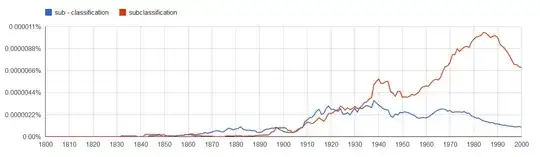
sub-classification vs subclassification ngram

  • At what ratio does one usage become more correct? – Edwin Ashworth Jun 18 '13 at 09:32
  • 1
    Why would such a ratio exist? – Matt E. Эллен Jun 18 '13 at 09:34
  • The difference is both geographic and stylistic so there are no clearly defined "rules" but American English tends to use fewer hyphens than British English which may partly account for the graph posted by Matt Эллен. I can't claim to be sure which is more common for Australians but in other areas of use Australian English seems to be more often akin to British English than American English. –  Jun 18 '13 at 08:48
  • I may be doing it wrong, but I can't get usable results from Ngram Viewer for hyphenated words. The problem is that Ngram replaces the hyphenated word (such as "sub-classification") with what appears to be "sub [minus] classification." One sign that Ngram isn't tracking occurrences of the spelling "sub-classification" is that the search results below the graph don't include any results for that spelling. You may also get a note from Ngram Viewer saying "Replaced [hyphenated word] with [word broken into two words with ' - ' separating them] to match how we processed the book." [continued] – Sven Yargs Jun 18 '13 at 21:06
  • Finally, in the search results for, say, "halfbaked" (in an Ngram comparison of "halfbaked" versus "half-baked"), many of the words that Ngram reads as "halfbaked" are instances where a line break produces "half-" at the end of one line and "baked" at the beginning of the next. Though Ngram interprets these line-broken words as being artificially broken examples of "halfbaked," they may instead be examples of "half-baked" that just happen to straddle a line break. If anyone knows how to get valid results for hyphenated words in Ngram Viewer, please let me know how to do it. Thanks! – Sven Yargs Jun 18 '13 at 21:07
  • @SvenYargs I agree that the linebreak hyphen could skew the results. I don't know how to account for that in ngrams, sadly. However, I went through the first 4 pages of a books search on sub-classification (which lumps in subclassification) and all of the entries that used a hyphen were not line breaks. – Matt E. Эллен Jun 19 '13 at 12:40
  • The biggest problem with Ngram Viewer results for "subclassification" vs. "sub-classification" isn't that a line-broken instance of "sub-|classification" may denote either "subclassification" or "sub-classification." It's that the program returns no search matches where "sub-classification" appears on a single line. When I tried to compare "medium-size" and "medium-sized," Ngram produced a graph of "medium - size" vs. "medium - sized," but it yielded no search matches. The best I could do was run "mediumsize" vs. "mediumsized"—and most of the (relatively few) search results were line-broken. – Sven Yargs Jun 19 '13 at 22:17