10

The words in headlines are capitalized. I'm interested in the history of this.

Where and why were capital letters first used in headlines? Where is this practice of capitalization of words in English titles derived from? Is it derived from German?

RegDwigнt
  • 97,231
  • 5
    Um, how could it possibly be derived from German? German does not capitalize words in headlines. – RegDwigнt Jun 12 '13 at 13:52
  • 4
    @RegDwighт German does capitalise nouns, so the OP could be confusedly thinking of that. – TrevorD Jun 12 '13 at 13:55
  • @TrevorD Exactly my point. – RegDwigнt Jun 12 '13 at 13:55
  • 2
    By "cpaitalized" do you mean "Five Forest Fires in Colorado" or "FIVE FOREST FIRES IN COLORADO"? – GEdgar Jun 12 '13 at 14:35
  • "Five Forest Fires in Colorado" – Clever Masha Jun 12 '13 at 14:38
  • 2
    This style of capitalization is commonly called "Title Case". Perhaps googling for that term will yield better results. See here: http://www.grammar-monster.com/lessons/capital_letters_title_case.htm – Avner Shahar-Kashtan Jun 12 '13 at 15:14
  • 4
    Most British newspapers don't use this style today, so presumably this practice developed in the U.S. It appears to have been in use at the time of the Civil War (~1860). – Peter Shor Jun 12 '13 at 18:23
  • @PeterShor do you have any links? – Clever Masha Jun 12 '13 at 23:55
  • 1
    Here's a link to some civil war headlines from the Philadelphia Inquirer. You can see that the headlines are either ALL CAPS or in Title Case, I think depending on their importance. If you use Google Images, you can find a lot more, but many of them are links to old newspapers for sale, so the links will presumably vanish fairly soon. – Peter Shor Jun 13 '13 at 00:43
  • 1
    @PeterShor, I have found this scan. It is 1664. And the information, that "The Capitalisation of Nouns (closest modern parallel, German) faded away between the Middle and End of the Eighteenth Century". But nothing about the begining of this. – Clever Masha Jun 18 '13 at 14:56
  • 1
    I think it is not connected with the Civil War. – Clever Masha Jun 18 '13 at 14:57
  • 1
    There's a rambling but fascinating discussion on MetaFilter about the History of English Capitalization where one poster opines that capitals "occur in books intended to be read aloud, as a way of showing the reader which words to stress" ca. 1650-1750. Extrapolating from this, title caps came about to show that every word in the title was important, since it was, after all, the title. – Gnawme Jun 20 '13 at 16:30
  • 1
    @Avner Shahar-Kashtan - In newspaper headlines, it's generally referred to as "upstyle," not title case. It's up to the paper's style guide; some papers use "upstyle" (In Which Most Words are Capitalized), some use "downstyle" (In which only the first word, or Proper Nouns, are capitalized). – Dennis Jun 21 '13 at 02:27
  • @CleverMasha: If you are willing to invest a little time, I suggest you get a free one-week subscription at http://www.newspapers.com/?xid=106&gclid=CL7kr4elqrgCFVOe4Aod71wAZQ. By linking a historical event to a date, you can access a newspaper headline associated with that event. Through the process of elimination you might be able to pinpoint when U.S. newspapers, at any rate, started using all caps. Using key words associated with a historical event in your search might lead to earlier and earlier headline. – rhetorician Jul 12 '13 at 16:01

2 Answers2

10

That seems like an interesting question, so I did a bit of research.

The short version of what I found is that headlines have been capitalized as long has there have been newspaper headlines.

Read on for the long version.

Everything Started In All Caps

I started with a quick look at the overall development of capitalization. In latin, the earliest occurrences of lowercase letters come from about AD 79. Before that, everything was essentially written in "uppercase". But of course wasn't standardized until the invention of the printing press.

The First Book Ever Printed Didn't Use Title-Case

The Gutenberg bible (of course the 1st book ever printed) doesn't have too much in the way of "headlines", but the closest thing approximation would be the titles of sections, such as the title for Jermoe's Prologue to the Pentateuch. Lucky for us, the British Library has a couple of its copies digitized and online. In the image below, from the British Library's paper copy of the Gutenberg, you can see that the title (in red) to Jerome's Prologue isn't in title case, and only the "I" in "Incipit" - the first word of the title - is capitalized.
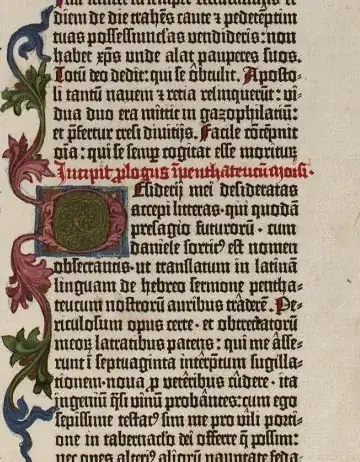
Gutenberg Bible

Moving On To Newspapers

The first newspaper ever printed (we'll ignore earlier handwritten newspaper-like things) was "The Relation" from Strasbourg, started in 1605. Also lucky for us, the University of Heidelberg has digital copies available online from the 1609 edition. It didn't have "headlines" in the way we'd think of them in modern newspapers, but instead had something more like a dateline. Here's an example of said dateline, from an October 1609 edition.
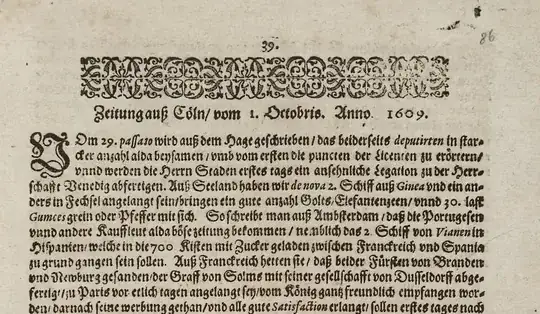
enter image description here

My high school German is a bit rusty, but I believe this headline reads, "News from somethingorsomeone/ From 1. October Year 1609"

We can't really conclude whether or not this is a headline in title case, since it's not truly a headline.

If we move all the way up to an early British paper, "The London Gazette" (which has great online archives) from 1665 , we run into the same problem.

The London Gazette 1665

In fact, all the way up to the 1800s, "The Gazette" still didn't have anything that could be called a proper headline.

The earliest newspaper I could find online with proper headlines was "The New York Herald" (the publication that sent Stanley in search of Livingstone among other things) from 1840. You can find a digital archive of scanned microfilm online. And all of its headlines are in either title-caps, or all-caps.
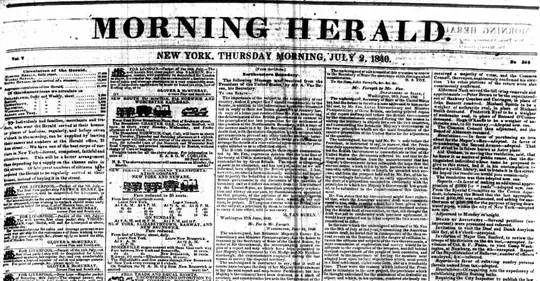
New York Herald

For further confirmation, you can see that when the New York Times launched in 1851, it also presented headlines in either title-case, or all-caps.
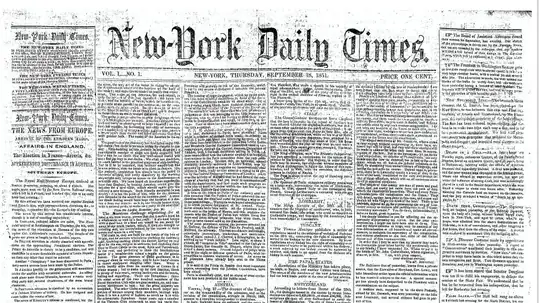
New York Times 1851

So, barring contradictory information, I gather that headlines have been capitalized at least as long as newspapers have had them.

Andrew
  • 166
8

When and where was there first a "headline"? Capital letters came first.

Lowercase letters are strictly a recent invention, dating from certain medieval hands; they weren't completely rectified until 1800 or so, when English dropped the "long lowercase S" in words like ſize and poiſon. Ngram graphs for "poison" vs "poifon", or any other internal S/F pair cross dramatically about 1800, because OCR picks up the long ſ as an f.

John Lawler
  • 107,887
  • 1
    Is this related to the German ß, I wonder? – Emre Jul 11 '13 at 23:27
  • 1
    Distantly. German Fraktur (black letter) type, which was abandoned after WWII, used three lowercase S's: a long one, like Early Modern English, a final "s", like English, and the es-zet combination ß for double "ss". Only the final "s" and the es-zet made it over to Latin characters. – John Lawler Jul 11 '13 at 23:38
  • 1
    Do you know when the first headline was used? At least in America, the Boston News-Letter (http://en.wikipedia.org/wiki/The_Boston_News-Letter) in 1704 made use of lowercase, and does not appear to have used headlines. I would bet that the first headline in English was published in the context of lowercase, and thus involved some reason to use uppercase besides lowercase not existing. – Dane Jul 12 '13 at 16:39
  • 1
    Notice that the German ess-zet letter amounts to the long s (like an uncrossed f) with a cursive-looking z hanging from the top end. – Andreas Blass Jul 18 '13 at 03:08
  • The German name for the letter Z is Zet, pronounced /tset/. – John Lawler Jul 18 '13 at 03:47