This tag is for questions about tense, or location in time by grammatical forms and constructions rather than by semantics.
Tenses are a set of forms taken by a verb to indicate the time of the action in relation to the time of the utterance.
Example questions
- Should I always use the perfect present, when the sentence uses "never"?
- Is this rule "If" specific?
- I'm born or I was born, which one to use
See also
This post is merely introductory, and deals only with grammatical tense in English. Fuller treatments, with cross-language discussion and references to the vast and fascinating technical literature, may be found in the articles on Tense at Wikipedia and at the Grammatical Features website. A treatment employing a framework which differs from that presented here is offered at the Council of Applied Linguists & Language Educators website. It is part of a series of articles (some still to be written) on TAMPA—Tense, Aspect, Mood, Perfection and Aktionsart—which are all worth reading. I also urge those whose first language is not English to investigate the expression of tense in their own languages.
Tense
Defining Tense
The grammatical term ‘tense’ means, generally, how and where an utterance locates a situation in time. In ordinary speech—the speech of students and secondary teachers— ‘tense’ is employed very loosely to refer to the various constructions a verb enters into: ‘past tense’, ‘present progressive tense’, ‘future perfect tense’, and so forth. Linguists, however, deprecate this use very strongly. They point out that such verb constructions actually signify many things besides location in time (aspect, mood and voice, for instance); that what any given form signifies varies in different contexts; and that in some contexts these constructions in fact say nothing about location in time. Consequently they restrict the concept of ‘tense’ to “time-relations in so far as these are expressed by systematic grammatical contrasts” (Lyons).
The most radically Positivist students of English grammar employ an even narrower definition: ‘tense’ is the component of temporal location expressed by ‘finite’ morphological forms of a verb. These linguists therefore reserve the term ‘tense’ for the property encoded in what we ordinarily call the ‘simple past’ and ‘simple present’ forms, and hold in consequence that English has only the two tenses, ‘past’ and ‘non-past’. There’s much to be said for that, methodologically; but it’s not very helpful for learners, so I will ignore it here.
Specifically, I will concede that the auxiliary will marks future reference. That’s not even approximately true; but it’s a universal convention in English teaching, because it makes explaining tense a lot easier to pretend that it’s true—in fact, most English teachers and students believe it is true.
In what follows I will be dealing only with ordinary indicative sentences. Tense—or at least recognizing and analysing tense—gets more complicated when it’s involved with modal and conditional expressions, and cannot conveniently be described here.
The Reichenbach model
The classic model for describing tense was described by Hans Reichenbach in Elements of Symbolic Logic, 1947. It has often been criticized and modified and enhanced, and it seems that every student (including me) develops a unique set of abbreviations for notating it, but has stood for three-quarters of a century as an elegant and transparent framework.
The Reichenbach model employs three distinct spans of time:
Speech Time (ST) is the time at which an utterance is spoken or written. In sentences, ST is always ‘now’. This gets conceptually tricky with written texts, since ‘now’ may be very different for the writer and a reader who picks up the text years or centuries later; but grammar pays no attention to this.
Reference Time (RT) is the time which is being talked about. In English grammar, there are three possibilities: RT may be either past, present or future—before, after, or at ST. I’ll notate those relationships as RT < ST, RT > ST and RT=ST.
Event Time (ET) is the time in which the event named by the verb occurs. This is located relative to RT—again, either before (<), after(>), or at (=) RT.
Event here has a local meaning which differs from its meaning in many other grammatical contexts. When speaking of aspect, for instance, we distinguish events (She walked to the park, The bomb explodes) from states (John was angry, Vidam understands nuclear physics). Many linguists therefore prefer to use eventuality or situation or occurrence to embrace both of these; but event and E were Reichenbach’s terms and are widely current, so that’s what I’ll use here. The ‘event’ is whatever it is that the main verb in a construction names, and ET is the time at which it happens.
It needs to be said that some of the expressions I’ve used here, like at and ‘=’, are not strictly accurate. The times we’re talking about here are timespans, not points in time, and timespans can overlap, or one timespan can be contained within another. These matters are of very great importance in describing the differences between different verb constructions and expressions. They are not, however, particularly important to the discussion of tense—they belong, rather to the discussion of aspect, which I urge you to explore.
Deictic tense
Deictic, and its noun form deixis, derive from a Greek word meaning “to point” and are used by linguists to designate expressions which define the relationship in space, time or ‘discourse space’ between the speaker and the topic or event the expression refers to. Since tense is anchored to ST, it is inherently a deictic category.
But English verb constructions define two sorts of relationship between the speaker and the event. The term deictic tense is reserved for those situations in which the relationship is direct, when the speaker is ‘pointing at’ the event. The speaker is always ‘pointing at’ RT, so in deictic tense expressions, that’s where the event has to be, too. ET = RT: the event takes place at the time we’re talking about.
What are ordinarily called the ‘simple tenses’—Present (PR), Past (PA), Future (FU)—are constructions expressing deictic tense:

The progressive constructions—Present Progressive (PR·PRG), Past Progressive (PA·PRG), Future Progressive (FU·PRG)—also express deictic tense. In these constructions, the lexical verb appears as a non-finite (‘not tensed’) present participle (PR·PPL), and tense is marked on the auxiliary, a finite (‘tensed’) form of BE:

Other forms of the verb—the infinitive (INF) and the bare present and past participles (PR·PPL, PA·PPL)—have no tense; the temporal location of the events they name is inferred from the context.
Relative tense
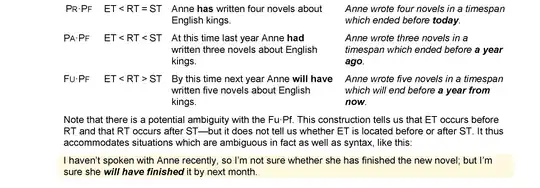
Perfect (PF) constructions work differently: the relationship between ET and ST is not direct—the speaker does not ‘point at’ the event, because it does not lie at RT. Consequently PF consructions express indirect or relative tense. In these constructions the lexical verb appears as a non-finite past participle (PA·PPL) and a primary tense is marked on the auxiliary, a finite (‘tensed’) form of HAVE, there are really two different time relationships at work.
The first part of the construction—the form of HAVE—defines RT, the time we’re talking about, just as in PRG constructions:

Note that because the time we’re talking about is defined by the HAVE part of the construction, standard usage does not permit sentences cast in the PR·PF to employ time adverbials which refer to the past:
*Anne has written a new novel last year.
Past-referring last year clashes here with present-tense has.
The remainder of the construction—VERB along with any progressive or passive auxiliaries—defines ET, the time when the event named by VERB takes place. ET is always before RT, before the time we’re talking about.
The ‘meaning’ of PF constructions is even more complicated than this—but that requires a post of its own.


