Questions tagged [perfect-constructions]

Perfect constructions employ a form of HAVE as an auxiliary and the past participle of a lexical verb to express past events as a current state.

NOTE: Building perfect constructions requires that you understand the different forms a verb may take, what are often called its ‘principal parts’:

  • the ‘infinitive (INF) form (identical with the 'present' form except with the verb BE)
  • the ‘present’ (PR) form, and its 3d person singular variant (PR3)
  • the ‘past’ (PA) form, sometimes called the -ed form
  • the ‘present participle’ (PR·PPL), also called the ‘active participle’, ‘participle-gerund’, or -ing form
  • the ‘past participle’ (PA·PPL), also called the ‘passive participle’ or -en form (in regular verbs, and some irregular verbs, identical with the 'past' form)

The Basic perfect (PF) construction

The English ‘perfects’ are a set of verb constructions which use a form of the auxiliary verb HAVE followed by the past participle (notated here as PA·PPL) of the following verb. In the ‘basic’ PF construction the following verb is the lexical verb (VERB), which is the verb which carries the ‘meaning’.

Here, for example, is how that works with the lexical verb WRITE:

Pcon1

Most forms of HAVE may be employed in this construction. Constructions employing a PR or PA ‘finite’ form are called the ‘present perfect’ (PR·PF) and ‘past perfect’ (PA·PF), respectively, and may be used wherever a finite verb is called for.

Pcon2

Constructions with the non-finite INF and PR·PPL forms of HAVE may be used like ordinary infinitives and present participles in subordinate clauses.

Pcon3

HAVE INF (have) may also be employed as the complement of modal verbs; when the modal verb is will the construction is called the ‘future perfect’ (FU·PF).

Coleridge may have written ‘Kubla Khan’ in 1797, 1798, or 1799.
I will have written my paper by next week.

But HAVE PR·PPL is never employed in the progressive (PRG) construction BE + PR·PPL:

Coleridge was having written ‘Kubla Khan’ in 1797, 1798, or 1799.

HAVE PA·PPL may of course act as the lexical verb (VERB) in the second position. In this case it has one of its ordinary senses, such as ‘possess’ or ‘experience’.

I have had a hard time with this essay.

Extended Pf constructions

PF constructions may also be combined with modal verbs (MODAL) and with progressive (PRG) and passive (PSV) constructions. The rules are basically very simple:

  • These constructions follow a strict order: the MODAL component first, the PF component next, then the PRG, then the PSV, with VERB always at the end.
  • Each construction is marked with a specific auxiliary verb, HAVE or BE, and there is a ‘ripple’ effect: the form (PPL or INF) of each of these verbs is determined by the preceding component.

Pcon4

If the HAVE form is preceded by a MODAL verb it must take the INF form, have. In all other cases the HAVE form is first. It can take any finite or non-finite form except the PA·PPL. It is always followed by the PA·PPL form of the next verb in the chain.

Perfect passive (PF·PSV) constructions

The basic PSV construction is built with a form of BE followed by the PA·PPL of VERB.

Pcon5

The PF·SV construction is therefore built as follows

  • It starts with a form of HAVE.
  • This is followed by the PA·PPL form of BE (been). That completes the PF part of the construction and starts the PSV part of the construction.
  • The final element is the PA·PPL form of VERB. That completes the PSV part of the construction.
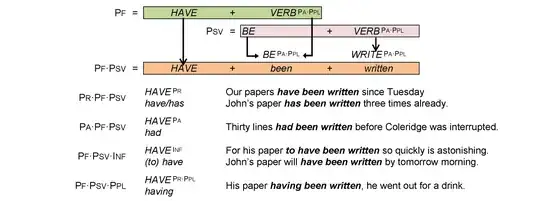
Pcon6

Perfect progressive (PF·PRG) constructions

The basic PRG construction is built with a form of BE followed by the PR·PPL, the –ing form, of VERB.

Pcon7

The PF·Prg construction is therefore built as follows:

  • It starts with a form of HAVE.
  • This is followed by the PA·PPL form of BE (been). That completes the PF part of the construction and starts the PRG part of the construction.
  • The final element is the PR·PPL form of VERB. That completes the PRG part of the construction.
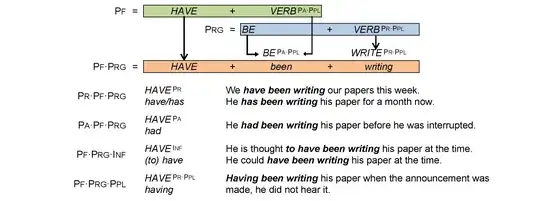
Pcon8

  • So the only difference between PF• PRG constructions and PF·PSV constructions is the form of the final VERB: an –ing form instead of a PA·PPL.

    PF·Psv John has been praised by Bill.
    PF·PRG John has been praising Bill.

Perfect progressive passive (PF·PRG· PSV) constructions

This construction combines the PF, PRG and PSV constructions:

  • It starts with a form of HAVE.
  • This is followed by the PA·PPL form of BE (been). That completes the PF part of the construction and starts the PRG part of the construction.
  • This is followed by the PR·PPL form of BE (being). That completes the PRG part of the construction and starts the PSV part of the construction.
    The final element is the PA·PPL form of VERB. That completes the PSV part of the construction.

There is rarely any occasion to use these complicated forms, and there is usually a simpler way to express the same thing. But for the sake of completeness, here are the construction and examples:
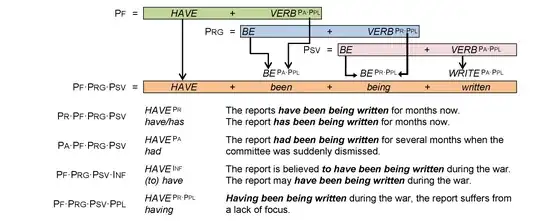
Pcon9

342 questions
10
votes
6 answers

Is "I have been to Italy two years ago for 2 months" correct?

When someone asked me "Do you like to go on another/foreign country trip?" or "Have you experienced to go another country?" Can I answer using one of these: "Yes, I do. I have been to Rome in Italy two years ago for 2 months." "Yes, I do. I have…
Ted
  • 321
  • 3
  • 7
  • 18
4
votes
2 answers

What tense to use for an event that was no longer valid?

You know how I say I told my friend what had happened before she came to class. Above is a time line in red. Time goes to the right. Its arrow is the present. "came" is in the past, a little back in time. I told my friend what had happned. "what…
3
votes
2 answers

Present Perfect Tense Asking

I am a beginner for English grammar. I read following paragraph in my grammar book. I got your long email about two weeks ago and have been trying to find time to write you back ever since. I have been vary busy lately. In the past two weeks, I…
Austin Jeong
  • 117
  • 1
  • 2
  • 6
3
votes
3 answers

Meaning difference between using "is" and "has been"

What is meaning difference in the below sentences? Once your ID card number has been noted, there’s no way of escaping the fine. and Once your ID card number is noted, there’s no way of escaping the fine.
user4084
  • 2,293
  • 41
  • 113
  • 167
3
votes
2 answers

John has spoken to his uncle just now or John spoke...?

Recently I found a pair of sentences in a grammar practice book: John has just spoken to his uncle. John spoke to his uncle just now. The sentences are almost the same. They only differ in the position of "just". I don't know why one sentence is…
user55846
  • 31
  • 1
  • 2
3
votes
2 answers

Is the phrase "are you come" in this sentence correct?

A man made big noise to rouse a Giant and the Giant rushed from his cave, crying: " You incorrigible villain, are you come here to disturb my rest?" This is from English Fairy Tales. I wonder if "are you come" is correct because I learned " Do…
Yuuichi Tam
  • 2,419
  • 3
  • 29
  • 50
2
votes
2 answers

Do I have to use the perfect infinitive

I was taught that if we had some action which can happen before some moment in the future, I had to use Perfect. For example: I will have done it by the morning. Some days ago I had to say a sentence like this: I will want to (come) by the…
Michael Azarenko
  • 1,053
  • 14
  • 26
2
votes
1 answer

There is no big difference between reacting after 6h and after 20h

The context: It's like there are two reactions and one has reacted for 6h while the other one has reacted for 20h. But there is no difference between them. I want to say There is no big difference between reacting after 6h and after 20h. Is this…
Kequan Xu
  • 31
  • 1
  • 5
1
vote
1 answer

Expressing achievements with present perfect

"She has recently dyed her hair blue." Did we use the present perfect simple to express an achievement or a finished action in the past with a result in the present??
1
vote
2 answers

I have been aware or I'm aware

I wrote this sentence "I have been aware, that my job is good" but my friend told me is not correct an answer. He said "I'm aware that my job is good" Why I can't use present perfect?
Akari Watanabe
1
vote
1 answer

Having injured or Injuring

A remote-controlled bomb exploded outside a hotel near the town square yesterday, _ at least 12 people. A having been injured B having injured C injured D injuring I think D is correct, but somebody argues that B is, saying it's a shorthand of…
ForOU
  • 1,673
  • 6
  • 17
1
vote
1 answer

Sentences with recent actions

If an action has just happened, I should use present perfect, right? (At least in BE) Like: A friend come back and he is sweating, I can reply "What has happened?" right? And:(fake story :)) If a guy disrespects me, should I say " What have you said…
safarie
  • 97
  • 5
1
vote
1 answer

why use "had had" instead of just using "had" in this context?

excerpt from a text: "He’d had a complicated childhood and was especially close to his brother, with whom he works. Friends suggested he was cheating. But I knew he was just trapped in an all-night flurry of anxiety about clients, medium-density…
1
vote
1 answer

"Julie has cooked dinner Let's go and eat!" (PrPerf vs PrPerfCont)

Is it OK to use Present Perfect Continuous here, just like with "have you been crying? Your eyes are wet!" (crying-result-tears) ===>"Julie has been cooking, Let's go and eat!"(cooking-result-baked food).
Leroy
  • 402
  • 4
  • 13
1
vote
1 answer

“If” Clause, Type 3, and Perfect Tense

"If he had come yesterday, he might have seen his sister." This sentence implies he didn't come yesterday and didn't see his sister. "If he has come YESTERDAY, he may have seen his sister." İ know that i cannot use this sentence with…
Help Me911
  • 29
  • 1
  • 4
1
2 3