76

Suppose I am enumerating reasons not to fly. Is it then correct to write/say:

Firstly, I prefer the train because I can see the landscape. Secondly, I have control over my luggage, and thirdly, it is better for the environment.

Or is it:

First, I prefer the train because I can see the landscape. Second, I have control over my luggage, and third, it is better for the environment.

I thought the first should be correct, but I find the second one in written texts. Which one is correct?

DialFrost
  • 8,001
  • 5
  • 14
  • 47
gerrit
  • 4,705
  • 7
  • 32
  • 55
  • 6
    Firstly, secondly, thirdly, all right. But please, not fourthly or fifthly or seventeenthly. It's not incorrect, it's just ugly. – SF. Feb 01 '13 at 11:03
  • I prefer "First of all," which I feel helps resolve the seeming discrepancy of non-parallel language in continuing to "secondly." – Nathan Feb 12 '20 at 23:24

6 Answers6

61

Both styles are used. In most genres, no-one will object to either. However, traditionally, first, secondly, thirdly etc. is used. Only pedants will insist on this usage, but it is something to be aware of, as there are many pedants. See Fowler's Modern English Usage (3rd edition).

The Oxford English Dictionary on firstly:

Used only in enumerating heads, topics, etc. in discourse; and many writers prefer first, even though closely followed by secondly, thirdly, etc.

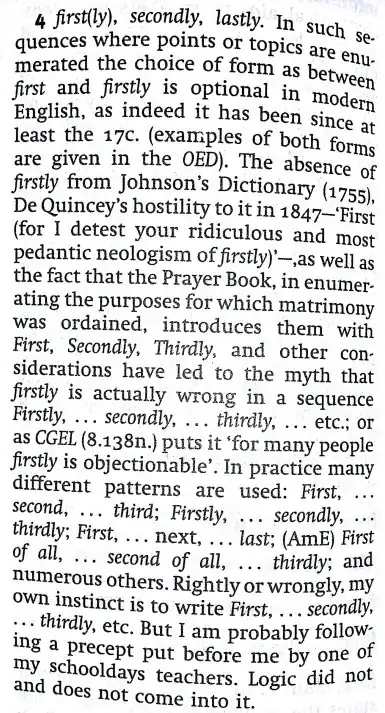
Burchfield in Fowler's Modern English Usage on first:

enter image description here

Cerberus
  • 5,206
  • 1
  • 21
  • 27
18

First, and firstly are both correct, since first is also an adverb. So you can say:

I prefer the train because I can see the landscape. Secondly, I have control over my luggage, and thirdly, it is better for the environment.

First, I prefer the train because I can see the landscape. Second, I have control over my luggage, and third, it is better for the environment.

The important thing is not to mix them, as in the following sentence:

First, I prefer the train because I can see the landscape. Secondly, I have control over my luggage.

Mari-Lou A
  • 27,037
  • 13
  • 72
  • 125
apaderno
  • 20,803
  • 40
  • 110
  • 183
  • 12
    I'm sorry, but your last statement is not right. The traditional sequence is first, secondly, thirdly etc. – Cerberus Feb 01 '13 at 10:56
  • @Cerberus Then the NOAD is wrong too. – apaderno Feb 01 '13 at 10:57
  • 1
    NOAD is wrong, really? I have never used it. In any case, leaf through a few books and you will find first, secondly all over the place. It is perfectly correct and even the preferred choice for many. – Cerberus Feb 01 '13 at 11:02
  • 1
    Are you sure NOAD didn't say "don't use firstly, second, thirdly, nor first, secondly, third"? The order of the -ly's is important. – Cerberus Feb 01 '13 at 11:10
  • "Make sure not to mix the two groups: first, second, third; not first, secondly, thirdly." – apaderno Feb 01 '13 at 11:15
  • Okay, that is simply wrong. Consult any style guide, like Fowler's. – Cerberus Feb 01 '13 at 11:26
  • Is it wrong basing on what? What said from a style guide is not more correct than what reported from a dictionary. The purpose of style guides is not saying what it is correct, but providing a guide. – apaderno Feb 01 '13 at 11:33
  • You and NOAD are saying first, secondly is wrong. That is a very broad claim. If significant evidence can be found that respectable authors use first, secondly, your claim is invalidated. I have added a quotation from the Oxford English Dictionary in my answer. – Cerberus Feb 01 '13 at 11:39
  • I didn't say "it is wrong"; I said "the important is not mixing them." Style guides are not evidences, nor does traditional order have any relevance. – apaderno Feb 01 '13 at 11:42
  • 7
    I think that Burchfield, in Fowler's, has hit it: "Logic did not and does not come into it." Gowers, in the second edition of Fowler's (1965), says "The preference for first over firstly in formal enumerations is one of those harmless pedantries in which those who like oddities because they are odd are free to indulge, provided that they abstain from censuring those who do not share their liking." – barbara beeton Feb 01 '13 at 13:21
3

This answer at ELU suggests:

Both are correct, however, there is "overcorrectness" in using firstly because it seems more like an adverb than first.

Go on the length principle: both have the same meaning, but firstly is two characters longer than first. The language will eventually evolve to do without the longer equivalent; I'd use first.

Be Brave Be Like Ukraine
  • 8,085
  • 11
  • 45
  • 83
1

From Cambridge website, mentioned:

We often use first, especially in writing, to show the order of the points we want to make. When we are making lists, we can use first or firstly. Firstly is more formal than first

So, If you are doing academic writing use Firstly, otherwise, use First for general writing use.

0

From this ELU post first answer, it is said that:

Eric Partridge ("Usage and Abusage") says:

firstly is traditionally said to be inferior to first, even when secondly, thirdly ... follow it.

As many others have mentioned, both are perfectly fine. Additionally "firstly" is more formal than "first" to most. Another ELL answer on that can be found on it (add on @Dongrui_Yang's answer).

Some alternatives are found here:

firstly = first off / "for a start..."

secondly = next / and then / another thing

moreover/furthermore = on top of that/this

It is said by Grammarist that:

“Firstly,” “secondly,” and “thirdly” are superfluous terms. “First,” “second,” and “third” are more acceptable words for enumerating text in writing. Experts also prefer “first” even if the other items state “secondly” and “thirdly.”

It is also said from Merriam-Webster that:

In writing, first is much more common than firstly and is probably the best bet for most situations, even if the only reason is that a reader may wonder if firstly is proper and be distracted by this word choice.

DialFrost
  • 8,001
  • 5
  • 14
  • 47
-2

If you are writing as a list (which most intend), use first, second and third. After all, if reading as a list of prioritised numbers, say, you wouldn't retort 'onely'; it would be 'one', 'two' and so on. Hence first, second etc. No need for the ly. This 'error' of 'firstly' etc is almost annoying as the improper use of 'which' (without punctuation), when most should actually be using 'that'.....

Nick
  • 1