Are the words "toward" and "towards" synonymous? If not, when should I use one over the other? "Towards" usually sounds silly to my ear, but is that just me?
Asked
Active
Viewed 1,250 times
27


-
7This is usually an AE vs BE difference. Actually toward sounds awkward to me. – deutschZuid Jan 30 '13 at 20:24
-
As far as I know, the choice between these two words is mostly a matter of where you live. Generally speaking, UK and US people use, respectively, towards and toward. However, I'm not a native speaker of English language; so I might be wrong. – Jan 30 '13 at 20:25
-
3If towards sounds "silly" to you, just use toward in your own speech and writing. But it would be ill-advised to tell someone else their usage sounds silly. It's just regional variation (primarily a US/UK split), but there's a certain amount of "personal taste". Myself, I use both freely, but as a Brit I probably favour towards. – FumbleFingers Jan 31 '13 at 01:16
-
towards usual in australia – wim Jan 31 '13 at 04:17
-
I don't suppose there's any etymological connection, but I can't resist pointing out that crabs move sideways** (and I never heard of a crab moving sideway** :). – FumbleFingers May 03 '13 at 22:05
4 Answers
29
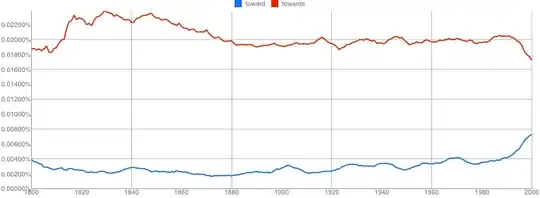
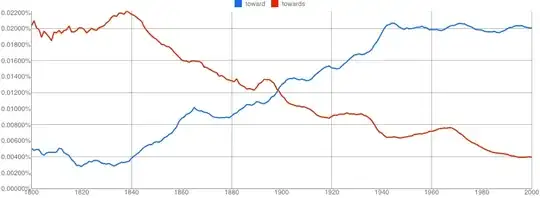
Indeed it seems that it is a British vs American difference. Note the ngrams below.
British:
 American:

Squazic
- 2,373
- 17
- 22
-
1
-
1
-
1This is pretty misleading. A survey of ten of my American friends' email over ten years shows a strong dominance of towards in these particular individuals. – tchrist Mar 07 '13 at 19:41
-
5A survey of 10 of your friends vs the massive sample size that this is taken from. – Squazic Mar 09 '13 at 21:57
-
1
9
The -ward root in words like forward, backward or toward is related to the Latin vertere and versus (to turn) and goes as far back as Sanskrit (vartate).
So this root has a rich history and has appeared in various altered forms in numerous Indo-European languages.
In German we have wärts which has the s: rückwärts (backward(s)) and vorwärts (forward(s)).
Evidently, in Old English the -ward root was either -weard or -weardes. So even in ancient times, there were already two forms: one with an es and one without. The idea that Brits use -wards, whereas -ward is a modern Americanism simply does not hold water since both versions trace back to respective Old English forms.
In any case, there is no need to have any qualms about putting the s on -ward or about leaving it off.

Kaz
- 6,546
- 14
- 17
-
3Certainly the modern usage of one form over the other can be regional, but I appreciate this short history lesson! – Flimzy Jan 31 '13 at 00:57
-
5I think that not only is it one versus the other regional, but in some dialects -wards seems to refer only to a manner of motion, where -ward is more general. You can move towards a goal (or toward), but you turn toward your friends for help. You also cannot look forwards to your vacation, only forward, but you can drive forwards and you can know something forwards and backwards. – Kaz Jan 31 '13 at 01:11
6
I agree with @carlo_R's comment and James Jiao's answer. However, towards isn't just limited to British English. For example, I grew up in the southern United States (Florida and Alabama to be exact) and say towards (my whole family does as well). Now, I live on the West coast United States and they generally say toward.

GorrillaMcD
- 160
- 5
4
This is usually an American vs British English difference. Toward is chiefly American and towards is chiefly used in BE and most commonwealth countries. The former is foreign to my ears but obviously understood due to the proliferation of American media.

deutschZuid
- 512
- 3
- 11