3

I heard a guy from Manchester, UK said —

It was the best restaurant I have ever went to.

And Google offers 23 million pages for the query "have ever went to", and only 3 millions for "I have ever gone to".

Is this form correct? Has the grammar changed?

Mari-Lou A
  • 27,037
  • 13
  • 72
  • 125
mosceo
  • 7,266
  • 35
  • 97
  • 147
  • "I have ever gone to" is definitely better than "I have ever went to." I would consider the latter to be wrong. – Daniel Jun 19 '13 at 13:53
  • 3
    Google's initial "guestimates" for text strings containing common words are often appalingly inaccurate. If you force it to actually *show* you all instances of "the best restaurant I have ever went to", you'll find there are only 17 (one being this question itself, several others being duplicates of each other). But you'll get bored scrolling through instances of "the best restaurant I have ever been* to"* - the initial estimate of 1,170,000 results might actually be true (or even an underestimate). – FumbleFingers Jun 19 '13 at 15:58
  • 1
    Some relevant discussion on ELU: http://english.stackexchange.com/a/31454/28567 –  Jun 19 '13 at 17:08

1 Answers1

6

The "correct" (by which I assume you mean "Standard English") for this would be to say:

It was the best restaurant I have ever been to.

or

It was the best restaurant I ever went to.
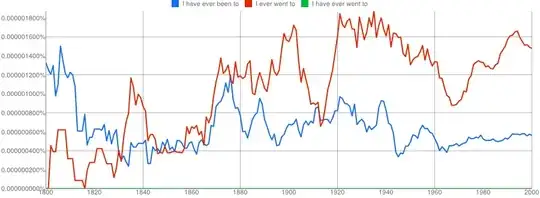
enter image description here

Note that ungrammatical text is quite common in some dialects, and can often creep in when people speak quickly or with an incomplete grasp of English (for example people learning English as a second language, or children).

As a learner you should try to focus on speaking Standard English yourself (unless you have a good reason not to), but be aware that other people, including native speakers, won't always speak perfectly grammatical English back to you.

Matt
  • 11,820
  • 1
  • 31
  • 54
  • I think it would make more sense if you'd graphed all three of I have ever been to, I ever went to, I have ever went to. We all know (well, all native speakers know) that the third of those *never* occurs - it's just not something people say, even when speaking quickly or casually. But of the valid usages, your chart obscures the fact that I ever went to is much more likely than I have ever been to. – FumbleFingers Jun 19 '13 at 02:39
  • 1
    "Never occurs" is too strong. Went as a past participle is an archaic form which is preserved in a number of modern dialects, such as Appalachian English. It's non-standard, of course. –  Jun 19 '13 at 03:20
  • 2
    @snailboat: Aye, forsooth! On ELU, a plus one for ye; but on ELL I agree with FumbleFingers. We shouldn't be teaching learners that "I have ever went to" is valid English, because in the English most learners will be encountering it isn't; it is only valid when discussing expert-level English (such as archaic forms and dialects) or when quoting directly from dialect-heavy speech. In the former, ELL is not the place, and to the latter, all English "rules" go out the window anyway. So I would venture to say that "'I have ever went to' is valid" is not something ELL should be teaching. – Matt Jun 19 '13 at 04:01
  • 1
    @Matt Sure, and I agree we shouldn't be teaching it as a valid choice. That's why I made sure to repeat that it's non-standard, even though you already said so in your answer. But all the same, we should avoid saying things that are contrary to fact. –  Jun 19 '13 at 04:39
  • @snailboat: Oh come on! It *never occurs among speakers of "standard English", if you insist. And even if there are still a few areas where a few older people say it "naturally", I would bet my life their children (or grandchildren*, more like) would be downmarked if they used it in school essays, for example. – FumbleFingers Jun 19 '13 at 15:49
  • 1
    @FumbleFingers You're right, it's a stigmatized usage. It's pretty common, though, and it's unremarkable in my native dialect. Lots of native speakers say it, and I'm afraid to report that not all of them are grandparents ;-) –  Jun 19 '13 at 17:04
  • @Fumble: I agree with snailboat. I never like to use never when talking about language. ;^) – J.R. Jun 19 '13 at 17:47
  • Everyone seems to have missed the oft confused past participles; "gone" and "been". Many native speakers and learners say and write: I have ever gone to to talk about being at a place (and then returning). I will tell Italian speakers not to worry unnecessarily unless they are sitting for an exam, in that case I have to insist on the so-called standard English version. – Mari-Lou A Jun 19 '13 at 17:55
  • @Mari-Lou: True - I wouldn't bother telling a learner that I've never gone* to a better restaurant* wasn't strictly "kosher". For many native speakers that's perfectly normal English, and I don't think ELL should be promoting pedantry for the sake of it. And where would you draw the line? I don't think even the most rabid pedant could object to "I've never gone to church in my life" (if anyone tried to tell me that was somehow "ungrammatical", I would simply roll my eyes! :) – FumbleFingers Jun 19 '13 at 19:46