54

I saw a new comic on xkcd http://xkcd.com/1602/ and understand that I don't get to go to the linguistics club.

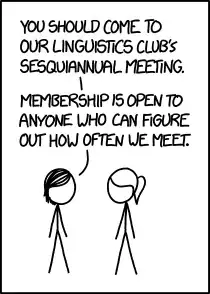
Megan talks to Ponytail. Megan: You should come to our Linguistics Club's sesquiannual meeting. Megan: Membership is open to anyone who can figure out how often we meet.

I Googled the word 'sesquiannual' and some say that it means it 'happens every one and a half years' - every 18 months, and some say it means it 'happens one and a half times a year' - every 8 months. So I need help.

Ajedi32
  • 643
  • 4
  • 9
Olga Akhmetova
  • 643
  • 1
  • 5
  • 10
  • 5
    Now that meeting will be overcrowed. And they need to change schedule to sesquiennial to accomodate everyone. – Chieron Nov 12 '15 at 11:49
  • 1
    @Chieron - Only if you know for sure the exact date of one of the meetings. Knowing how often they meet is useless if you don't have a point of origin to start from... – Darrel Hoffman Nov 12 '15 at 16:13
  • @DarrelHoffman to have half a meeting it must run from NYE to NY every other year so for any given year you know they must meet on one of 2 specific days. – JamesRyan Nov 13 '15 at 16:50

3 Answers3

48

http://www.explainxkcd.com/wiki/index.php/1602:_Linguistics_Club explains:

A SESQUIANNUAL meeting is one that occurs one and a half times every year; equivalently, 3 times every 2 years, or once every 8 months. It comes from the Latin prefix "sesqui-", which means "one and a half times", and "annual", which means "happening once every year".

This is NOT to be confused with SESQUIENNIAL, which means every one and a half years, or 18 months. A linguist or Latin scholar, the joke suggests, should be able to figure sesquiannual out as "half-and-one every year".

This is an extension of the common confusion between "biannual," meaning "twice a year", and "biennial", meaning "once every two years". Compare with the Sesquicentennial Exposition celebrating the first 1½ centuries of the United States.
Andrew Lott
  • 746
  • 7
  • 19
  • 8
    I never knew that about -annual and -ennial. This naturally leads to a second question, is there a similar change that takes place for other range periods like bi-monthly or bi-weekly? – Corey Ogburn Nov 12 '15 at 16:31
  • 6
    The terms bi-monthly and bi-weekly are always confusing,unfortunately. – Andrew Lott Nov 12 '15 at 17:13
  • 1
    @AndrewLott we have fortnightly for the week-tier, I'm not sure what we have for the month-tier. – Flaw Nov 12 '15 at 17:15
  • 3
    A fortnight is a British term, often not even understood by Americans. – Andrew Lott Nov 12 '15 at 17:18
  • 6
    Americans understand fortnightly, but it sounds literary, and I don't think it comes naturally to most of us in conversation. I myself use twice-weekly, twice-monthly or semi-monthly, and semi-annually instead of biweekly, etc. For terms of multiple weeks or months I have to resort to longer wording to avoid ambiguity: meetings are held in alternating months or meetings are held every other week or meetings are held every six weeks and so on. – choster Nov 12 '15 at 18:59
  • So, um, I hesitate to ask, but I must know. If Sesquicentennial is 150 years, what would be every 75 years (one and a half times every century)? Sesquicentannual? Seems like nobody's used it legitimately enough to get it into the dictionary yet. It also doesn't sound like a real word. – Steven Lu Nov 13 '15 at 05:07
  • 1
    @StevenLu Every 75 years is four times in 300 years, or one-and-a-third times every century. Sesquiannual would be three times in 200 years, that is, every 66 years and eight months. That might explain why it's so rarely (if ever) used. – David K Nov 13 '15 at 12:40
  • @AndrewLott I think fortnight is one of those terms many Americans understand (I have known it since childhood) but almost never use. In fact the most common use of it I know is in the phrase "furlongs per fortnight" (220 yards every 14 days, though I am sure that by tomorrow I will once again have only a vague notion of the length of a furlong--many yards but a fraction of a mile). – David K Nov 13 '15 at 13:01
  • This was one of the most interesting QA's I've seen for a long time. It makes for a perfect party "trick" or at least exciting conversational topic. In enoughly neardy crowd, that is. +1! – Konrad Viltersten Nov 13 '15 at 18:22
  • @StevenLu: I think the reason *sesquicentannual doesn't exist is because bi- has become a prefix that can be applied to English words (like weekly, monthly or annual) while sesquicent- only really exists as a Latin prefix. (The parts in bi-annual both come from Latin, but the way they're put together is unique to English.) – sumelic Nov 14 '15 at 05:50
  • Sure, and what significance can a period of 66 years and 8 months really have, anyway? Can't believe I thought that 100/1.5 was 75. Hah! – Steven Lu Nov 14 '15 at 05:53
8

'Sesqui' means "one and a half" and 'annual' means "yearly".  But if the meeting is held (on average) every eight months, then there will be TWO meetings every second year — which flies in the face of the definition of 'sesquiannual'.

So you must hold 1 meeting and half of another meeting in a given calendar year.... and the only way to do that is, at the second meeting, go through approximately half of the order of business and then call to adjourn.  Reconvene the following year and complete the meeting from the point of adjournment.

  • 5
    Or you could hold one regular meeting and one meeting that doubles as a New Year's Eve party that, of course, runs past midnight of New Year's Day. So 2015-04-01, 2015-12-31 running into 2016-01-01, 2016-08-01, 2017-04-01, etc. – shoover Nov 12 '15 at 16:55
0

Neither sesquiannual nor sesquiennial are in my Shorter OED. "sesqui" is a term which roughly means the ratio of (n+1)/n for some integer n, and is usually associated with 2 (in chemistry it means 3:2 ). 3:2 is the most common meaning, but not the only one; 9:8 occurs in music... I wonder if Monroe meant the double entendre, that it is precisely the people interested in linguistics who would argue over its definition...Somehow, I doubt it...hence a joke a miss.

user26391
  • 9
  • 1