2

How do I pronounce "caulk" so that it is not misheard as "cock"?

Some native speakers told me that they are the same sound.

Void
  • 18,058
  • 7
  • 75
  • 107
  • I had a plumber once who was from North Carolina, and he was by no means uneducated. He very distinctly pronounced "caulk" as "cork" (as in cork screw). Thus, I'd say that there are (at least!) three ways to pronounce "caulk"... – Mico Oct 10 '15 at 05:45
  • You might want to refer to a chart (search inside the link) for cock and caulk. Closeness of phonetic materialization can cause neutralization of difference. https://aschmann.net/AmEng/ – Lambie Aug 07 '19 at 17:29
  • The answer you have chosen is wrong, linguistically, socially and regionally. – Lambie Aug 08 '19 at 14:16

2 Answers2

4

I have never heard this word as anything other than a homophone for "cock" -- not in the Northeast, Mid-Atlantic, South, Southwest, West, or California. Not anywhere. An ex girlfriend said "caulk" once with an "l," but when I asked about it she said she had only ever seen it in writing.

Native speakers are well aware of the coincidence, and the potential for unintentional innuendo. You will never come off as intentionally impolite using "caulk" where needed. Of course the topic is to be avoided completely around immature people and teenagers, but otherwise do not be afraid to discuss "caulk" openly, in adult company.

However, bearing that in mind, you can sometimes use "caulking" to effectively avoid things that would be really off-sounding, and tough to rephrase. For example, if you had a color preference for the caulk, or have some question about how long it takes to harden, or something like that... caulking is useful.

sas08
  • 355
  • 1
  • 7
  • 7
    Caulk is /kɔk/ with the THOUGHT vowel where I’m from in the Midwest, while cock is /kɑk/ with the FATHER vowel. Those aren't even close. – tchrist Oct 10 '15 at 02:07
  • 1
    The spelling-pronunciation /kɑlk/ may not be common or “dictionary-official”, but I personally wouldn't consider it wrong if a person uses it deliberately to avoid misunderstandings about his “wet caulk”. – dan04 Oct 10 '15 at 03:30
  • 1
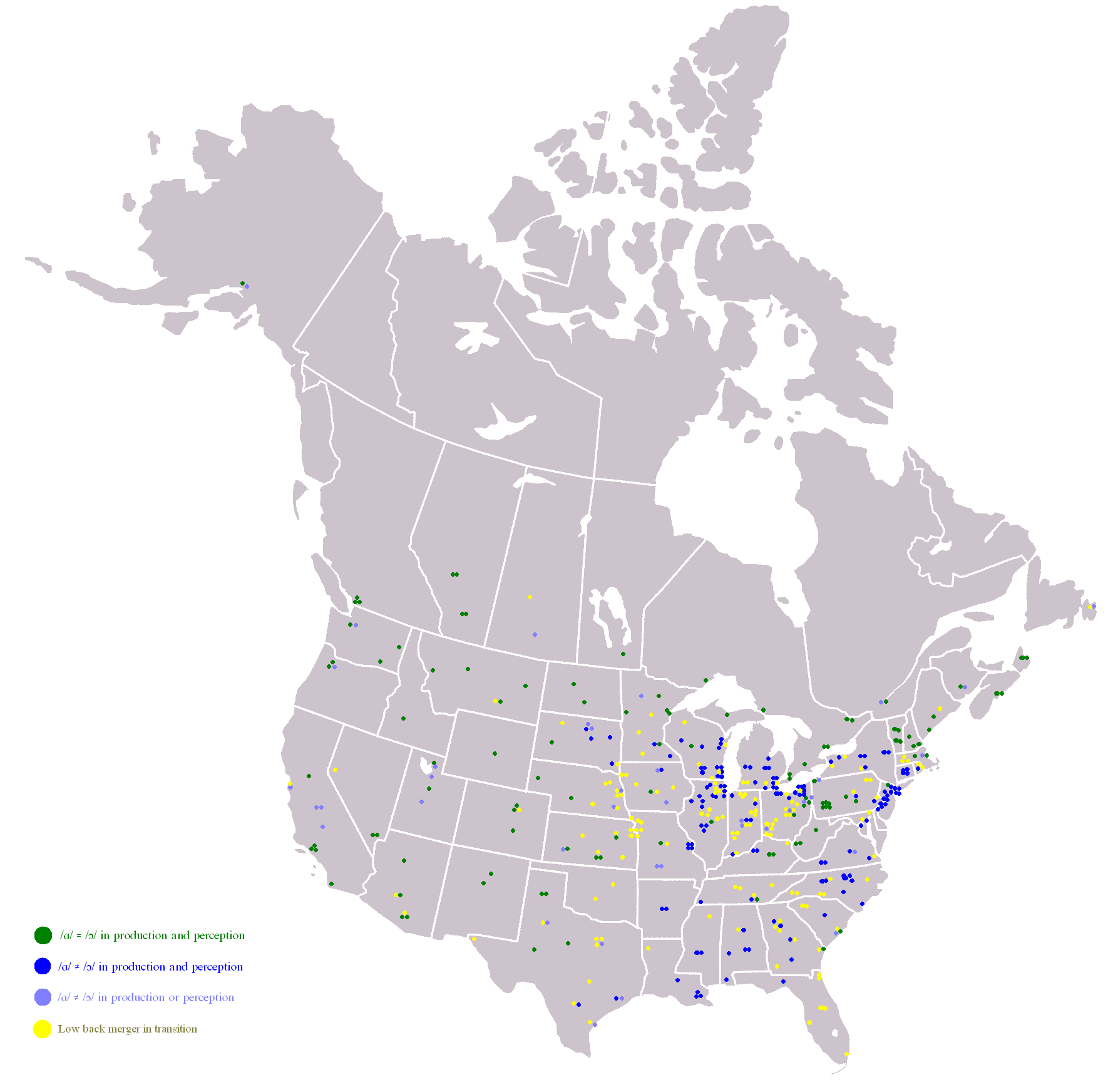
    The blue dots here represent places where people often do make the distinction. I live in one of the densest clusters of blue dots. If you don't observe people pronouncing them differently, it's likely because you weren't brought up making the distinction, and so simply perceive them as variations on a single vowel sound. – hobbs Oct 10 '15 at 05:51
  • 3
    @tchrist: Worth pointing out that the vowel in cock will only be the same as the vowel in father for dialects with the father-bother merger - which includes most US dialects, but not, for example, most British ones. In most British dialects caulk and cock are distinct - but caulk and cork are homonyms; since this could lead to some real home improvement disasters, I guess this may be why we usually say "sealant" rather than "caulk"!) – psmears Oct 10 '15 at 17:42
  • @psmears For me, caulk and cock are distinct as well, because I have not lost all my round vowels the way many Californians have. However, only one of those is rounded for me: the first one. Most North American dialects have no separate /ɒ/ phoneme (the CLOTH vowel), and merge it either with the THOUGHT vowel or the FATHER vowel. I don’t know what they call the cloth–thought merger, but it is separate from the caught–cot merger. I do have father–bother and cloth-thought, but not caught-cot. I also have /ɔ/ in palm, calm, but a lot folks don’t round that one in their dialects. – tchrist Oct 10 '15 at 17:50
  • @tchrist if I understand your comment, it's that midwestern people say "cock" differently... not that they pronounce "caulk" in a way that doesn't sound exactly like "cock" if you were in the mid atlantic or new england, or the south... or California. – sas08 Oct 11 '15 at 05:12
  • Just google "caulk prank call" and see how many hits you get. Teenagers do this all over the country. Alternatively, run a youtube search for DIY videos on caulking, and see how people say it. This isn't even cherry picking...

    https://www.youtube.com/watch?v=Qj7WcMMbrIg https://www.youtube.com/watch?v=QajXA95thJM https://www.youtube.com/watch?v=eLnVB-u0txs https://www.youtube.com/watch?v=CsNTqR6xWoY https://www.youtube.com/watch?v=GdHfuL64zqw https://www.youtube.com/watch?v=Pg9-SNpBMkw Notice the broad range accents represented here... & this was not cherry picked. Zero counterexamples.

    – sas08 Oct 11 '15 at 05:53
  • the amount of confidence in the first paragraph is weird. I am from the south and to me these (and talk/tock, caught/cot) sound quite different from each other-- so different that the joke in question isn't very funny (and I'm perfectly capable of being immature about words sounding like vulgar words... these are just very far apart from me). – hunter Nov 02 '15 at 19:38
  • 1
    there is a psychological bias when you exhibit a vowel merger to not notice that those in other dialects don't exhibit the merger, and I suspect that's what happened in some of those regions you mentioned in the first paragraph. – hunter Nov 02 '15 at 19:39
  • @hunter I would tell you that it's overconfident to assume you A) know where I'm from and B) how it affected me and C) that I don't hear what you're hearing. I can hear difference in the way people say "caulk." Inter-regionally it is sometimes distinct from "cock." But people also say "cock" differently, do you understand? As a practical matter, trying to avoid the homophone is not necessary. Also, it's going to make you probably sound stilted if you'd naturally say it that way with whatever accent you've picked up. – sas08 Nov 04 '15 at 00:48
  • P.s. it's not relevant to harp on vowels or the internet version of me's supposed inability to hear how people use them differently. The fact is the overlap in how people say "cock" makes it impossible to get it from the vowels alone. The real cue is the L in UK dialect and it's not strongly pronounced even then: http://www.oxforddictionaries.com/definition/english/caulk http://www.oxforddictionaries.com/definition/american_english/caulk http://www.oxforddictionaries.com/definition/american_english/cock http://www.oxforddictionaries.com/definition/english/cock – sas08 Nov 04 '15 at 02:44
  • This is completely wrong regarding AmE. caulk is like hawk or ought or cause and cock is like bock or lock. The O is much more forward in AmE for caulk and the O is further back for cock (different backness and highness). Also, it may be that people think it is the same due to the contiguity of making the sounds in the mouth. cocking the gun is not caulking the bathroom but they are very close in terms of phonemic realization. Ergo, some might not make the difference, but is far from universal in AmE. – Lambie Aug 07 '19 at 17:30
  • @Lambie This is a stupid debate in a forum for language learners. We don't know if people can hear a difference in the subject region. We don't know the subject region. We don't know if the speaker can reproduce any difference. That's doubtful if natives don't always produce one. My advice stands regardless. There are common jokes about a homophone relationship. The main point is people don't say the L. I'm quite aware of different vowel sounds. Not interpreting something as significant isn't the same as not hearing it. These differences exist WITHIN regions. No one is not aware of them. – sas08 Aug 07 '19 at 18:19
  • 1
    @Lambie This is not a complicated point: cock and caulk sounds overlap between regions, within some, and actually do so in multiple different ways. If I happen to be aware of more accents, particularly if I have experience speaking to foreigners who acquire language fluidly and imperfectly with a mix of accents, my interpretive process will be broader, not narrower. There's nothing parochial about filtering distinctions as noise based on 1000s of conversations with English speakers from multiple regions. Again, answer was intended to inspire confidence and set expectations of decent behavior. – sas08 Aug 07 '19 at 18:56
  • @sas08 Your answer contains a very categorical statement that is simply false. The reason that people avoid it is not because it is the same; it is because it is very close and therefore could be mistaken for the same thing. Your answer is misleading and non-linguistic. As to decent behavior, where does that even enter into this?? The terms are not homophonic. Look in any dictionary at all. – Lambie Aug 08 '19 at 14:14
  • @Lambie You're attempting to lecture me, but begin by comparing an absolute. Very categorical? It is either categorical, or it isn't. If you're confused by that, you may refer to Kant. – sas08 Sep 07 '19 at 11:19
  • @Lambie And what is your argument? I'm saying that it's a homophone. You're saying that it sounds so close as to be indistinguishable by many ears. Is there a better word than HOMOPHONE for that? The word homophone does not imply that a word must sound the same in all dialects to all speakers. – sas08 Sep 07 '19 at 11:20
  • @Lambie Here's a nice place to begin: what is the categorical (?) statement you regard as false? And if you think this is a stupid argument, don't @ me. – sas08 Sep 07 '19 at 11:42
3

Unfortunately whether this is possible depends on dialect.

Some dialects differentiate the two sounds /ɔ/ (caulk) and /ɒ/ (cock), some don't (like in many North American dialects).

http://www.usingenglish.com/forum/threads/219836-Caulk-VS-Cock

http://forum.wordreference.com/threads/pronunciation-caulk-vs-cock.3073730/

And an article dealing with this dialectual variation:

https://en.wikipedia.org/wiki/Phonological_history_of_English_low_back_vowels

If you run into a person who treats these as homophones, you have to hope that the listener has the context to not mishear it.

Nihilist_Frost
  • 4,564
  • 1
  • 13
  • 30
  • At issue is that there is no /ɒ/ phoneme in most American dialects. Therefore they will hear those both as /ɔ/, which is one reason why they would sound the same. Someone with those as separate phonemes thinks they are saying different vowels, but the listener who doesn’t distinguish them will call them the same. But more likely one is /kɔk/ and the other /kɑk/: rounded versus unrounded. – tchrist Oct 10 '15 at 00:30
  • I linked the Wikipedia article for that reason! – Nihilist_Frost Oct 10 '15 at 02:07
  • 1
    my former coworker was telling a story about redoing his bathroom in black tile and said "I had black caulk all over my hands and face" – Keltari Oct 10 '15 at 03:51
  • People can mistakenly think they are the same, they are not. cocking a gun is not caulking the bathroom tiles. It's angst of similarity. – Lambie Aug 07 '19 at 17:58
  • 1
    @tchrist The phonemes are different. No one confuses hawk and lock. – Lambie Aug 08 '19 at 14:18