18

The Judiciary also uses a special type of monitoring through the General Inspection Office and Bureaucratic Justice Court. Additionally, either of the three powers have internal supervision mechanisms.

"Either" in the above paragraph is used for more than two items (three powers). Is it grammatical?

Jasper
  • 24,268
  • 4
  • 54
  • 86
Mehdi Haghgoo
  • 2,298
  • 5
  • 33
  • 49
  • 2
    To answer the general question in your title: Yes, it can. "The majority of his paintings feature either children, fishermen, or old people --This England, Autumn 1983", excerpt from MWCDEU page 293. You can also find related info on this type of coordination in the 2002 reference grammar by Huddleston and Pullum (et al.), The Cambridge Grammar of the English Language, pages 361 and 388. That is a vetted grammar source. – F.E. Aug 04 '15 at 20:54
  • 2
    As for the example in the body of your post: I wouldn't be surprised if that excerpt is from a relatively old writing, or from a rather formal or restricted register (e.g. legal stuff). In other words, that type of usage is rather rare. The story on that type of construction is somewhat different (from that of the coordination usage). My MWCDEU provides this example: "… beside him was a telephone through which he could communicate with anyone, on either of the three trains. --Hector Bolitho, A Century of British Monarchy, 1951". (cont.) – F.E. Aug 04 '15 at 21:03
  • 2
    (cont.) This is their concluding sentence for that usage #2 on page 293: "You can therefore conclude that either is rarely used of more than two when a pronoun or adjective, but that the conjunction is commonly so used. – F.E. Aug 04 '15 at 21:04
  • 1
    I aspire living in an English speaking country, but I can't for now. Thanks for your lots of useful info @F.E. – Mehdi Haghgoo Aug 04 '15 at 21:12
  • 5
    When you're writing that many comments, it's usually a sign that what you're writing is actually an answer :-) –  Aug 05 '15 at 02:59
  • I recommend an edit to the question title to make it more in line with the question content. The two questions are asking different things. – Catija Aug 05 '15 at 15:01
  • 1
    Can you please clarify whether this is an original sentence that you have written yourself or if it is a quote from somewhere else? I can't find the sentence when I search for it, so it would be helpful to know the source of the writing. – Catija Aug 05 '15 at 15:25
  • @Catija I translated it into English from a Persian dissertation abstract. I am not sure if I had seen similar usage of either somewhere, but I found it somehow convenient to use and wondered if it was grammatical. So posted a question here :) – Mehdi Haghgoo Aug 05 '15 at 19:12
  • @JasonStack Ah, I see. That makes sense. I hope my recent edits of my answer clarify things for you in this usage case. If you have any specific questions I'm happy to try to help. – Catija Aug 05 '15 at 19:13
  • Thank you @Catija. Your answer treats the usage quite well from different aspects. I don't know it has been down-voted. – Mehdi Haghgoo Aug 05 '15 at 19:17
  • 1
    @JasonStack The original version of the answer was less well-explained and had some errors, which I have worked to rectify. :) – Catija Aug 05 '15 at 19:20
  • 1
    I wouldn't want to argue with my readers that what they're reading is good English because a "vetted grammar source" says so. If you've made a large proportion of them backtrack or stumble, then it's not good English. "Either A, B, or C" falls into that category, as often does usage of the split infinitive, despite many fine writers having used it and many fine sources saying it's not incorrect. Don't battle with your readers over whether you're using good grammar or not. –  Mar 05 '21 at 23:19
  • Know your audience. If you consider that your readers will be prevented from backtracking or stumbling when they read a given construction by their knowledge that Jane Austen used it, or that the Cambridge Grammar of the English Language says it's OK, then fine - use the construction to your heart's content. –  Mar 05 '21 at 23:31

4 Answers4

10

You've asked two questions here; one in your title:

Can “either” be used for more than two items?

and one in the body of your question:

Is this use of “either” correct in the above paragraph?

Catija has (correctly, in my opinion) given an answer to the second question. I'd like to answer the first: It depends.

As one grammar blogger wrote:

When used as a conjunction, “either” implies one of two or more elements. However, if it’s an adjective (meaning “one and/or the other”) or a pronoun (meaning “the one or the other”), then “either” implies one of two only.

The Free Dictionary has a usage note:

The traditional rule holds that either should be used only to refer to one of two items, and that any is required when more than two items are involved: Any (not either) of the three opposition candidates still in the race would make a better president than the incumbent. But reputable writers have often violated this rule, and in any case it applies only to the use of either as a pronoun or an adjective.

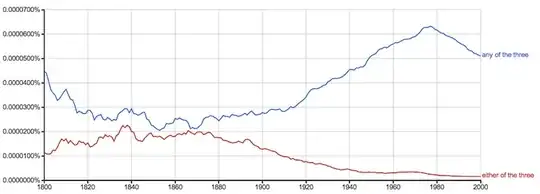
As for those aforementioned "violations," you can find several of them by going to Google Books and searching for "any of the three". When I did that, I noticed that several of the hits were from the 19th century, which made me wonder if either of the three was not considered the grammatical misdemeanor a century or so ago that it is today, a theory that seems to be supported by this Ngram:
enter image description here

J.R.
  • 109,547
  • 9
  • 164
  • 291
3

I agree that "either" as a conjunction is helpful when multiple options follow. If I say, "I'm visiting Europe, and I want to go to London, Paris, Athens, Budapest, Stockholm ...", it begins to sound like an ambitious and perhaps superficial trip. But if I end it with "... or Rome.", you will then realize that it is not superficial; I'm still deciding which one to go to. In this case inserting "either" before "London" would have served the useful function of preventing that confusion.

2

No - but the problem is your example sentence.

In your sample, you'd need to use "all":

Additionally, all of the three powers have internal supervision mechanisms.

You need an inclusive word that means "all" or "each".

Either is problematic because that's not what the sentence is saying. "Either" allows you to choose between options.

You can have either soup, salad, or breadsticks.

This is a perfectly acceptable construction. It means you can only have one of the three.

But it would be incorrect to say:

Additionally, either of the three powers have internal supervision mechanisms.

Because it implies that not all of the powers have internal supervision mechanisms, which they certainly do, so "all" is required in this case.

Catija
  • 25,400
  • 4
  • 63
  • 95
  • 1
    "It would be incorrect to say" is a very strong opinion which is unhelpful to learners. The use of either does not preclude all of the possibilities being viable. It merely indicates that there's alternatives available. So the context of the utterance decides whether either is viable or not. As we don't have the context here we don't know. It depends on the purpose of the paragraph. Don't believe me? Well, either the Merriam Webster Dictionary or the OED have useful info that you could check out. – Araucaria - Not here any more. Aug 14 '15 at 09:26
  • Notice that I could have said "both the MW and OED have useful info". – Araucaria - Not here any more. Aug 14 '15 at 09:27
  • 2
    @Araucaria it's incorrect in context. Your example is not the same use. – Catija Aug 14 '15 at 13:27
  • I disagree: if the text is in response to an allegation that there's no mechanism to deal with a specific type of problem then the OP's sentence is fine. If it's in response to the idea that there's no type of monitoring, that's fine too. It's only if it's a bland description that it may not be ok. But it's plain wrong to suggest that saying either of the three has internal mechanisms to deal with this implies that some of them don't. I don't see how anyone could rationally come to that conclusion. – Araucaria - Not here any more. Aug 14 '15 at 16:41
  • I have to agree with Araucaria's conclusion here, though perhaps for slightly different reasons. "Either" should have two adjective entries in most dictionaries. It can mean "one of a group" when used like "you can wear either hat." Or it can explicitly mean "both/all" when used like "she had an apple in either hand." To my ear, "either of the..." strongly implies the first definition (probably based on commonality of usage), but I can't find any reason to state that it would be incorrect to apply the second definition here. – GrandOpener Sep 14 '23 at 22:08
1

"Either of the three" sounds wrong to my native ear.

But I wouldn't say that about a case such as

"There were no knives, no forks, and no plates either."

That doesn't sound wrong, insofar as one can reasonably parse it to be about two alternatives: on one hand, knives and forks; on the other, plates. But it does sound awkward, because the reader may be unclear as to whether it's that two-way alternative that the author has in mind or the three-way alternative.