You must remember that these prepositions have multiple meanings. Some dictionaries will list between one and two dozen meanings for each, and sometimes these meanings will even overlap!
The best way to fully understand these prepositions is to use a good dictionary (such as Collins or Wordnik) to appreciate the flexibility of these words. If you try to get locked into a mindset where you think you know what a preposition means, you're liable to trip yourself. For example:
Using 'at' in this context is not suitable because island is big enough use 'in'
That line of reasoning seems like maybe you're overthinking it. After all, at can be used to designate a place (at the store), a time (at midnight), an event (at the opera), or a rate (at 10 meters per second). And it's flexible enough to use with island, too:
There were huge Dolly Varden and another variety of trout in the bay where we were camped at the island. (Paul L. Jones, 2010)
I might have used on there, but these words are pliable enough that I wouldn't say that at is "wrong."
Your book claims the answer should be "on" probably because that's the more common and idiomatic preposition to use when talking about what's on an island.
Yet it's important to realize such usages can change over time. For example, look at this Ngram:
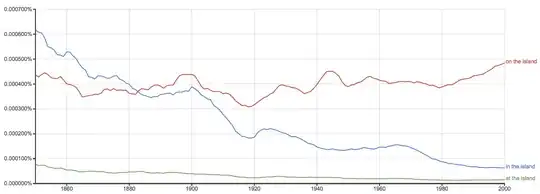
You can see there was a time when in the island and on the island were both used, but for some reason, in the island fell out of favor about 100 years ago. You'll still find modern hits for "in the island," but many of those are cases where island functions an adjective, such as:
...despite the fact that tourism is an important element in the island economy.
Here's a sentence where I would have used on the island, not in the island:
The road here is the best in the island, though in many places steep and difficult.
however, that was written by David Porter in 1823, and, as I mentioned, preposition usage has changed over time.


