22

I think the word pudding is used mostly as a general name for sweet dishes in the UK, whilst in the US it is a specific dessert. What do the British people call it? It looks delicious innit?
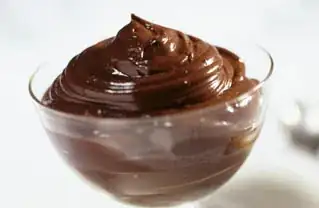
Chocolate pudding

Ben Kovitz
  • 27,566
  • 3
  • 53
  • 109
Mrt
  • 10,951
  • 65
  • 176
  • 257
  • 8
    Actually, "innit" is sloppy (British) talk for "isn't it?", not "doesn't it?" (I'm not sure how to spell the sloppy talk for "doesn't it?" without losing the rhythm.) – Ben Kovitz Feb 08 '15 at 23:16
  • 2
    @BenKovitz "dunnit" as in "whodunnit"? It means "done it" in this context, but given the sloppy speech, it sounds similar to "doesn't it" :) – Maciej Stachowski Feb 08 '15 at 23:18
  • @MaciejStachowski Indeed it does, doesn't it? But "dunnit" is short for "done it", which is lower-class grammar for "did it". I think Murat needs sloppy speech for "doesn't it". The spellings I can think of all fail to communicate the rhythm properly: "dunnit", "dudnit", "dun'nit". There are three slurred beats in a row, maintaining the rhythm of ordinary "doesn't it", just slurring the s and middle t almost out of existence. Maybe someone knows of a conventional way to represent it. – Ben Kovitz Feb 08 '15 at 23:23
  • Well, I don't have my finger on the pulse of UK slang, so that could well be. In that case, it would be doubly sloppy! (I also never heard the term "tag question" before, if that gives you some idea of how well-known that term is.) – Ben Kovitz Feb 08 '15 at 23:58
  • 4
    @BenKovitz: I don't have my finger on the pulse of UK slang either (despite living here I'm in my 30s). However, "innit?" is used by the yoof as an intensifier on pretty much any statement. Example usage: teenager sitting in the middle of three seats on a train. I sit next to him. He rolls his eyes and huffs a bit. Slightly older guy with him (I guess older brother) says, "well move over then, innit?" :-) "It looks delicious innit?" seems convincingly idiomatic UK slang to me. But you could say "don'it" ("Doesn't it" -> "don't it" with glottal stop for the t). – Steve Jessop Feb 09 '15 at 00:35
  • @SteveJessop Ha! That's amazing (to me, at least). Well, clearly I was wrong. Murat's use of British slang stands! – Ben Kovitz Feb 09 '15 at 00:38
  • 3
    @BenKovitz: I think it was initially specific to London and related dialects, especially since you have to lose all the consonants to get from "isn't it" to "innit". The train in question was in South London. But this stuff spreads and London is where a lot of media lives, so UK people are aware of it even if they don't use it. "innit" has become an examplar of "how kids talk these days". – Steve Jessop Feb 09 '15 at 00:40
  • 2
    Note, that in a lot of Central-European languages the word puding or pudding actually refers to this particular sweet and not the general term – SztupY Feb 09 '15 at 11:14
  • @BenKovitz: just to chip in, Steve Jessop is completely correct that "innit" is commonly used in contexts where it seems ungrammatical. Put differently: allow it blud! – Lazzaro Campeotti Feb 09 '15 at 12:59

8 Answers8

19

Speaking for the UK, if we served a dessert looking like that, it would probably be a chocolate mousse (although this seems to have been piped into the dish, which isn't what you'd normally do with mousse).

However, I don't know enough about US pudding to know whether that dessert pictured actually is something we'd call a chocolate mousse, or just looks like it. A quick search for a US recipe for chocolate pudding yields something that probably isn't a mousse since it doesn't seem to have much air whipped into it. Maybe it does from the boiling milk, but a typical UK home-made mousse you'd whip egg-whites then fold them into your chocolate (whereas chocolate mousse bought in a pot from a shop almost always has gelatine, I assume because it has to stay fluffy a lot longer).

There is such a thing as custard, and it can be (rarely) flavoured with chocolate, but if your pudding doesn't have eggs in it then it pretty much isn't custard. Anyway "chocolate custard" certainly isn't a common dessert here.

Based on the recipe I found, we might call it "chocolate sauce" and wonder why it's being served on its own! So I suspect the problem is you're asking for the UK name for something that isn't typically served here, and doesn't really have a UK name.

Steve Jessop
  • 1,637
  • 9
  • 11
13

I'm a Brit that's spent a number of years in the US.

There's no direct analogue. But, if you want to describe it, remember, context is everything. Just as dessert is the name of the 'sweet course of a meal' in the US, you can get things with the name dessert in them and not be confused. Likewise with pudding.

Plus, in British English pudding isn't even a generic name for 'sweet things' in all contexts (because you'll be really surprised when you take a bite of steak+kidney pudding) but is actually a reference to a shape, specifically the 'pudding bowl' (and hence leading to the name 'pudding bowl haircut')

Just call it what it is, 'chocolate pudding'. Anyone who knows what it is, will know, and anyone who doesn't, won't— whatever the name.

choster
  • 17,736
  • 3
  • 50
  • 86
6

Quoting from Wikipedia:

In Commonwealth countries these [North American] puddings are called custards (or curds) if they are egg-thickened, blancmange if starch-thickened, and jelly if gelatin based. Pudding may also refer to other dishes such as bread and rice pudding, although typically these names derive from the origin as British dishes.

Gelatin pudding is very common in the US. Anything you buy at a grocery store or make from a boxed mix will most likely be gelatin. Egg-thickened custards are higher-quality but more difficult to make.

Adam Haun
  • 3,311
  • 15
  • 26
  • Is there any distinction in the UK between this and what the US would consider a gelatin based dessert? i.e. something like Jell-O, which is more "solid" - it springs back into shape if you compress it a little, and if you compress it too hard you'll "cut" through it. – Random832 Feb 09 '15 at 03:39
  • @Random832 What do you mean by "this"? UK jelly = US gelatin/Jell-O (what you've described). Gelatin pudding is something different, though. As you might infer if you're American (and so typically conflate gelatin and Jell-O), Jell-O pudding (image) is an example of gelatin pudding. – Esoteric Screen Name Feb 09 '15 at 05:35
  • 1
    @EsotericScreenName A look at the ingredients list of a few examples suggests they are thickened with corn starch, not gelatin. – Random832 Feb 09 '15 at 05:37
  • @Random832 I didn't bother to check the ingredients, and am quite surprised by that. I'd assumed they used gelatin since they have as much as they want on hand. – Esoteric Screen Name Feb 09 '15 at 05:40
  • The name "Jell-O" is suggestive, but it's simply a company/brand which began with the classic gelatin products (the word "jello" is synonymous with it in the minds of many Americans, and the only commonly used name for it, with "jelly" referring instead to what you would consider a type of jam) but has branched out to also selling pudding/mousse/etc. – Random832 Feb 09 '15 at 05:43
  • 2
    Brits often use brand names, so in my youth this would have been called Instant Whip. Even if it was another brand, that's the name people used because it was always in advertisements. – RedSonja Feb 09 '15 at 09:00
  • 3
    @RedSonja Yep, I would call something like this Angel Delight. – starsplusplus Feb 09 '15 at 11:33
6

If it's a pudding made from milk, corn starch and flavourings mixed together and whisked, then the British equivalent is Angel Delight. (This is a brand name, but it's synonymous with the dessert in the same way as Hoover is with vacuum cleaners.)

If the same ingredients are cooked and then cooled, then it's flavoured custard. Egg-free custard made from corn starch, milk and flavourings is very popular in the UK. Individual pots of chocolate custard do exist, although they're not as popular as American pudding seems to be. Ambrosia is a popular brand.

ssav
  • 6,768
  • 23
  • 30
  • 2
    that is a particular brand of mousse – JamesRyan Feb 09 '15 at 11:19
  • @JamesRyan that's as may be - but it's also the closest analogue to what the OP has pictured. And it's a brand name that was once synonymous with the dessert in question, much as "hoover" is of "vacuum". It's what I immediately though of when I saw the picture. This answer doesn't deserve downvoting IMO, although it could probably use a bit more detail. – Bob Tway Feb 09 '15 at 11:46
  • 3
    from what I know as pudding here in Germany and the recipe posted in another answer for US pudding, this actually isn't the same thing. Pudding becomes solid because the starch is cooked. This Angel Delight is whipped. I assume it has a lot more air bubbles than pudding because of this and feels different! – Josef Feb 09 '15 at 11:51
  • I wouldn't consider Angel Delight to be a mousse (and neither do Birds, who market it as an instant whipped dessert). Mousses generally contain either egg white or cream. – ssav Feb 09 '15 at 12:18
  • I think Josef has got it. The cooked equivalent of Angel Delight is custard. I've edited to cover that. – ssav Feb 09 '15 at 12:37
  • 2
    Perhaps a better analogy than Hoover and vacuum would be Jello and gelatin dessert. Everyone I know calls it Jello, whether it's made from that brand or a different brand. – J.R. Feb 09 '15 at 15:22
2

I would say a flavored custard is the best way to describe American style pudding, when making from scratch, you typically follow the same directions as a custard, and while store bought premade packs exist and have gelatin and cornstarch in it, they are really just acting as replacement ingredients for the eggs and to save money

Mer Watts
  • 21
  • 1
2

I think is it 'vla' (http://en.wikipedia.org/wiki/Vla) although probable no one will use that word ;)

Rob Audenaerde
  • 291
  • 2
  • 12
  • As fun as it is to answer questions on ELL with knowledge of Dutch (I've done it too), maybe a Dutch.SE or Netherlands.SE should exist... It also seems less fluid than vla. I think we'd call this pudding too. – RemcoGerlich Feb 09 '15 at 19:05
1

In Britain American "pudding" would be called "flavoured custard".

"Custard" in Britain would be Bird's custard powder which is vanilla flavoured corn starch.

mmmnnn
  • 11
  • 1
1

A chocolate mousse is a hybrid of a pudding & a flavored whipped cream served on it's own rather than as a topping.

Pudding in the US is milk mixed with cornstarch, gelatin, sugar, & flavoring, & often requires no cooking.

Custard is the most like pudding in consistency, but made with eggs.

Blancmange & Flan/Pudim are technically Jellos/Gelatins made with milk & eggs. They're too stiff & jiggly to be puddings.

European puddings would confuse Americans. A Rolly Poly Pudding there is a Swiss Roll Cake here, a Yorkshire Pudding there is a hollow biscuit here, a Kugel there is a casserole here, a Boudin & Kishka there is sausage here, Cheese Pudding there is Sweetened Ricotta here, Groaty Dick there would be an unsweetened hot breakfast cereal here, Pease Pudding/Pottage there is Split Pea Soup here, Toad in the Hole there is a deconstructed Corndog here, Spotted Dick there is Fruitcake made with lard here, Figgy Duff there is "Brown Bread in a Can" here (love that stuff), Sussex Pond Pudding there is basically a doughnut with a fruit filling made with lard.

  • 1
    Yorkshire pudding really isn't a hollow biscuit. Toad in the Hole is usually a YP made to serve 4+ people with sausages in it (or sometimes other meats, etc). YP is sometimes served as a home style dessert with any topping of choice. Golden syrup is a favourite. It comes in a tin or small bottle, is golden and incredibly sticky and just about 100% sugar made into a sweet sauce. Some of the above foods sound quite bizarre. Most of us have only ever seen Sussex Pond pudding on TV,- if cooked with a whole lemon inside a human being might conceivably attempt to eat it. Spotted Dick is a very filli – Catherine Joy Jun 27 '20 at 17:23