4

I have come across the following pair of sentences on an iTool to the course book which prepares students for Cambridge Key English Test.

There must be a mistake in the second pair of sentences because option A should be correct (though option B is ticked as the correct one).

Am I right in thinking so?
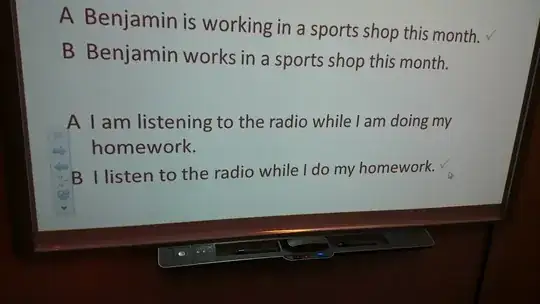
enter image description here

Yukatan
  • 1,276
  • 5
  • 17
  • 34
  • 3
    I'm not sure A is 'wrong' but it's horribly awkward. 'while doing' might help it out. – DoneWithThis. Dec 11 '14 at 11:15
  • In my opinion in the second pair of sentences sentence A is right because we can actually use the present continuous tense in the main clause and after while to talk about simultaneous actions, can't we? – Yukatan Dec 11 '14 at 11:17
  • I'm no grammarian, but B flows much better to my ear, native UK. A, even if it might possibly be technically correct, is just clumsy. – DoneWithThis. Dec 11 '14 at 11:19
  • Interesting. Maybe the use of the finite form in the while-clause in A makes the whole sentence imply you're doing the homework right now. I mean, "while I am doing" instead of just "while doing". – CowperKettle Dec 11 '14 at 11:25
  • Yes, A is definitely 'right now', B is 'usually, but not necessarily right now'. Even with the 'while doing' replacement, it's still 'right now'. – DoneWithThis. Dec 11 '14 at 11:29
  • @Tetsujin - but this page provides the following habitual action example with Present Progressive: "While I'm walking the dog, my wife is making dinner." – CowperKettle Dec 11 '14 at 12:01
  • I don't see a problem with that one [though both the breakfast examples make me squirm.] I think it's just the repetition of "I am… while I am…" that makes A uncomfortable. – DoneWithThis. Dec 11 '14 at 12:06
  • @CopperKettle I have visited the link you provided, but one thing sounds strange over there. In the first paragraph it stats that present continuous tense is used for habitual action. This really sounds weird, even those two example sentences that the site provides in support of their theory. I think that the whole statement and those examples are completely wrong. Because the continuous tense is for progressive actions, not for habitual actions, and hence got the name - "continuous". – Man_From_India Dec 11 '14 at 13:05
  • @CopperKettle I can see the answer you provided earlier and later deleted. I completely agree with your view regarding the question being discussed here. Both can be right and the decision to choose one over the other is completely based upon what you are trying to convey. The tense is a vital point here. If you are talking about the progressive, then go for the first one. If you are talking about the habitual action, go for the second one. – Man_From_India Dec 11 '14 at 13:07
  • Thank you, @Man_From_India, but after a short discussion in the chat I understood that I'm not really sure, so let a native speaker handle this. (0: – CowperKettle Dec 11 '14 at 13:08
  • 3
    @CopperKettle: (speaking for American English). When we unambiguously wish to say that our practice or wont is to do such-and-such, we use the simple present: I snore. I eat lunch at 12 sharp every day. When we wish to say that something occurs regularly or typically, we can use the progressive: Q: How do you like retirement? A: It suits me fine. I'm out walking on the beach most days by 6AM. – TimR Dec 11 '14 at 14:37
  • 1
    @TRomano I second that. You are using continuous tense to mean the habitual action. It's only possible due to the inclusion of "most days". Nice examples. – Man_From_India Dec 11 '14 at 14:54
  • All four example sentences are fine and grammatical. Though, they could be used to mean different things. :) – F.E. Dec 11 '14 at 18:57
  • 1
    In case you have a copy of the 2002 CGEL handy, it talks about this topic or topics. (There's some related info on pages 165-6, [7] and [11]. E.g. [11.iii] "She was reading while he was watching TV.") As for your question in the OP, could you also provide the course book's question so that we can see what it thought it was asking about? – F.E. Dec 11 '14 at 19:11
  • @F.E.The rubric is: Select the correct sentence. – Yukatan Dec 11 '14 at 20:34
  • @Yukatan But you see, all four sentences are fine English sentences. As to which one is "correct", that will depend on the context and the speaker's intention -- or if this is a test, then on the specific test question. – F.E. Dec 12 '14 at 06:53
  • I'm well aware of the fact that everything depends on a context.. We still have to choose the best option and 'the thing is that none of the sentences applies to the three uses of the present continuous tense we have covered so far i.e.: 1. we use PC for actions happening at the moment of speaking 2. we use PC for actions happening 'around' now 3. we use PC with 'always' for annoying actions that happen repeatedly' @F.E. – Yukatan Dec 12 '14 at 11:53
  • @Yukatan Then why don't you add that "context" to your original post, and maybe that'll help you get the type of answers that you are looking for. Because right now, the way your post is worded, all I can really say is that all four sentences are good, valid, English sentences. – F.E. Dec 12 '14 at 17:38
  • 1
    there is no context - it is what it is (I've quoted the rubric for you as well) - I'm not the one who made up the exercise in question @F.E. – Yukatan Dec 12 '14 at 18:00
  • Hi Yukatan! Could you briefly state in your original question why you think "option A should be correct." –  Dec 12 '14 at 18:56
  • unfortunately, I haven't got a copy of CGLE but the excerpt from it cited above explains my choice perfectly well: "She was reading while he was watching TV." It just somehow refers to the past.. but smth makes me think that one can apply it to the present as well. @CarSmack – Yukatan Dec 12 '14 at 19:41

3 Answers3

2

The sentences describing Benjamin are extremely close in meaning. The sentences describing listening and doing homework are different. A describes what you are doing right now, in the immediate present. There is no implication that you have done so in the past or will do so in the future.

B describes what you normally do. It applies to the present, the past and, potentially, to the future.

Gary's Student
  • 1,850
  • 13
  • 12
  • As an English teacher I do get all the examples and explanations given above, but the thing is that none of the sentences applies to the three uses of the present continuous tense we have covered so far i.e.: 1. we use PC for actions happening at the moment of speaking 2. we use PC for actions happening 'around' now 3. we use PC with 'always' for annoying actions that happen repeatedly – Yukatan Dec 11 '14 at 14:36
  • 1
    @Yukatan I applies to actions happening right now: ie number 1! (But that's not the reading we want!) – Araucaria - Not here any more. Dec 11 '14 at 18:47
1

We can use while or as to talk about two longer events or activities happening at the same time. We can use either simple or continuous verb forms. In this case, we can use simple verb form to describe a habit. Therefore, the answer is correct.

VariableTao
  • 316
  • 1
  • 3
0

Benjamin is working this month IDIOMATIC AMERICAN ENGLISH

Benjamin works this month NOT QUITE IDIOMATIC|UNIDIOMATIC " "

I am listening to the radio while I am doing my homework.

I'm listening to the radio while I'm doing my homework. OK, but requires something like the question, What are you doing at this moment?

I listen to the radio while I do my homework. IDIOMATIC ( it is my general practice to have the radio on when I do my homework).

TimR
  • 123,877
  • 7
  • 100
  • 202
  • I'm listening to the radio while I'm doing my homework. OK, but requires the question, What are you doing at this moment? - The answer is at present I am doing two things - listening to music as well as doing my home work. I really didn't get the point in your explanation (I marked that part in bold) – Man_From_India Dec 11 '14 at 13:57
  • 1
    What does your vertical pipe indicate? –  Dec 11 '14 at 13:58
  • 1
    I'm listening ... while I'm doing means "at this moment I am listening to the radio while doing my homework." Such a statement makes sense when one receives a phone call, say, and the person asks "What are|were you doing just now?" It does not imply habitual practice. – TimR Dec 11 '14 at 14:00
  • @snailboat: Vertical pipe is a shorthand way of separating items in a list of valid choices in some forms of technical writing. E.g.: I go, he|she|it goes. – TimR Dec 11 '14 at 14:03
  • I am not saying that it refers to a habitual practice. You means such kind of actions that are done simultaneously at a given moment only makes sense when it refers to receiving phone calls? – Man_From_India Dec 11 '14 at 14:04
  • The word "say" in the phrase when one receives a phone call, say,... means "for example". I was giving an example of an actual context where such a statement would make perfectly good sense and be idiomatic. Consider: I am thinking of my car while lying in bed. That means I am lying in bed and thinking of the car. Simultaneously, yes. It does not mean that whenever I am in bed I think of my car. – TimR Dec 11 '14 at 14:08
  • Well, I think I didn't make my point clear. Please excuse me for that. In your answer you mentioned OK, but requires the question, What are you doing at this moment? I suppose you clearly meant that "What are you doing at present" is missing. But I don't think so. It's clearly there in the sentence - "I am listening to the music" or you can say "I am doing my homework". – Man_From_India Dec 11 '14 at 14:13
  • Sorry, "Man_From_India". I was being elliptical there. It requires a context where one desires to say what one is doing at this very moment, such as when one receives a phone call and is asked "What were you doing just now?" Answer: I was listening to the radio while doing my homework. – TimR Dec 11 '14 at 14:20
  • @TRomano Now it's make perfect sense :) You might think of editing your answer a little bit, or else some one might end up misinterpreting your answer as I did ;) Thanks for the time for explaining :) – Man_From_India Dec 11 '14 at 14:26