0

What I know about 'made from' and 'made of' is this:

Chairs are made of wood - the wood is still wood, you see that AND
Paper is made from wood -wood disappears, you don't see wood

What I know about the word virgin as an adjective is this:

in its original pure or natural condition and not changed, touched or spoiled

So, keeping in mind that if *the original material is changed, it does not remain virgin. Said that, --[anything] made FROM virgin [anything] is not possible.

But here...

What makes it (they are talking about 3D printer filament) especially attractive is the cost of conventional filament made from virgin plastic: about $35 to $50 a kilogram.

The Guardian reads:

Extra-soft, quilted and multi-ply toilet roll made from virgin wood causes more damage than gas-guzzlers, fast food or McMansions, say campaigners

Question

Now, if we change/alter the original material, how is it possible to call it virgin? The moment you change/alter the main material, it's not virgin anymore! :)

So shouldn't we use 'made of virgin' (since it's not changed) over 'made from virgin' which means 'altered'.

Ben Kovitz
  • 27,566
  • 3
  • 53
  • 109
Maulik V
  • 66,059
  • 109
  • 310
  • 456
  • 1
    The article's use of "virgin wood" is fine. Note what is at the bottom of that article: This article was amended on Wednesday 4 March 2009. We mistakenly referred to virgin forests when virgin wood, which includes that from planted, managed forests, was meant. This has been corrected. – F.E. Dec 10 '14 at 07:42
  • 1
    I'll give you a hint: the from/of distinction you mention at the beginning of your question is something most native speakers don't really think about, and prepositions are flexible enough that there are plenty of cases were either from or of will work fine, depending on the wording of the rest of sentence. I hash this out some more in my answer here. "Made from virgin olive oil" is just fine, so long as "made from olive oil" would be okay in the same context. – J.R. Dec 10 '14 at 10:48
  • 2
    Why the downvotes? This sort of thing is quite confusing for non-native speakers. – Ben Kovitz Dec 10 '14 at 11:58
  • 1
    I don't think we should treat language as logic. But let's take a ride along your reasoning line for a bit. You gathered a) X is made of Y, X is still Y; b) X is made from Y, X is not Y anymore (in their words, Y disappears); and c) virgin means "untouched, not changed, etc." From them you deduced that we should use "made of virgin Y (since it's not changed) over made from virgin which means 'altered'" [sic]. This is illogical. – Damkerng T. Dec 10 '14 at 14:40
  • 1
    Consider X when X is not virgin Y (as you said, "it's not virgin anymore"): which one would you prefer between 1) X is made of virgin Y, and 2) X is made from virgin Y? With a) and b), you should be able to answer the question. (Imho, virgin of virgin Y has nothing to do with the choice of preposition (of or from) at all.) – Damkerng T. Dec 10 '14 at 14:41
  • 1
    @J.R. just curious about this - On the ELU site, the nuance of 'made of/from' is defined, and this is how actually natives' sharp eyes see what we cannot. In fact, I always take care of made of/from after learning form that excellent answer. The question came to my mind because I learned the real use of made from/of. – Maulik V Dec 11 '14 at 05:26
  • MV: What I'm saying is: those nuances are just that: nuances (or subtleties). They might help you pick the right preposition 9 times out of 10, but they'll lead you astray if you "overapply" them (as in, "How can it still be virgin if it's been changed?"). (That said, I share the confusion of @Ben about the downvotes). – J.R. Dec 11 '14 at 09:48
  • @J.R. Yeah, learning the language precisely costs me. Check out four downvotes that too for a question! – Maulik V Dec 11 '14 at 09:56
  • 1
    Yes, but three upvotes. It's still a net gain for your rep. :^) – J.R. Dec 11 '14 at 10:18
  • @J.R. "(That said, I share the confusion of -- about the down votes)." <== That sounds like a good question for ELL Meta. Why don't you ask there? – F.E. Dec 11 '14 at 18:49
  • @F.E., JR, Ben, I wonder if it's some misunderstanding about the word virgin? Cuz otherwise it's unfathomable to me ... – Araucaria - Not here any more. Dec 12 '14 at 00:25
  • @J.R. hahaa true! :) – Maulik V Dec 12 '14 at 04:09
  • @Araucaria I have been following this thread as the OP's post has changed, and been watching and reading the answer posts as they were made and edited. You can tell that I've been here early on from that first comment of mine under the OP's question post. And so, I do understand why there have been so many downvotes. – F.E. Dec 12 '14 at 06:35
  • 1
    @F.E. Sorry, I'm feeling dumb, why is it? – Araucaria - Not here any more. Dec 12 '14 at 12:56
  • @Araucaria What "it" are you asking for? – F.E. Dec 12 '14 at 17:39
  • @F.E. that there've been so many downvotes? – Araucaria - Not here any more. Dec 12 '14 at 23:54
  • 1
    @Araucaria I had upvoted this answer post in this thread, since I thought it a good answer (look at the 1st version of that answer), and then, since I was procrastinating, watched the developments, the edits and comments, etc., that went on in this thread. If you look at that answer post and comment(s), that's the tip of the iceberg. I can't speak for the other downvoters, but at the end, after an answer was "accepted", I finally had enough and had to down vote the OP. (If you want more in-depth info, then an ELL Meta thread might be appropriate.) – F.E. Dec 13 '14 at 01:18
  • @Araucaria don't get into it! Many don't know the reason to downvote. To some, it's merely a practice! Aim at learning the language and accepting answers that seem logical to you. No matter who answers how. I've many things to say on this but I'll refrain myself doing so. – Maulik V Dec 13 '14 at 04:34

5 Answers5

3

Edit (due to changes in the OP's question):

The link J.R. supplies deals with the use of "made of" vs "made from." And that post links to an additional post, in EL&U, which also covers the same two expressions, "made of" and "made from." I would like to throw in another possibility, "made out of," which seems to combine "made of" and "made from." (out of can mean from or of, depending on context).

The Guardian's usage of 'made from' is correct and idiomatic:

TP is made from virgin wood. as is
TP is made out of virgin wood.

As far as TP is made of virgin wood, I agree that some speakers may find it problematic. But not so much that it is impossible to say. I think of can be interchangeable with from and out of in such constructions. In other words, I don't think of necessarily carries with it the meaning that the raw material is still present in its unchanged form.

TP is made of (virgin) wood. But (virgin) wood that has been changed. The bulk of my original answer deals with why it is okay to use virgin wood in such a construction.

of can have more than one meaning here, basically equivalent to from.

Did you know that TP is made of (virgin) wood? works in my world. But then, so does

I made this bag of my old jeans. To me of can carry the same genitival meaning as from or out of.

Original answer (answer to an earlier version of the question):

I suggest the OP is being overly-literal and overly pedantic in his definition of virgin wood.

Virgin wood is a type of wood.

Virgin wood
Virgin wood consists of wood and other products such as bark and sawdust which have had no chemical treatments or finishes applied.

Source: Biomass Energy Centre.

The same site says:

The wood processing industries, such as sawmills and timber merchants, are also a source of virgin wood in the form of offcuts, bark and sawdust.

In other words, virgin wood is wood from a forest that has not undergone chemical processing. This is different from other wood, which has already undergone some sort of chemical processing.

From the article:

More than 98% of the toilet roll sold in America comes from virgin wood, said Hershkowitz. In Europe and Latin America, up to 40% of toilet paper comes from recycled products.

It seems clear that the article is opposing virgin wood and wood that has gone through processing. Such could be recycled wood.

If the OP does not recognize that virgin wood (even after being cleared from a forest, sent to the sawmill, debarked, and planked) simply means wood from a forest, as opposed to processed wood, then I do not know what else to say. In that case, it appears the OP is playing 'a subtle, specious, or crafty argument' and the question is no longer one about English but about logic, specious or not.

3

While JR is absolutely correct that native speakers might use either preposition in this case, I'd like to say a bit about the difference between the two, since it seems you want to get into the gritty semantic details.

So shouldn't we use 'made of virgin' (since it's not changed) over 'made from virgin' which means 'altered'.

This is exactly why it shouldn't be made of. As you note, the definition of virgin is:

in its original pure or natural condition and not changed, touched or spoiled

But here, the product in question is a toilet roll, also called toilet paper. Is this sort of thing made of wood? I and my bottom certainly hope not, because that would be very painful! During the manufacturing process, the wood is changed and made into "extra-soft, quilted and multi-ply" paper. Thus, it's no longer virgin, or even wood. Virgin wood in this context refers to the raw materials used to make the toilet roll, not the constituent elements of the finished product, hence from rather than of.

Esoteric Screen Name
  • 7,555
  • 1
  • 22
  • 35
2

In the article is not talking about the toilet roll that would be virgin. It is the raw material that used to be virgin wood.

So I don’t see anything wrong with the use of the virgin wood in the article.

Lucian Sava
  • 11,458
  • 15
  • 46
  • 98
2

So shouldn't we use 'made of virgin' (since it's not changed) over 'made from virgin' which means 'altered'.

No; I think you're parsing the sentence wrong. Remove the adjective virgin, and replace it with some other adjective:

the cost of conventional filament made from red plastic

extra-soft, quilted and multi-ply toilet roll made from fresh-cut wood

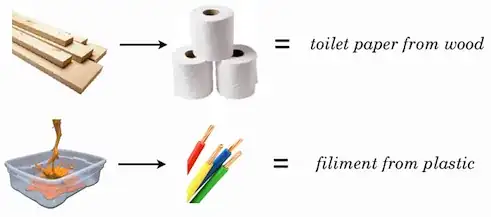
The transformations here are from wood to toilet paper, and from plastic to filament. The wood and the plastic can undergo all sorts of changes beforehand (or not) – that's outside the scope of this context.

Think of it this way:

enter image description here

It makes absolutely no difference what kind of wood or plastic is used – red or yellow, painted or unpainted, moldy or clean, processed or virgin – the transformation is there, and from is the correct preposition. In this case, the adjective has no influence on the prepostion, because we are not referring to any steps taken (or not taken) before this transformation.

J.R.
  • 109,547
  • 9
  • 164
  • 291
1

"I married a virgin" doesn't mean she's a virgin anymore. The writers chose the word virgin to suggest that something pure, precious, and irreplaceable is being lost—wasted on an unworthy purpose.

When the newspaper article says that the toilet paper is made from virgin wood, it means the state of the wood before they manufactured the toilet paper. Virgin wood is the input to the manufacturing process. Toilet paper is the output. We do not call toilet paper "wood" at all, even though that's what it's made from. From virgin wood to toilet paper—from sacred purity to filthy impurity—that's how the writers are trying to get you to see the situation.

Made from is more correct here, since that phrase suggests that the material was transformed when the object was made, as wine is made from grapes. Made of suggests that the material is still recognizable in the completed object, like a bridge made of steel. There is no exact rule, of course.

Ben Kovitz
  • 27,566
  • 3
  • 53
  • 109
  • I wondered how many seconds it would take for that to get a downvote. – Ben Kovitz Dec 10 '14 at 17:44
  • 1
    Thanks a ton. At least one answerer understood what I had in my mind. +1 and accepted especially for the first half of the answer. – Maulik V Dec 11 '14 at 05:23
  • @Ben - There oughtta be a badge for that :^) Good answer, btw. – J.R. Dec 11 '14 at 09:55
  • @snailboat I hit Save after typing the first sentence, wondering if anyone would pounce on it before I finished the whole answer. Indeed that sentence alone would be an absurd answer. Maybe the reason this question has attracted so many downvotes is also the main point of my answer: the word virgin has a strong emotional charge. – Ben Kovitz Dec 11 '14 at 13:27
  • @J.R. Ha! Thanks. I was inspired by this answer. – Ben Kovitz Dec 11 '14 at 13:33
  • @snailboat "I see two downvotes but no explanation. Would someone care to explain either ① why the downvotes were left ..." <== That sounds like a good question for ELL Meta. Why don't you ask there? – F.E. Dec 11 '14 at 18:47
  • I don't have a problem with anonymous and unexplained downvotes in principle (I think they're important, in fact)—but in this case I wondered if I might learn something from asking, so I did :-) I've removed my question-comment now that Ben Kovitz has answered. –  Dec 13 '14 at 07:57