The class of verbal concepts involved is called nonfinite clause, where the clause is originated from a verb operating in a nonfinite mode.
The basis of a nonfinite is that its origin-verb is not anchored to any point in time, or in number of perpetrators.
- He came here to die.
- They came here to die.
- They are coming here to die.
- I will be coming here to die.
First, let me establish some premises, which you would probably already know, because it helps to understand the categorization. These are not the only nonfinites in English, but are the ones in question.
1. Infinitive
The infinitive is still operating as a verb.
2. To-less infinitive
Same premise of to-infinitive, without being fixated in tense or in number
- I propose that he paint doors.
(note: "I propose that he paints doors" is bad grammar)
- I advise that he apply for the loan.
- I advise that they apply for the loan.
However, the following is not nonfinite, since we already know for a fact that it has already happened or is happening. Or, that our belief is grounded in time.
- I know that he paints doors. He paints doors.
- I believe that she saves money. She saves money and has two jobs.
3. Present participle
They are adjectives or adverbs.
Adjectival present participle: used to describe a noun.
- Look at the flying fish.
- We are on a winning streak.
Adverbial present participle: used to describe the state of another action.
- He came home running. (Describes the action came)
Adverbial to the auxiliary verb
- He is painting the house.
- I am eating durian.
- He is going to go to school.
(I'm poking fun at people's penchant for using going to)
4. Gerunds
Gerunds are nouns. They are names of actions. They are neither adjectives nor adverbs.
Names of non-transitive actions.
- I enjoy painting and walking.
Names of transitive actions.
- I enjoy painting doors and walking my dog.
Name of a possessable action.
- I wish to thank you for your painting my doors and your walking my dog.
- I am furious at her arriving at work late everyday.
- My grandma appreciates my holding her hand every time I visit her.
Adverbial gerund
Where the gerund is not an adverb, but is described by an adverb.
- Eating sloppily is bad manners.
Adjectival gerunds.
Where the gerund is described by an adjective.
- Your sloppy eating reflects your bad manners.
5. Verbal nouns
They are no longer actions. They are names of concrete products of actions.
Products of non-transitive actions.
- I wish to buy your painting.
- Bernie Maddoff has cheated me of my life's savings.
- I have to clean up his shavings from the sink everyday.
- "Friending" is the name of my favourite horse that will win the race.
Products of non-transitive prepositional actions. Has a preposition between the verbal noun and the subject of the verbal noun
- This is the painting of my grandma.
- They live in government housing by the river.
Concrete product of an action being an adjective
- The painting exhibition.
- I have a savings account with the savings bank.
- The coupling factory makes couplings for transmission cables.
- Similar to using a usual noun as adjective, e.g., water bottle.
Answer:
The best way is for your student to read, and read, and read. But if I were teaching a machine software some rules ....
Scoring ranks:
Au Gold = is grammatically acceptable
Ag Silver = is not logically awkward or out of alignment
Cu Copper = least number of words
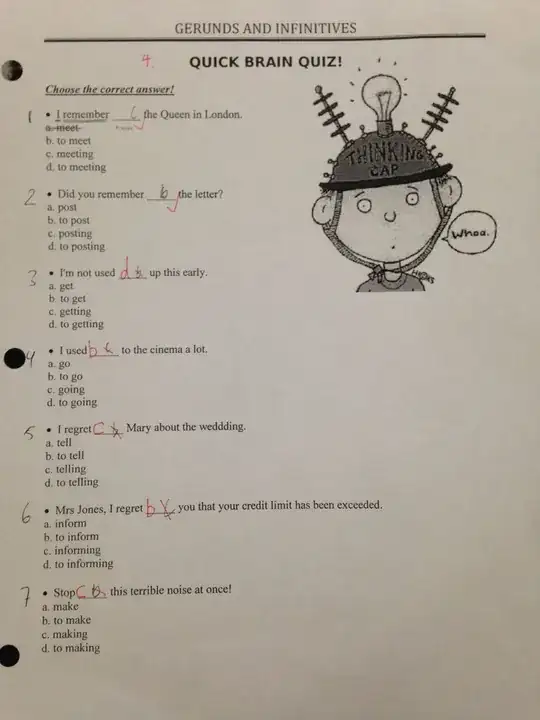
I remember {} the Queen in the palace.
- Obviously, using {to meeting} is not grammatically acceptable.
Au = 0;
- I remember {to meet with} the Queen in the palace.
Au = 1;
Ag = 0: because this is logically out of alignment. Being nonfinite the infinitive has no grounding in time, a sentence needs to provide the finite grounding in time of when the action is to take place.
These do not need to be grounded in time, because it is your intention to let them continue ungrounded:
I remember running. I take a painting. I like drapings. To meet the Queen is my fantasy.
To fulfill your intentions to ground an infinitive in time, you would supply a finite verb
I will remember {to meet} the Queen.
I did remember {to meet} the Queen.
I remembered {to meet} the Queen.
I struggled to remember {to meet} the Queen.
- I remember {meeting with} the Queen in the palace.
Au = 1; Ag = 1; Cu = 0;
- I remember {meeting} the Queen in the palace.
Best score: Au = 1; Ag = 1; Cu = 1;
Did you remember {} the letter?
- {post}
Au = 0: not a nonfinite.
- {to posting}
Au = 0: not a nonfinite
- {posting}
Au = 1;
Ag = 0;
Did you remember {} the letter?
is totally acceptable. It asks if you had any memory having posted a letter say while sitting in your car yesterday. But that is not what you intend to ask.
- {to post}
Highest possible score: Au = 1; Ag = 1; Cu = 0;
I am not used {} up early.
Read about preposition-verb couplings: https://english.stackexchange.com/questions/202863/preposition-for-tie/202942#202942.
We need a preposition {to} after used:
I am not used {to {nonfinite} }.
I am not familiar/familiarized {with {eating}} with chopsticks.
I am not bothered {about {approving}} the XL pipeline.
Without need of scoring:
I am not used {to {getting}} up early.
Not the preposition-verb coupling as previous question.
Plain to-infinitive:
I used {to-infinitive} to the cinema.
I trained {to get} up early.
I remembered {to get} up early.
- I used {get} up early.
I used {go} to the cinema.
Au = 0;
- I used {getting} up early.
I used {going} to the cinema.
Au = 1;
Ag = 0: not logical or not the intended message:
I used getting up early as an excuse to avoid late nite parties.
I used going to the cinema as excuse to see her.
- I used {to go} to the cinema.
Best score: Au = 1; Ag = 1; Cu = 1;
I regret {} Mary about the wedding of her ex-boyfriend.
- I regret {tell} Mary about the wedding of her ex-boyfriend.
Au = 0;
- I regret {to telling} Mary about the wedding of her ex-boyfriend.
Au = 0;
- I regret {to tell} Mary about the wedding of her ex-boyfriend.
Au = 1;
Ag = 0: not the intended message, out of alignment in time/tense with the intended message
- I regret {telling} Mary about the wedding of her ex-boyfriend.
Best score: Au = 1; Ag = 1; Cu = 1;
I regret {} you that your loan application has been rejected.
- I regret {tell} you that your loan application has been rejected.
Au = 0;
- I regret {to telling} you that your loan application has been rejected.
Au = 0;
- I regret {to tell} you that your loan application has been rejected.
Au = 1;
Ag = 0: not the intended message, out of alignment in time/tense with the intended message
- I regret {telling} you that your loan application has been rejected.
Best score: Au = 1; Ag = 1; Cu = 1;