75

In my mother-tongue, there's a word for it. I'm wondering what the English word is.

If potato chips come in contact with humid air (as in rainy days), they lose their crispiness, and become _____________.

Fill in the blank. Note that the chips are eatable and won't cause food poisoning. But neither are they wet because of contact with liquid water. They are just not crispy. In other words, if you take a potato chip and break it, it won't produce any sound of 'cracking'. It'd rather bend :)

I'm not looking for something like 'uncrispy' because it'll serve an all different purpose in this context.


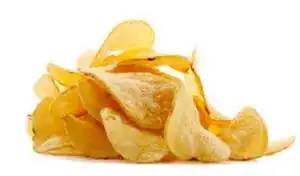
To avoid confusion of chips or fries, this is the picture of what I mean chips here.
enter image description here

Maulik V
  • 66,059
  • 109
  • 310
  • 456

9 Answers9

87

Soggy fits the bill I believe.

Saturated or sodden with moisture; soaked: soggy clothes.

marantou
  • 1,089
  • 7
  • 8
  • 29
    Just a data point (from California): If I am told something is soggy I expect a water to drip out if I squeeze hard enough. – Phil Aug 05 '14 at 16:27
  • 14
    Agreed, Phil. When my teen leaves the chip bag open, or bowl exposed to the air, they lose their crispness, but aren't wet. They are stale. – JTP - Apologise to Monica Aug 05 '14 at 18:00
  • 11
    Soggy is possible for potato chips, but not likely. If they're deforming under their own weight from all the moisture I'd say soggy rather than stale. – Charles Aug 05 '14 at 19:02
  • 11
    Your quoted definition says "saturated or sodden" — which is probably much more extreme than the situation that the question asks to describe. – 200_success Aug 05 '14 at 19:25
  • @200_success true enough, soggy does sound extreme when talking of chips left exposed. However, the question specifically mentions rainy days (see extra moisture in the air), which I think calls for the use of the word soggy to describe the state of the chips. – marantou Aug 05 '14 at 20:05
  • 9
    @Phil I disagree. "Soggy" when applied to food doesn't normally mean dripping wet - just unpleasantly moist. It's perfect for potato chips that have been exposed to damp air. – Dawood ibn Kareem Aug 06 '14 at 04:56
  • 4
    If something is described as "soggy", I at least expect it to feel wet to the touch, or have some liquid forced out of it when I bite into it. I can't see this happening with potato chips left in humid air. – WinnieNicklaus Aug 06 '14 at 13:54
  • 1
    I can imagine potato chips getting soggy if they were exposed to enough moisture, but I've never actually witnessed it myself. I've personally only had stale chips. –  Aug 06 '14 at 15:05
  • @JoeTaxpayer they aren't stale either. Check my comment to Trey's answer. – Maulik V Aug 07 '14 at 04:51
  • @DavidWallace The question is referring to humid air, not damp air. Put a bowl of chips on a table inside, open a window on a rainy day, and they will not become soggy (unless the rain is actually falling on them), but soft and unappealing. – SevenSidedDie Aug 10 '14 at 23:30
  • Chips in humid air aren't saturated ("holding as much water or moisture as can be absorbed"). Put those chips in water and I'll bet you money they'll absorb more, proving they aren't saturated (and therefore not soggy). – Cornstalks Aug 11 '14 at 01:49
83

The answer IS stale:

Stale adjective (staler, stalest)

  1. (of food) no longer fresh and pleasant to eat; hard, musty, or dry:
    'stale bread'

synonyms: dry, dried out, hard, hardened, old, past its best, past its sell-by date

Taken from the Oxford Dictionary of English and the Oxford Thesaurus of English.

  • 23
    The synonym of "dry" for something purported to mean having "come into contact with air/moisture (as in rainy days)" concerns me – Richard Tingle Aug 05 '14 at 12:20
  • 2
    Dry is only because many foods should be moist. Chips most definitely become stale when they are left with the bag open over night. – Phil Aug 05 '14 at 16:25
  • 12
    While chips going stale may be from moisture in the air, if there's so much moisture that the chips bend instead of break, I'd describe that as soggy, not stale. Stale happens when bread, chips, etc. are exposed to air for too long. This soggy state doesn't happen with typical air, and requires more direct exposure to water. – Tim S. Aug 05 '14 at 18:04
  • 1
    @oerkelens I'm not plagiarising because I never said the meaning came from me, I should of specified that this came from the Oxford dictionary, but I am not taking credit for these words, I kenw the answer, but did not know the full definition and thus I searched the full definition and posted to answer the question. – SomeAmbigiousUserName Aug 06 '14 at 12:03
  • 5
    @TreyTaylor What you write here are your words, except when you mention an external source. So if you quote from a source but you do not mention the source, you do take credit for it, and yes, that is seen as plagiarism. – oerkelens Aug 06 '14 at 12:17
  • @oerkelens I don't take credit for it one bit, If I were I'd be denying the external source 100% but I openlly will say the source. – SomeAmbigiousUserName Aug 06 '14 at 12:29
  • 1
    @TreyTaylor You admitted to the source and mentioned it, 20 hours after having been asked to do so and interestingly, some ten minutes after I called it plagiarism. Currently, indeed, it is not plagiarism anymore, but it certainly was at the time I applied the word. I will remove my earlier comment because you added eventually your source. – oerkelens Aug 06 '14 at 13:02
  • @oerkelens Actually, I hadn't noticed the 20 hour one, yours was the first I read (no offence to any one else) – SomeAmbigiousUserName Aug 06 '14 at 14:18
  • Stale things are harder and if it's food, it's no longer fresh. This does not fit into the context of chips and other Indian dishes that I'm talking about. When bread is stale (as derobert describes), it becomes stale and that's the perfect example of the state of staleness. – Maulik V Aug 07 '14 at 04:49
  • @MaulikV What do you mean by chips; are you using this as BrE or AmE? AmE chips = BrE crisps; BrE chips = AmE fries; it makes a difference to what happens when the food is left out. Also, stale does not necessarily mean hard. – Esoteric Screen Name Aug 07 '14 at 04:56
  • 5
    @MaulikV Logical or not, "stale" is the common term for this phenomenon, even though it refers to something different when it comes to bread. If you Google "stale chips," you will find article after article telling you about how to dry them out. "Soggy" has much fewer of such results, mostly referring to french fries, but still seems to work. – trlkly Aug 07 '14 at 08:47
  • 6
    Also, to defend the definition given above, the word "musty" above also refers to being damp, even if the rest of the definition doesn't. Furthermore, a lot of other definitions refer to a lack of freshness and palatability without commenting on dryness. – trlkly Aug 07 '14 at 08:52
  • @EsotericScreenName what we have in Lays and not McD's french or freedom fries – Maulik V Aug 07 '14 at 09:18
  • 1
    @MaulikV Lays being U.K's Walkers?

    if so then stale is correct.

    – SomeAmbigiousUserName Aug 07 '14 at 09:26
  • @TreyTaylor question updated. – Maulik V Aug 07 '14 at 09:43
  • 1
    @MaulikV ah thank you laddy! and yes stale in this context works, soggy doesn't beacuse that effects the molecular integrity causing it to lost shape, where as stale means expsoure to air and loses (in this case) it's 'crispiness' – SomeAmbigiousUserName Aug 07 '14 at 10:26
  • @TreyTaylor you mean laddie... first I read lady with an exxtra d :P haha. – Maulik V Aug 07 '14 at 11:32
  • haha sorry xD haha – SomeAmbigiousUserName Aug 07 '14 at 13:27
  • 4
    Other dictionaries disagree with Oxford that stale must mean dry or hard, or they limit the "dry" meaning to bread-like foods and have other words for other foods. These dictionaries would be better supports for this answer: M-W, Wiktionary, Dictionary.com, Macmillan, Cambridge. Oxford is the odd one out. – SevenSidedDie Aug 07 '14 at 17:55
  • 1
    Yes, it may seem contradictory, but soft things harden when the get stale, while crispy things soften when they get stale. I guess stale just means the texture is no longer desirable, without having any specific meaning as to what the new texture is. – jbyler Aug 09 '14 at 06:05
  • What is the difference between stale food and stale chips then? The previous is certainly unhealthy and spoiled and hence not eatable. This is not in the latter case. Stale word is ambiguous. – Maulik V Aug 10 '14 at 02:27
  • 4
    @MaulikV Who said food called stale means it is spoiled and inedible? Stale just means "no longer fresh." Different foods become "not fresh" differently. – SevenSidedDie Aug 10 '14 at 23:28
56

This is a somewhat technical answer. Hey, I'm an amateur cooking geek :-)

For a starch or starch-oil food (which includes bread, chips, french fries, etc.), there are several ways they become less palatable:

  • Soggy. This seems like what you're mainly describing. It's a change in the texture (how it feels) not so much how it tastes. If you dipped it in water, it'd become soggy. (Similarly, cereal left in milk too long becomes soggy).

  • Stale. This is a change in both taste and texture, and is a change to the starch. The texture (for bread at least) is normally drier. Put some bread in the fridge for a few days, and it'll be stale. (Note this can be mostly reversed by heating). In bread at least, it occurs fastest around fridge temperatures.

  • Rancid. This is the oil or fat oxidizing, so it can't happen without fat or oil. For things with a lot of oil, and once its well-progressed, you'll notice a very off odor that's normally described as "chemical" or even "paint thinner". This is also what, for example, limits the shelf life of whole wheat flour; the oils go rancid. This won't actually give you food poisoning, by the way.

  • Spoiled. There is mold, bacteria, etc. growing on it. It's no longer safe to eat it. Also, especially in extreme cases, rotten.

derobert
  • 660
  • 4
  • 7
  • 2
    I've also heard 'rancid' used more generically to mean 'really disgusting' - in fact, I didn't know the usage above until just now :) – Matt Lyons-Wood Aug 11 '14 at 04:53
23

From the Wikipedia entry on "Jaffa Cakes":

McVities defended its classification of Jaffa Cakes as cakes at a VAT tribunal in 1991, against the ruling that Jaffa Cakes were biscuits ... The product was assessed on the following criteria: ... The product hardens when stale, in the manner of a cake.

The implication here is that while some things (e.g. cakes) harden when stale (presumably by losing moisture) while other things soften (e.g. biscuits) when stale (presumably by gaining moisture).

If the chips got directly rained on, then that would be "soggy", but if you left the bag open on a humid day, causing them to get a bit damp, that would be "stale".

Garg
  • 169
  • 4
  • 10
Alex J.
  • 496
  • 2
  • 3
14

I recommend the simple contrast of soft if the environment is such that the chips lost their crispness much faster than normal. (Or, for humor value, you could refer to them as flaccid.)

Stale is also quite appropriate, as many others have pointed out: it is kind of a middle state where the food is no longer fresh, has lost some of its appeal and has degraded in some way, but is not yet harmful or inedible. Normally you would use this if the food has sat out for some extended period.

Soggy is a more drastic state that implies an excess of moisture, to the point that it may actually drip water, or at least will make your fingers damp if you hold it.

Hellion
  • 18,753
  • 3
  • 49
  • 80
  • 2
    Flaccid. Hehe. Strangely enough, I have rarely seen the word "flaccid" used in contexts other than that concerning genitalia. – LiveMynd Aug 05 '14 at 21:52
12

We've also got a word for that in my country's primary language. :D

From experience, I believe the English word you are looking for is "stale".

"Stale" seems to have the meaning "no longer pleasant to consume after being left in the open for too long". In which case, stale chips have lost their crispness, stale bread has become hard and dry, stale beer has lost its carbonation, stale coffee has oxidized and become sour and rancid.

LiveMynd
  • 1,305
  • 6
  • 10
9

Mushy would be a good description. Merriam-Webster defines it as "soft and wet".

Soggy could also work, but I would say that it applies only when the chips are significantly saturated with water. If the chips are merely no longer crispy due to exposure to low levels of moisture, mushy would be a better word.

200_success
  • 8,133
  • 1
  • 31
  • 46
5

They become damp.

damp

moisture diffused through the air or a solid substance or condensed on a surface, typically with detrimental or unpleasant effects.

This isn't unique.

SrJoven
  • 410
  • 2
  • 5
  • 2
    Technically, your answer is valid, but I've never heard of damp potato chips. – J.R. Aug 07 '14 at 18:04
  • 1
    @J.R. I don't disagree with you at all. Stale usually means to me out long enough to spoil, but usually doesn't have to do with moisture, and soggy implies dripping with moisture. Neither of those work, though limp would be an adjective of uncrispy, which is explicitly not sought by the OP. – SrJoven Aug 07 '14 at 18:31
  • 2
    RE: Stale .. usually doesn't have to do with moisture – Perhaps, but moist air can hasten the staling process for chips. From eHow: Moisture is the culprit when discussing stale potato chips. The chips themselves are very dry. When chips are left open, air circulates into the bag. When the air comes into contact with the dry chip, the chip will soak up some of the moisture in the air. Stale chips are basically chips with too much moisture. I think stale is the word the O.P. was seeking. – J.R. Aug 08 '14 at 00:18
2

Given that it's come in contact with water, the word would not be "stale" which is when it becomes hard and dry but, as others have said, "soggy" or perhaps "sodden".

A stale chip will snap audibly, a soggy chip will bend and tear.

Mark
  • 137
  • 3