13

A: Can you give me a pen?
B: Yes, take it.
A: Thanks much OR Thanks a lot

Is there any difference between these two phrases? Which one is preferred to use?

Ihor
  • 131
  • 1
  • 1
  • 3
  • 2
    On an unrelated note, this dialogue does sounds quite peculiar. "Can you give me a pen?", "Yes, take it." sounds very aggressive to me- it's as if person B is being mugged at gunpoint. "Can/May I borrow a pen?", "Go ahead/Here you go/Yes, you can have this one", sounds much more natural (to me, at least). – Matt Fletcher Jul 02 '14 at 09:44

5 Answers5

16

Thanks a lot is the ordinary use in conversation, or bare thanks! Many thanks is more frequent in writing, particularly in formal writing. Thanks much is unusual.

Here's a Google NGram. Keep in mind that the underlying corpus here is printed works, so the more formal phrase is significantly overrepresented.
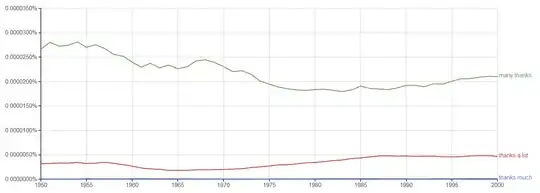
enter image description here

StoneyB on hiatus
  • 175,127
  • 14
  • 260
  • 461
  • 1
    I've never heard thanks much, though I am familiar with ta muchly. – TRiG Jul 01 '14 at 14:18
  • @TRiG: Ditto. Though I think if I did ever hear "Thanks much" I might be inclined to interpret it as a sarcastic observation along the lines of this ELU question (i.e. - "I hope you're satisfied now, even though you haven't had the decency to express your gratitude!"). – FumbleFingers Jul 01 '14 at 15:21
  • Some folks seem to find thanks much a bit alien, others find it natural. There's an interesting online discussion about this topic here. – J.R. Jul 01 '14 at 15:55
  • 1
    @J.R.: I think the number of people who might find "Thanks much" natural is so small as not to be worth bothering with for learners. – FumbleFingers Jul 01 '14 at 16:04
  • @Fumble - To be honest, what's suprised me most here is how foreign it seems, even to native speakers. I don't care if it's relatively uncommon in written books compared to some of its counterparts. It gets used quite a bit where I live, but usually in informal settings (like at the end of an email, for example, where "thank you very much" might sound a bit over-the-top, and "thanks much" works well), but those wouldn't show up on an Ngram. – J.R. Jul 01 '14 at 16:13
  • @J.R.: Does your area happen to be one where the "Jealous much?" form is particularly common? Or have a higher-than-usual percentage of non-native speakers? – FumbleFingers Jul 01 '14 at 16:44
  • 1
    @Fumble - I just scanned my work inbox for "thanks much" and found several instances. One was from a physicist who is about 70 years old. Another was from a woman half his age who holds a PhD in environmental engineering from a university in Utah. Another was from a program manager in Alabama who is in his 50s. Another was from an engineer originally from California. Another just got her masters degree in astronautical engineering. These are all native speakers, all bright people, who come from various locations in the U.S. As I said, it's used as a shortened form of "thank you very much." – J.R. Jul 01 '14 at 22:42
  • @J.R.: People put some weird things in emails that they wouldn't dream of using in speech or other contexts. And if they're anything like me they might just have copied the form from someone else's email once, and retained and replicated it again and again afterwards without giving it a second thought. Whatever - I certainly wouldn't use my emails (particularly received, but also sent) as any kind of guide to "normal" usage that I might expect to see or use in other contexts. – FumbleFingers Jul 01 '14 at 22:53
  • @Fumble, my point was twofold (1) your Ngram isn't going to find all usages, and (2) I disagree that the phrase is so unnatural that non-natives shouldn't bother with it (not on this side of the Atlantic at least). You asked me if it's non-natives who are using it, and I answered your question. – J.R. Jul 01 '14 at 22:57
  • @J.R.: As happens not uncommonly, we must simply agree to differ. I would not recommend learners to think it's okay in a spoken context to use a form which you mainly seem concerned to prove occurs in email sign-offs from some (atypical) native speakers. – FumbleFingers Jul 01 '14 at 23:01
  • 2
    Agreed with @FumbleFingers, when learning a language it's important to realise what's a regional colloquialism, to keep it in the back of your mind as a reference in case somebody says it to you, but if you want standard English, don't say it yourself. I can't recall anybody saying this in Australia. – Ming Jul 02 '14 at 00:06
  • @setek I think this is exactly the right approach: know what it means, but don't bother adding it to your own repertory of phaticisms. – StoneyB on hiatus Jul 02 '14 at 00:32
  • @Fumble - Yes, it's used a lot in emails. As for speech, I wouldn't necessarily coach a learner to use it as an alternative to the more familiar/cordial "Thank you," or "Thank you very much," or even, "Thanks! I appreciate it!" That said, I don't think the learner should regard "Thanks much" as an impolite slap in the face. As I mentioned earlier, it's been used at a White House dinner. I've seen it in a Dickens story. It's found in the acknowledgement section of many books. When someone asks about the phrase, I'm not going to tell them it's wrong when it isn't, or pretend it doesn't exist. – J.R. Jul 02 '14 at 01:34
3

I have never heard thanks much used anywhere.

Thanks muchly or, more often, ta muchly are used occasionally but they are both highly informal. Also, I would doubt if they are used outside British English.

Thanks a lot is far more widely used.

Chenmunka
  • 8,127
  • 15
  • 41
  • 49
  • ta muchly? Is that British? – djechlin Jul 01 '14 at 13:35
  • 2
    @djechlin: It's a facetious "mock dialectal" form which I suspect is more common in UK SouthEast than anywhere else, but I'm pretty sure was never actually a "standard" usage within any actual dialect. – FumbleFingers Jul 01 '14 at 15:25
3

In my experience (U.S. English; Indiana, Kentucky, Tennessee and Florida) "Thanks much" is a quick informal expression similar to "Thanks!" On the other hand, "Thanks a lot" would be taken as sarcasm unless context and the tone of voice made it very clear that it was sincere. Better to avoid "Thanks a lot" unless you intend to be sarcastic.

TecBrat
  • 699
  • 4
  • 11
  • OK - a late question: I just wonder, is this sarcasm limited to some geography or is it a general thing? As a non-native speaker, it sounds hard to infer sarcasm from it intuitively. – Halil Özgür Jan 24 '17 at 13:19
  • 1
    If you'll read the comments on mistermarko's answer, you'll see that while mistermarko thought the word "mostly" applied, others thought "often" or "sometimes" was the better word. In either case, the tone of voice and context should make it clear. A safer expression might be "Thank you so much!" I think it is far less likely to be mistaken for sarcasm. – TecBrat Jan 24 '17 at 14:16
0

“Thanks much” is wrong/never used/strange , however you can say “Thanks so much” or “Thanks a lot” or even “Yeah huh”

-8

'Thanks much' is not English whereas 'thanks a lot' is perfectly acceptable.

Dave
  • 11
  • 1
  • Not sure why this is downvoted. – Mark Pattison Jul 01 '14 at 13:13
  • 1
    @MarkPattison I didn't downvote; but Thanks much has been recorded at least since 1883. – StoneyB on hiatus Jul 01 '14 at 13:24
  • 1
    Fair enough, but it would certainly get you a funny look if you used it today (native, in southern England). – Mark Pattison Jul 01 '14 at 13:54
  • 8
    This answer deserves to be summarily downvoted. Saying that it would get you a strange look in southern England is fine; saying that it is "not English" is way off. Webster's New World American Idioms Handbook says that there are many "common and acceptable" ways to express thanks, including thanks a million, thanks a lot, many thanks, and thanks much. We need to be careful about saying something is "not English" when it may in fact be rather common in some parts of the world. He attended a White House dinner.. “Thanks much for what you are doing for your country,” the place card read. – J.R. Jul 01 '14 at 15:41
  • 2
    I think "thanks much" sounds ridiculous, but then again that's probably the difference between American and British English... – Matt Fletcher Jul 02 '14 at 09:39