26

I have a small question about the usage of Google as a verb. Is it always capitalized, even as a verb? For instance:

I Googled his name and I got hundreds of results.

Now, I am aware that this is a neologism and as such, it's probably not going to be in any dictionaries, but what is the most common usage for Google as a verb? It really looks strange to me to write or read "Googled", hence my question.

unpollito
  • 395
  • 1
  • 4
  • 8
  • 4
    Did you try looking it up in a dictionary? Here are some results: http://dictionary.reference.com/browse/google , http://www.merriam-webster.com/dictionary/google. And here is an article about it: http://googlesystem.blogspot.ch/2006/07/google-is-officially-english-word.html – fluffy Jun 30 '14 at 08:50
  • 1
    Oh, I thought it wouldn't be in any but it seems that English dictionaries are not as slow as Spanish ones! ;) Anyway, it seems to me that the capital G is preferred, yet Merriam-Webster lists "to google" rather than "to Google". Perhaps it's a bit of a divisive topic, isn't it? – unpollito Jun 30 '14 at 09:06
  • 3
    I try not to say 'G/google' or 'P/photoshop' as verbs. There are other search engines and photo editing programs. – Sydney Jun 30 '14 at 11:02
  • 1
    Google (the company) would prefer that you only use the verb form of 'google' to mean specifically using their search engine. They'd also prefer that you capitalize it. This is to prevent Trademark Erosion and Genericization. – Doc Jun 30 '14 at 14:05
  • 2
    @Doc: No, they don't even want you to do that. Their "Rules for proper usage" state: Use the trademark only as an adjective, never as a noun or verb, and never in the plural or possessive form. – Cornstalks Jun 30 '14 at 16:25
  • 4
    @Cornstalks: As an adjective? I see that they write that, but it doesn't seem to make much sense ... according to that rule, a sentence such as "This is an absolutely Google search engine." would be allowable, whereas the sentence "In addition, Google may provide you with written requirements (...)." (from that very page) would not. That seems ... peculiar. – O. R. Mapper Jun 30 '14 at 18:26
  • 4
    "and never in the plural or possessive form.", then, two bullet points later: "Use only Google-approved artwork when using Google's logos." *scratches head* – Doc Jun 30 '14 at 21:31
  • 3
    @O.R.Mapper Unfortunately, there's no requirement that IP lawyers actually understand language when writing about it publicly. –  Jul 01 '14 at 00:21
  • @O.R.Mapper Interestingly, the reason that your first sentence doesn't work isn't because of Google, but because of absolutely. "This is a Google search engine" works completely fine, doesn't it? There are arguments over whether nouns acting as adjectives should be called adjectives, but if we say that adjectives describe some kind of property of the noun, then they are. Just consider that there are two types of adjectives: gradable (tall, hot) and non-gradable (Google, Facebook). – jimsug Jul 01 '14 at 12:26
  • @jimsug: If Google is used as an adjective in the sentence "This is a Google search engine." then the question and answer pair "How is this search engine?" - "It is Google." would make sense, which seems to sound weird again. And even though you correctly state that some adjectives are non-gradable (in that they cannot be partially fulfilled), all adjectives can generally still be modified with adverbs that do not express the level to which they apply, but for example the certainty at which they apply - leading to the sentence "This is an undoubtedly Google search engine." – O. R. Mapper Jul 01 '14 at 13:04
  • @jimsug: Interestingly, this resource by the British Council lists absolutely as an example of adverbs that can be used with non-gradable adjectives. – O. R. Mapper Jul 01 '14 at 13:09
  • @O.R.Mapper If it's an adjective, then you should be able to answer What kind of search engine is this? How is this search engine? is suitable for probing adverbs and complements, such as This is a cold drink/This drink is cold, not This is a Google search engine/This search engine is Google (which works, but only because it sounds like you're introducing it). undoubtedly is another way of grading the adjective, so it doesn't contradict my assertion: this is an undoubtedly cold drink works, because cold is gradable... – jimsug Jul 01 '14 at 13:12
  • ... that resource is contradictory, and in that example, absolutely seems to be modifying the verb, not the adjective. You can't call an adjective non-gradable and then grade it, seems a bit silly. Classifier may be a useful term here, since using a noun in this fashion denotes a subclass, not a property. – jimsug Jul 01 '14 at 13:28
  • @jimsug: When the question What kind of search engine is that? is applied to statements like This is a search engine that belongs to Max. or This is a search engine by Sarah., the phrases that belongs to Max and by Sarah would qualify as adjectives just as well. As demonstrated by your example This drink is cold., the question How is this drink? is suited to retrieve the adjective cold from the sentence. – O. R. Mapper Jul 01 '14 at 20:43
  • @jimsug: Based on the definition from the beginning of the linked resource, grading of adjectives takes only place when the degree to which they apply is expressed. As you see, the examples there are consistent with that, as, in accordance with the definition, non-gradable adjectives are are modified only by non-grading adverbs such as absolutely or completely. – O. R. Mapper Jul 01 '14 at 20:43
  • @jimsug: That said, you seem to be following the alternative approach of what constitutes a part of speech that is occasionally used in English, namely that the part of speech of a word is determined by the word's function and usage in the sentence. Inflection and possible combinations with other parts of speech, on the other hand, are largerly independent of the part of speech in that interpretation. Then, it is conceivable that Google in Google search engine is called an adjective, just like search in the same phrase, or the bear in a bear trap. – O. R. Mapper Jul 01 '14 at 20:44

3 Answers3

30

No. Google as a verb should not be capitalized. Because if you put 'G' capital, you mean the word 'Google' as a company (proper noun). You cannot company something.

I found this on Wikipedia. It's useful.

The first recorded usage of google used as a participle, thus supposing an intransitive verb, was on July 8, 1998, by Google co-founder Larry Page himself, who wrote on a mailing list: "Have fun and keep googling!"

Its earliest known use (as a transitive verb) on American television was in the "Help" episode of Buffy the Vampire Slayer (October 15, 2002), when Willow asked Buffy, "Have you googled her yet?"

There's no first letter capital.

OALD has an entry of the verb google.

It's observed that when the tool of doing something becomes too popular (and omnipotent in its field!), its proper noun, over the period of time, becomes a verb and then the first capital letter is lowercased.

Another such proper nouns are --Photoshop, when used as a verb becomes photoshop (no capital) and Xerox, when used as a verb becomes xerox (no capital again).

On one blog (as fluffy says) it's written:

The verb "google" (no capital) has been used in the recent years with the meaning "search (something) on the web", even though you use other search engine than Google (capital).

[Generally, a verb is not capitalized. However, the only verb with first letter capital I have come across is Christianize. I had asked that question here on this board some time ago.]

Noun and verb usage:

Did you google this term? Vs. Did you search this term on Google?
You can photoshop this image to make it better Vs. You can make this image better using Photoshop.

Maulik V
  • 66,059
  • 109
  • 310
  • 456
  • 1
    Amazing answer! Thank you very much. I'm afraid I can't vote up just yet. – unpollito Jun 30 '14 at 11:58
  • @PíoPío1949 thanks. That's okay. Your words say it all :) Good question though (+1). Many wonder this (including my teammates). But now they are convinced! :) – Maulik V Jun 30 '14 at 11:58
  • 1
    FYI, that link you posted is not to Google's blog: "This blog is not affiliated with Google." – Ajedi32 Jun 30 '14 at 13:16
  • 8
    As a point, Google (the company) states explicitly that you should not say that you are googling something unless you use the Google search engine. This is due to trademark law - if 'Google' becomes ubiquitous to mean simply "search online" rather than specifically using Google, then Google would lose their rights to the word (it would become a Generic Trademark). Coca-Cola went through a similar battle with "Coke", as did Xerox and Kleenex. – Doc Jun 30 '14 at 14:01
  • 1
    Of course, all of coke, xerox, and kleenex are now generic for many speakers. Google, too, for some. –  Jun 30 '14 at 23:34
  • @Doc interestingly, in India nobody does photocopy. All do xerox and eight out of ten machines are not Xerox machines. They are of different manufacturers. Still it's xeroxing a document. – Maulik V Jul 01 '14 at 02:13
  • In the US, almost everyone "xeroxes" a document. I remember at IBM (who made copiers in competition with Xerox), they were very insistent that you "copy" or "photocopy" something -- using "xerox" too much could really hurt your career advancement. BTW, the generic process is called "xerography" (dry + writing), so it's not far off the mark to call it xeroxing. – Phil Perry Jul 01 '14 at 03:24
  • @PhilPerry In Canada we always say that we "photocopy" something. – ithisa Jul 01 '14 at 06:09
  • @MaulikV Thanks for dragging my name into this, but I think I didn't say anything in this question before. (You could remind me when I said it if I've said anything related to the quote, though.) – Damkerng T. Jul 01 '14 at 09:44
  • @DamkerngT. OMG. I have sighting of yours then lol. Sorry, it is fluffy. Extremely sorry. – Maulik V Jul 01 '14 at 09:52
  • @user54609, it would probably depend on how much market penetration and mindset share that Xerox achieved (at some point in the past). In the US it was very large for a while, so "xerox" = "photocopy" in most minds. In Canada, maybe Xerox never achieved dominance before competitors carved up the market among themselves. – Phil Perry Jul 01 '14 at 16:44
  • Hmm I see. Yeah I don't recall seeing Xerox brand photocopiers a lot in Canada...or Kleenex brand tissues a lot either. – ithisa Jul 02 '14 at 03:12
6

Ignore people telling you what Google the company would like. Even with all their money to pay the best lawyers in the world, they're not going to affect the eventual position. They're currently holding the line...

google

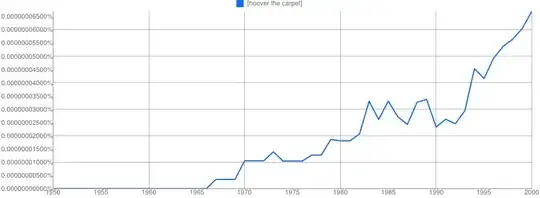
...but it's a racing cert they'll end up following in the footsteps of Heroin, Aspirin, and Hoover...

aspirin

heroin

hoover

(The Hoover company was slow off the mark staking their claim to ownership of the word, so Hoover the room doesn't even occur often enough to graph.)

Personally, I tend to capitalise when I'm referring to things like the Google results page, Google Books, Google NGrams, etc., but not when it's just a verb (in which context I don't really care if I'm googling using a different search engine). Even if Google goes bust next year I expect that in a decade or two capitalising to Google = to search on the Internet (perhaps using Google) will be seen as "quaint".

FumbleFingers
  • 70,966
  • 4
  • 97
  • 196
  • I'm pretty sure that "Aspirin" was seized as enemy property (from Bayer) during WWI, and put in the public domain. "Heroin" may have suffered the same fate (it was originally a pharmaceutical), but may have already been illegal by WWI. Do these ngrams exclude words capitalized because they are the first word in a sentence? Finally, to "hoover" a carpet is very rare in the US. – Phil Perry Jul 01 '14 at 03:21
  • 1
    Well, interestingly, there are possibilities that the sentences begin with the word Googling. (Googling is the simplest way to find information on anything) and thus are capitalized. Also, in such cases, they serve as a noun and not a verb. The OP is quite specific about to do (verb) where capitalization is generally not observed. – Maulik V Jul 01 '14 at 04:22
  • @Phil, Maulik: Okay, I've changed the first NGram to only chart verb usages. It's still the same story - currently most people do capitalise, but I'm sure that won't last. – FumbleFingers Jul 01 '14 at 08:32
  • I don't see any clear trend in either direction (yet). About the same fraction of users capitalize over a long period of time. – Phil Perry Jul 01 '14 at 16:51
  • 2
    @Phil: Absolutely! Which is why I think the top-rated answer here is potentially misleading (where's the sense in telling people that non-capitalising is "correct" when the majority are still doing that?). But we're talking about a very new usage here (unknown to most Anglophones even a decade ago). The point of my answer is I'm absolutely certain usage patterns will shift significantly over the next decade or two, and I've supplied other examples showing that's the general tendency (regardless of what Google, Inc.'s lawyers try to do about it). – FumbleFingers Jul 01 '14 at 16:57
6

I searched the The Corpus of Contemporary American English (COCA) (1990-2012) for both google and googling, then used a script to count how many occurrences of each were capitalized.

Here's what I found:

  Googled   134       googled   17
  Googling  83        googling  19

So most occurrences (86%) in this corpus are still capitalized. This, I think, reflects more conservative style. You may wish to do the same—I certainly don't think it's incorrect to capitalize the verb.

However, when I repeat the experiment with The Corpus of Global Web-Based English (GloWbE) using a random sample of 1000 results for each term, I find:

  Googled   284       googled   726
  Googling  385       googling  626

This is quite a different result! Here, we find only 33% capitalization, as opposed to 86% in COCA. My feeling is that this reflects less conservative usage. Note that this corpus contains on average more recent usage, and that it doesn't have nearly as much copy-edited or formal content.

I believe it is now commonplace to write the verb google in lower case. If you like, you may follow more conservative usage and capitalize it, but there is no particular need to do so. My personal preference is for lower case.

  • True, leaving the term aside, it's obvious that we shouldn't capitalize it for two reasons. To avoid ambiguity and verbs are not capitalized - back to my concern of the word Christianize. – Maulik V Jul 01 '14 at 02:18
  • 1
    @MaulikV You are free to advocate your own prescriptive view in your own answer. I prefer lower case, myself. But since there are so many capitalized examples in the wild, it would be silly to say capitalizing it is actually incorrect. –  Jul 01 '14 at 02:21