35

For me it is often hard to distinguish between these two words while speaking. The t in the bitch is almost neglectable in speech.

What is the correct pronunciation of these two words?

Void
  • 18,058
  • 7
  • 75
  • 107
  • 1
    Google Translate might help a little bit. You can listen to the words (press the speaker button): http://translate.google.com/#en/en/bitches%20beaches – fuxia Jan 24 '13 at 15:01
  • You also might be interested in the answer to Exercises for pronouncing 'I'

    http://ell.stackexchange.com/questions/553/exercises-for-pronouncing-i

    – stacky-bit Feb 05 '13 at 16:47
  • @m0nhawk, usually the difficulty people have with these words is the vowel sound. But you are correct, there is no difference in the consonant sound here. The TCH in bitch sounds exactly the same as the CH in beach. – aparente001 Apr 18 '15 at 19:45

3 Answers3

20

English spelling is crazy, these two words are pronounced identically except for the first vowel. Don't worry about the 't' at all, it's not really a separate sound.

In Standard American English (the British and other varieties of English might have slightly different vowels):

  • 'beaches' = beeeeeeee - chez, The 'eeeee..' sound, when exaggerated, is like when you clench your teeth and smile, very tense and long. In IPA, it is /bij tʃiz/

  • 'bitches' = bih - chez. the 'ih' sound is very relaxed and short. In IPA, it is /bi tʃiz/

I hope that clears up the pronunciation of the vowels.

As to the 'tch' vs 'ch', they are written differently but pronounced the same; the 't' is not really pronounced separately from the 'sh'. An example is better:

'ditches' vs 'dishes': these two are pronounced identically except for the consonant in the middle. The middle consonant in the first word is pronounced ike the first and last consonant in 'church'. There's no separate 't' sound, you sound out a 't' and a 'sh' at the same time. The technical terms for these are 'fricative'' (for 'sh') and 'affricate'' for a combined 'stop' and fricative sounded out at the same time. (please pardon the technical vocabulary but these are very precise concepts that have a precise vocabulary to go along with them.

Mitch
  • 1,961
  • 18
  • 27
  • 2
    They're not pronounced identically at all, there is a very specific difference between them. You're referring to the slang colloquial way of pronouncing bitches, which is incorrect. – spiceyokooko Jan 24 '13 at 14:18
  • @spiceyokooko: can you elaborate? what is the 'correct' pronunciation of bitches, because that is what the OP would like. Technically, there is no difference in the 'middle' consonant of the two words. Which slang/colloquial version are you talking about? I don't know of one. I'm talking about the standard versions of both. – Mitch Jan 24 '13 at 14:26
  • I've elaborated in my own answer and you should make it clear whether you're referring to AmE, BrE, slang colloquial and so on. – spiceyokooko Jan 24 '13 at 14:28
  • 2
    So you pronounce itch in the same way as each? – spiceyokooko Jan 24 '13 at 14:29
  • @spiceyokooko That's not what Mitch is saying. He's saying that the consonants are the same even though one word is spelled with a t. He clearly says that the vowels are different. – Mr. Shiny and New 安宇 Jan 24 '13 at 14:30
  • @spiceyokooko: ?? I showed two very different pronunciations for beach and bitch. Likewise I do not pronounce each and itch the same. – Mitch Jan 24 '13 at 14:31
  • You're not differentiating between BrE and AmE, that was my point. You're an American, you don't know how those words are pronounced in British English. – spiceyokooko Jan 24 '13 at 14:43
  • @spiceyokooko: I've edited my answer to say that I am talking about Standard American English. So are you now saying the Standard British English pronounces the 'ea' and 'i' the same in those two words? Or are you just saying that British English has different vowels there than American (and if so what are they)? – Mitch Jan 24 '13 at 14:58
  • In Australian English these two words are completely different, we put a lot more emphasis on the "t" in "bitches".. The words are said more like: "bit-chez" and "bee-chez". – Deco Jan 25 '13 at 01:09
  • 8
    Your IPA has a few problems... fairly certain you don't mean a rounded front high vowel for instance! Surely something like /bi:tʃəz/ vs /bɪtʃəz/. – Aant Feb 05 '13 at 01:01
  • You shouldn't use e in the -chez part. People will naturally pronounce it like in "Fez". This "e" is a reduced vowel, pronounced as a "schwa" like the "a" in "ago". Many people are familiar with the schwa symbol used not only in IPA: ə. When using "English phonetic spelling" it's common to use uh for this sound. Posh British accents like RP will instead use the same sound for the "i" and "e" in "bitches" resulting in a sounds like "bichiz". – hippietrail Feb 11 '13 at 03:22
  • @spiceyokooko: I'm an American, and I do know how those words are pronounced in British English. Pretty much the same as they are in American, actually, at least where I lived. – BobRodes Jul 24 '13 at 03:48
  • 1
    @spicyyokooko: Are you trying to say that an Australian pronounces "bitch" in a way that doesn't rhyme with "which"? – sumelic Apr 18 '15 at 20:54
  • I also pronounce "-tch" with a minimal, but definite, t. I'll guess that most of those who pronounce the t also have distinctive pronunciations for "Mary", "marry", and "merry". – MMacD Jan 02 '17 at 18:36
5

The "itch" vowel is IPA /ɪ/, which is slightly more open and back than the "each" vowel, /i:/.

See this chart of all the IPA vowel signs courtesy of Wikipedia:
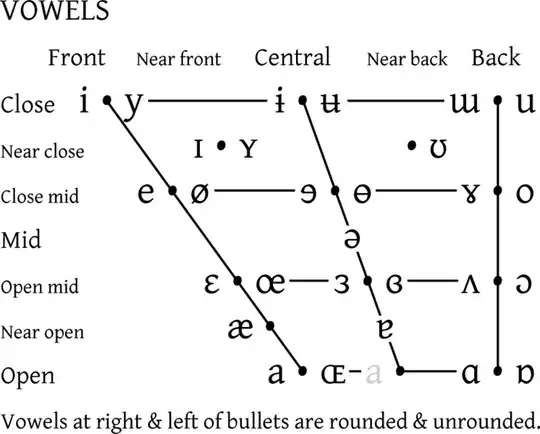
vowel chart

This may help if you can locate the vowels of your native language and figure out the "feel" of the three directions (close/open, front/back, and rounding) shown on the chart.

The "t" is a red herring - even if there are some dialects that pronounce the consonants differently or break the syllables differently, the most reliable distinction (at least in American English) is the vowel, which you'll have to learn for other word pairs as well (bit vs beet, for example. If you're already able to distinguish bit/beet, just add a "ch" at the end.)

hippietrail
  • 594
  • 5
  • 12
Random832
  • 241
  • 1
  • 4
  • I think most English learners will not be familiar with the linguistic terms "open" and "back". Not that I can think of a simple alternative ... – hippietrail Feb 11 '13 at 03:23
  • Well, yes, but ideally you can figure it out from the chart and your native vowels (provided you can find out which symbols correspond to your native vowels), which is why I included that. – Random832 Feb 11 '13 at 18:39
0

Bitch ~ pitch
bitches ~ pitches

beach ~ peach
beaches ~ peaches

I believe there is an American (possibly Latino, but I'm guessing) beeet-ches pronunciation, similar to how stinking becomes steeenking - as in "we don' need no steeenking baadges" - but I digress.

In general usage, bitches and beaches sound as different as pitches and peaches.

disclaimer: I speak Australian

mcalex
  • 6,136
  • 1
  • 22
  • 35
  • 9
    As a non-native speaker I find this rather unhelpful, because for me pitch and peach, too, sound exactly the same. As do each and itch. – ЯegDwight Jan 24 '13 at 16:46
  • Interesting. How much difference do you notice between eagle and igloo? Is the each/itch difference noticeable when the vowel sounds are being stressed? – mcalex Jan 24 '13 at 17:10
  • The vowels are stressed for me in both each and itch. These are one-syllable words, after all. My native language does not differentiate between vowel lengths, so not only can't I pronounce the words differently, I don't really hear a difference when a native speaker pronounces them. Same for consonants. Coke and cock are the exact same word to me. And saying that one is like joke and the other like jock does absolutely nothing for me, because it merely replaces the only sound I don't have any problems with. Same for igloo, which is just an eagle with an /u/ slapped on. – ЯegDwight Jan 24 '13 at 19:01
  • @ЯegDwigh -- in your speech, does "which" rhyme with "pitch"? How about the pronunciation of "this"? (In US English, the "i" in "bitch"/"pitch" has the same pronunciation as the "i" in "this". If you hear the same vowel sound in "this" and "peach", it's going to be hard to make sense of an answer without an audio assist.) – barbara beeton Jan 24 '13 at 19:07
  • 1
    @mcalex: it's very common for people from the West Coast (not just Latinos) to turn the short 'i' into the long 'ee' before the sounds 'nk' and 'ng'. But they don't do it before other consonants. So people from Southern California do say steenkeeng badges, keeng and peenk, but they don't say peach instead of pitch. Americans will sometimes say beach instead of bitch, but this is essentially a pun, and we know we're mispronouncing it. – Peter Shor Feb 05 '13 at 16:41
  • @ЯegDwight Well, ultimately, you'll need to learn the difference between those vowels, or you'll pronounce the words the same. Others have claimed there is a subtle difference between the consonants in some dialects, but that's not true in all dialects, almost certainly isn't true for all words, and in any case isn't a way to be reliably understood when the word's not clear from context. The short (as in "itch") vowel sound is slightly more open and slightly more back than the long one (as in "each"), and there's no better way to describe it. – Random832 Feb 06 '13 at 19:26
  • The problem is that English has more vowels than many other languages of which some have as few as five vowels. You just need to practice, both in hearing the difference (listen to the same person - preferably a native speaker with a standard dialect - saying both of two words that only differ in the one vowel) and saying it (here, at least, mouth shape/placement information can help if you can understand it). – Random832 Feb 06 '13 at 19:30
  • That is a Latino pronunciation; there isn't an equivalent to short i in Spanish or French. One will find that the French tend to turn our short i into long e as well. – BobRodes Jul 24 '13 at 03:51
  • Reg, what is your first language? By your name, you're English. – MMacD Jan 02 '17 at 18:38