49

What is the difference between:

  1. "How it works?"

and

  1. "How does it work?"
DialFrost
  • 8,001
  • 5
  • 14
  • 47
zgjie
  • 613
  • 2
  • 8
  • 9
  • 2
    How it works is a phrasal noun. How does it work? is an interrogative sentence (question). The former is commonly used as a heading and there is no question mark at the end. – Kris Feb 20 '14 at 10:20

4 Answers4

45

Short answer

Your first example, how it works, is a free relative clause which cannot be used as a question. Your second, How does it work?, is an ordinary question.

Longer answer

What I'm going to call an "interrogative phrase" (IP) is a sort of 'variable' which stands for an unknown 'value'. The IP is headed by a word which defines the 'type' of value for which it stands: who, what, which define the type as nominal, how, where, why define the type as adverbial, and the construction what ... do defines the type as a verbal. The IP may also be followed by additional terms which further restrict the type—how many or what sort of machine.

Two sorts of clause employ IPs: questions and free relative clauses. In both types of clause the IP represents a constituent of an ordinary declarative clause, 'moved' to the beginning of the clause from the place where the constituent would normally stand:
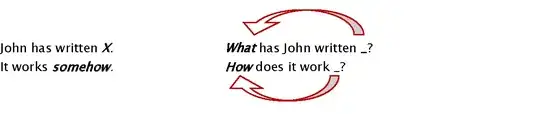
IP Movement

But the two sorts of clause play very different roles, and have different syntactic structures:

  1. A question asks the hearer to supply the value for the variable named by the IP and defined by the remainder of the clause. A question is an independent clause—it can stand on its own.

    The first syntactic rule is that first constituent1 after the IP must be a tensed verb. If the IP stands for the subject of the clause, nothing has to move, because the IP and the verb are already in these positions:

    Q-SubjIP

But if the IP stands for some other constituent, the tensed verb must fall before the Subject, and a second rule comes into play: the tensed verb must be an Auxiliary. (Grammarians call this subject-auxiliary inversion.) If the 'canonical' statement version of the clause does not have an Auxiliary verb, the appropriate form of DO is pressed into service. (Grammarians call this DO-support)

Q-AuxInv

Thus the proper form for a question using how is this, with both subject-auxiliary inversion and DO-support:

Q-How

1Note that an adjunct—a non-essential syntactic component—is allowed to fall between the IP and the tensed verb: Who recently wrote an app?

  1. A free relative clause does not ask for the value of the IP but designates it—hearers may fill it in from their knowledge, but the actual value is not required.

    A free relative clause does not call for either inversion or DO-support, regardless of which constituent the IP stands for. After the IP at the beginning, the ‘natural’ order of a declarative sentence is maintained, Subject-Verb-Objects/Complements; the only thing that signals that this is not an ordinary declarative sentence is that something is missing where a constituent was 'replaced' by the IP and 'moved' to the front.

    A free relative clause is always a dependent clause—it is embedded inside a 'head' clause and acts as a noun phrase. In these three examples, the head clause is in ordinary black type; the free relative acts as Direct Object, as Subject, and as the Object of the preposition about.
      (Since DO-support is not in play here the tensed verbs are not distinguished.)FR-Syn How it works, then, with the subject before the verb, is a free relative clause. Here are some examples of how it might be used:

    FR-How

StoneyB on hiatus
  • 175,127
  • 14
  • 260
  • 461
  • @F.E. I found other matters I had handwaved, too. I think I've fixed it now; I'd value your review. – StoneyB on hiatus Oct 13 '14 at 19:11
  • I think it might be helpful for readers if you changed the main verbs in your examples so that they weren't DO! :) – Araucaria - Not here any more. Oct 15 '14 at 08:06
  • In the grammar that you are using, is there a difference between a "free relative clause" and a "subordinate open interrogative clause"? -- (It seems that your "free relative clause" might correspond to the 2002 CGEL's "fused relative", or so I'm sorta assuming.) – F.E. Oct 15 '14 at 18:38
  • @F.E. It's more or less what CGEL calls a fused relative. I'm sorta dubious about the distinction a lot of people draw between fused/free relatives and "embedded questions" or things of that sort. They're all built the same way and act as NPs. – StoneyB on hiatus Oct 15 '14 at 19:27
  • @Araucaria Yah, I should do that - and will eventually. – StoneyB on hiatus Oct 15 '14 at 19:28
  • 2
    I'm a bit confused on what the difference is between your interrogative words and relative words. That is, when there is a difference between them and when they are the same words. It seems that in a prototypical interrogative main clause, e.g. "What did Sue eat?", that the word "what" is an interrogative word but not a relative word. But for embedded questions and relative clauses/phrases, e.g. "Tom knows what Sue ate", then, the "what" word is a relative word, is that right? -- So does that mean that, in your grammar, there are no interrogative words in subordinate clauses/phrases? – F.E. Oct 15 '14 at 20:00
  • 2
    In the example "Tom knows what Sue ate", let's assume that Sue had eaten a ham sandwich, and so, that means that Tom knows the answer to the question 'What did Sue eat?' which is that Tom knows that Sue had eaten a 'ham sandwich' -- But it does not mean that Tom personally knew that 'ham sandwich', not unless that ham had been Tom's pet pig earlier before it was slaughtered and cured and made into a delightful sandwich (which an attempted fused-relative interpretation of that example might be: "Tom knows that which Sue ate"). – F.E. Oct 15 '14 at 20:27
  • @F.E. "Interrogative" is just a name (so are they all, all honourable names); any declarative statement may be recategorized as the answer to the corresponding question. What what is is what, with a variety of uses, including heading what are named fused relative clauses. Likewise, know in "Tom knew Sue" may mean that he was personally acquainted with her or that he recognized her from newspaper photographs or that he had sexual congress with her or that he was confident of what behavior she would exhibit or that he was acquainted with Eugene Sue's works. – StoneyB on hiatus Oct 15 '14 at 21:48
  • Minor: there are some typos, such as two rights and the red predicate. Major: fused relatives ("free relative clauses") function differently in a matrix clause than do subordinate interrogatives. In a fused relative, the antecedent and the relativized element are fused together; the subordinate interrogative clause has no antecedent. – F.E. Oct 16 '14 at 21:59
  • 1
    Here's an example that helps show that a fused-relative is a different beast from that of a subordinate interrogative clause. From a 2005 textbook by Huddleston and Pullum, A Student's Introduction to English Grammar, page 192: "[22.iii] What she wrote is unclear. [ambiguous: relative or interrogative]" . . . "Unclear, however, licenses both an interrogative and an NP subject, and [iii] can be interpreted in either way. The fused relative interpretation is 'That which she wrote is unclear' -- a letter or report, perhaps. (cont.) – F.E. Oct 17 '14 at 05:18
  • (cont.) In the interrogative interpretation, what is unclear is the answer to the question 'What did she write?'. On this interpretation the implication is that I'm not sure what it was that she wrote." – F.E. Oct 17 '14 at 05:18
  • @F.E. Thanks - I lost track of my color-coding. I'll fix it. As for the other, it seems to me that H&P are making my point. The construction is a box. What you do with what's in the box varies: you may not know what's in the box or you may be unable to read what's in the box; but it's the same box. I don't see the point in saying that what kind of box it is changes depending on what you do with the content. (But I do feel that we might oughta give the box a better name.) – StoneyB on hiatus Oct 17 '14 at 12:53
  • 1
    Many expressions when taken in isolation could have a shape that could be of different categories. Consider the expression "the bagels you can have", which could be a NP in "Those are the bagels you can have", or it could be a clause with its object preposed as in A: "Are those cupcakes for sale?" B: "No, they're a special order. But the bagels you can have." (last example borrowed from CGEL, pg 1369). It's the matrix clause or the context that is needed to know how to interpret an expression. Often a similar situation arises with subordinate interrogative clauses and fused-relatives. – F.E. Oct 17 '14 at 20:13
  • 1
    @F.E. Certainly. And what's in the box may represent either an independent interrogative clause or a dependent free relative. But there are both syntactic and phonological reasons for distinguishing those two categories; I see none for distinguishing free relatives from 'embedded questions'. Do you categorize the school as two different sorts of NP in the two interpretations of "I ran for the school"? – StoneyB on hiatus Oct 18 '14 at 00:42
  • 1
    Ah, sometimes intonation can help identify whether an expression is being used as a fused-relative or as a subordinate interrogative clause. :) -- There's the textbook example in CGEL, page 268, [52]. (Note that the fused-relative defines a variable, while a subordinate interrogative clause specifies a value.) Footnote '37' on pages 268-9 also has good info -- especially the stuff that got split onto the second page. (aside: it seems that the really good info in CGEL is often found in the 'blue sections' and in the footnotes.) – F.E. Oct 18 '14 at 00:59
  • 1
    @F.E. Finally figured out what you meant. 'doh! ... I want to continue this, but I'm too punch drunk now. If I may, I will invite you to Chat tomorrow. – StoneyB on hiatus Oct 18 '14 at 02:44
  • I don't do chat :) But, usually I might write a few comments now and then, as I have time and inclination. . . . – F.E. Oct 18 '14 at 03:04
  • @f.e. Stoney, This problem has always bugged me too, from the Stoney B point of view. Although I tend towards H&P for various reasons, I've never been sure about the status of subordinate interrogative/exclamative/declarative content clauses. For example, it you take the sentence I never knew how big the problem was. According to CaGEL, this is ambiguous between an exclamative clause and an interrogative clause, right? This seems reasonable, you can see the ambiguity there- 'it was a big 'n I didn't realise' versus 'I didn't have any size information'... – Araucaria - Not here any more. Oct 21 '14 at 10:35
  • @f.e. Stoney, But then hold on a minute, how about this: I didn't know the extent of the problem. This seems to have exactly the same ambiguity, but it would be difficult to argue that it has a different structure for each reading. In fact it seems to be a slightly different meaning of know which drives the exclamative or interrogative/declarative flavour of this sentence. The grammar seems to be the same. Now if we go back to .... how big it was - it seems that we may need explicate the difference in the grammar to justify a grammatical difference here - but, I can't see any ... – Araucaria - Not here any more. Oct 21 '14 at 10:43
  • @f.e. Stoney, Does that make sense? – Araucaria - Not here any more. Oct 21 '14 at 10:43
  • 1
    @Araucaria That's exactly my feeling: it's the same clause, but the head clause 'selects' different aspects as focus. (I concede, however, that some internal choices limit the possible selections - the wh--ever words, for instance.) – StoneyB on hiatus Oct 21 '14 at 11:03
  • @StoneyB Yes, that's kind of why I tentatively hedge with the H&P analysis ... – Araucaria - Not here any more. Oct 21 '14 at 11:19
  • @Araucaria John Lawler over at ELU links an interesting paper; I haven't sorted out yet just where it belongs in the discussion. – StoneyB on hiatus Oct 21 '14 at 11:26
  • @StoneyB Thanks, I'll read that as soon as I finish my existential post(s) -hopefully today! PS, I'd like to ask, can you help with this question which I'm trying to petition the gentle reader folk here to reopen? http://meta.ell.stackexchange.com/questions/1238/can-we-reopen-this-question-subtitle-he-asked-can-we-reopen-the-question – Araucaria - Not here any more. Oct 21 '14 at 11:33
  • @Araucaria As you wish - the Meta post is convincing. By the way: my man Shaw usually marked that sort of question with an extra capital: The question before us is What is to be done? – StoneyB on hiatus Oct 21 '14 at 11:40
  • @StoneyB is that as in Bernie? – Araucaria - Not here any more. Oct 21 '14 at 11:40
  • 1
    @Araucaria Ayup. Taught me most of what I know about writing. – StoneyB on hiatus Oct 21 '14 at 11:41
  • Whats's the difference between 'how is it' and 'how does it'? – Anubhav Jun 14 '16 at 11:21
  • @AnubhavSingh How is what? – StoneyB on hiatus Jun 14 '16 at 12:33
12

'How it works' used in an interrogative phrase is something you may not find very commonly spoken amongst native speakers.
Such a sentence construction can be correctly used as an assertive statement (for instance, newspaper headings). Another example is:

Rob knows how it works.

But then again, it may be a part of an interrogative sentence, as in:

Will you tell me how it works?

Here, 'how it works' is correct because it isn't a direct part of the question being asked. The question asked is, "Will you tell me _?" 'How it works' is just that part of the sentence which goes into the blank, as an assertive phrase.

'How does it work' is what you'd say while asking somebody about the way it works. This construction is used in interrogative sentences.

mikhailcazi
  • 284
  • 1
  • 4
4

I'll correct Maulik's second answer:

So now you know how it works, don't you?
How does it work? Do you know?

You see that he sets the expressions in context, which is always very important.

If you're using a sentence fragment rather than a sentence proper in your first example (say as a section heading), you'd drop the question mark (and probably the period):

How it works

Edwin Ashworth
  • 1,785
  • 12
  • 17
2
  1. How it works.

This usage refers to the way or method of action of the object (it). Example: "He was interested in how it works" = he was interested in the way in which it works.

  1. How does it work?

This usage specifies a question.

ColleenV
  • 11,971
  • 13
  • 47
  • 85
Alexandros
  • 21
  • 2
