27

According to the Cambridge dictionary, the answer for “What time is it?” depends on the minutes.

When the times outside five-minute intervals, we say minutes past or minutes to:

9.01 one minute past nine

9.03 three minutes past nine

9.36 twenty-four minutes to ten

9.58 two minutes to ten

Otherwise, we can say directly what we see on the watch / clock, it says to read it simply. For example:

9.05 five past nine or nine oh five

9.10 ten past nine or nine ten

9.15 quarter past nine or nine fifteen

9.20 twenty past nine or nine twenty

9.25 twenty-five past nine or nine twenty-five

Can we say times out loud by the actual numbers that are on the watch / clock and maybe these Cambridge rules are only in the UK? According to what I remember, many times when I asked people about the time, they didn't follow those rules. They would say: 10:13 = Ten thirteen. 8:21 = eight twenty one etc. If that is correct, then what about 10:11, 10:10, 9:11 — if I simply read them as they are (Ten eleven), it works?

Virtuous Legend
  • 27,128
  • 196
  • 415
  • 597
  • 5
    Firstly, please note that the Cambridge Dictionary entry you're citing specifically says "british-grammar". I don't know if it's correct for Britain, but in the US it is definitely not correct, as choster says. – stangdon Mar 27 '18 at 19:39
  • 17
    I actually read this question as Can the time ten eleven be spoken as “Ten eleven”? in my mind. – John Hamilton Mar 28 '18 at 05:22
  • 1
    It's very interesting to know that these are historical things as you call them, when they are actually taken from the book "English Grammar Today - An A–Z of Spoken and Written Grammar" that published in 2016. Cambridge dictionary states that these things are from this book. http://www.cambridge.org/us/cambridgeenglish/catalog/grammar-vocabulary-and-pronunciation/english-grammar-today/ – Virtuous Legend Mar 28 '18 at 05:50
  • 1
    This is a great example of why dictionaries aren't the be-all and end-all source of truth when it comes to language and usage. Especially prescriptivist-leaning dictionaries like the Cambridge. – user428517 Mar 30 '18 at 19:32

10 Answers10

79

Admittedly, I'm answering a BrE question as an American, but your source is suspect.

9.36 twenty-four minutes to ten

This is grammatical, but nobody in their right mind would actually say it. Who's got the time to calculate 60 minus 36 to come up with this version? You'd just say "Nine thirty-six". (If the time is close to a round value, it's perfectly normal to say it's "twenty to one" or "a quarter to three")

In the days of analog clocks, people would normally give the time to the nearest 5 minutes.

Now when the most likely way to find the time is to look at your phone, you'll mostly just read off exactly what it says, whether it's "ten fifteen" or "seven twenty-seven". When the minutes are less than 10, you'll add an "oh", as in "six oh five".

The Photon
  • 10,390
  • 1
  • 22
  • 19
  • The round up method is perfectly normal for smaller or rounder values. The example used would also be fine if the 10th hour or the countdown is important, but yeah, not as often. – jaxad0127 Mar 27 '18 at 23:49
  • 23
    As a native BrE speaker, I completely agree with this point. – AndyT Mar 28 '18 at 08:50
  • 9
    This usage was around for decades before "the most likely way to find the time is to look at your phone". It's been common ever since digital watches became common, and even before that, it would be the natural way to read a time in a transport timetable where times are given to the minute. – Rosie F Mar 28 '18 at 10:12
  • 1
    I have to disagree with this, as a native European English speaker, I would say "24 to 10" but would usually round , so just "25 to 10" – Cloud Mar 28 '18 at 12:32
  • 3
    The to phrasing, to me, seems only appropriate for five to, ten to, a quarter to, and twenty to. Any other values just seem wrong and weird—to include @Cloud’s twenty-five to, I have to say. Only single-word, “milestone” values need apply, I suppose. Even when one of those values is correct, I’d still only use it if I wanted to emphasize the next hour for some reason, over the current one. I’m far more likely to say eight fifty-five than I am to say five to nine in most cases. – KRyan Mar 28 '18 at 12:56
  • 4
    @KRyan Where are you from? Five to nine would be a very common way to speak the time where I live... – Cloud Mar 28 '18 at 14:04
  • @Cloud US, mostly northeast. And it is pretty common, but I’m saying eight fifty-five is more common. – KRyan Mar 28 '18 at 14:18
  • 1
    Also from the US here--PNW--and I can attest. "Five to nine" might even get laughed at. It might sound pretentious or maybe like slang from a bygone generation. "Quarter to" is the only such phrasing that wouldn't cause me to blink. – user25366 Mar 28 '18 at 14:32
  • 14
    As a BrE speaker, I disagree with this answer, because I would absolutely say "it's twenty-four minutes to nine", if that was the time and if the asker was looking for that level of accuracy. Mostly, however, when answering a verbal "what time is it?" question, I would tend to round my answer to the nearest five minute interval, so in this instance I would actually probably say "It's twenty-five to nine". – Simba Mar 28 '18 at 15:41
  • 8
    The premise of the answer is incorrect because if I look at an analogue watch face, I can see that it's one minute off the 25-to mark, so it doesn't need mental calculation to know that it's 24 minutes to the hour. The answer seems to imply that analogue clocks and watches aren't used any more; they most certainly are. – Simba Mar 28 '18 at 15:41
  • 4
    @Simba, when reading an analog clock, everyone I know rounds to the nearest 5 minutes. – The Photon Mar 28 '18 at 15:59
  • 1
    @ThePhoton - yes, that's exactly what I said; most of the time I would do exactly that. But if I knew that a more precise answer was wanted, I would phrase it as "twenty-four minutes to nine", and I wouldn't need to stop and think about it before I said it. – Simba Mar 28 '18 at 16:04
  • 3
    @Simba, That's fair enough. But the original source is still a bit suspect in saying (or OP is misinterpreting) that we always say "24 minutes to 9" rather than "eight thirty-six". – The Photon Mar 28 '18 at 16:09
  • 3
    There is a Chicago song titled "25 or 6 to 4", which means "somewhere between 3:35 and 3:54", but I had trouble figuring that out. – Acccumulation Mar 28 '18 at 17:51
  • 13
    @cloud and Simba if you told me the time was "24 to 10" I'd be annoyed with you for giving me a math problem instead of the time. – Rob K Mar 28 '18 at 20:15
  • 5
    @Acccumulation INterestingly, Wikipedia cites a different time range: "The song's title is the time at which the song is set: 25 or 26 minutes before 4 AM," which I suppose would make sense if it were "twenty-five or [twenty-]six to four." I sure as heck didn't understand the title until just now =) – Cort Ammon Mar 29 '18 at 00:07
  • 1
    @RobK Not if you had to be somewhere at 10. You'd be glad to know you have 24 minutes left. It all depends on the situation really. I personally do both but this all goes automatically and I rarely even stop to think. – Yates Mar 30 '18 at 14:35
  • It's worth mentioning that most of Europe describes the time mathematically, "five to nine," "24 to nine." In the US, what The Photon says generally holds true. But there are often gradations of the two in regions with heavy influences from multiple cultures. – K_foxer9 Mar 30 '18 at 17:00
  • @K_foxer9 I don’t think you’re right about that. Certainly not for the northern parts of Europe. If this level of accuracy is required, most people nowadays would say “nine thirty-six” in their respective north-European languages. The more mathematically challenging phrasings are only used for rounded-off times. At 9:35, for instance, Scandiwegians in general would happily tell you it’s five minutes past half an hour before ten without blinking; but they wouldn’t be likely to tell you it’s twenty-four to ten one minute later. – Janus Bahs Jacquet Mar 31 '18 at 01:24
19

In spoken English, you can always state the time as the hour and minutes (aside from the top of the hour), and you would only state minutes if you need to be explicit or if you are deliberately drawing attention to the time for rhetorical effect.

Ten eleven, eleven past ten, or eleven after ten (at least in American English) would all be far more common than eleven minutes past ten, if nothing else, because they are shorter. In casual speech, eleven past the hour or even simply eleven after might be adequate.

I have never encountered any difference conversationally whether the number of minutes is a multiple of five or not in North America, but perhaps that is a transatlantic difference.

choster
  • 17,736
  • 3
  • 50
  • 86
  • 1
    If you said the time with the minutes not divisible by 5, once upon a time people would have thought, "there's a guy who still thinks a digital watch is a pretty neat idea". Possibly the Cambridge Dictionary hasn't caught on that nowadays everybody reads the time off their phone. – The Photon Mar 27 '18 at 19:58
  • 2
    @ThePhoton Ironically, I use a "fuzzy time" widget that displays the time as quarter past four and so on. After all, why get a smartphone only to have it display the time the same way my Casio wristwatch did in 1983? – choster Mar 27 '18 at 20:10
  • 7
    @choster The KDE desktop clock widget had a configurable level of fuzziness. At the far end, it just said "weekend"! – chrylis -cautiouslyoptimistic- Mar 28 '18 at 05:19
  • 10
    I don't think that "eleven after ten" is more common that "eleven minutes past ten" in British English. "x after y" sounds very American to my ear. – Guy G Mar 28 '18 at 08:59
  • 1
    @ThePhoton Did you mean to imply that no phones display times "with the minutes not divisible by 5"? – Rosie F Mar 28 '18 at 10:17
  • @choster What a weird thing! Readers wouldn't realise you were using such a thing, unless you'd said you were. Is fuzzy smarter than accurate to the minute? Matter of opinion. How can I get Windows to show the system time as "time you started cooking dinner", "bedtime" etc? – Rosie F Mar 28 '18 at 10:22
  • @RosieF How did you read The Photon's comment and come up with that idea? – bye Mar 28 '18 at 16:05
  • @DrEval I might've misunderstood The Photon's comment, but it suggested to me that "people would have thought" someone stating a time that's not a multiple of 5 minutes must have read it from a digital watch. Why couldn't a mobile have displayed it? It's unclear when "once upon a time" was, and their "still" suggests that digital watches are no longer a neat idea, but they're not dead yet! If, as it seems, I've misunderstood, then I don't see how The Photon's second sentence follows from the first. – Rosie F Mar 28 '18 at 17:06
  • @RosieF, the "once upon a time" refers to the 1980s, before there were cell phones. The quote is from Hitchhikers Guide to the Galaxy, which was written in the late 70s and early 80s. – The Photon Mar 28 '18 at 20:22
14

Specifically in Scotland, especially west central, e.g. Glasgow, the phrase “the back of” is used to refer to a fuzzy period of time just after the hour, but no later than 15 minutes past. (For reasons unknown, even to myself, I tend to interpret it as anything from 4 minutes past, to 13 minutes past, with the sweet spot being about 8 minutes past.) Example:

[It’s just after seven o’clock in the evening. A couple of friends, Dick and Harry, are waiting “under the clock” in Glasgow Central train station for a third, Tam, to arrive. Dick an American, is a stickler for punctuality. Harry is an Englishman, but one who has been in Scotland for a while and so understands the locals. Tam was born, bred, and still lives in Queens Park, at the heart of Glasgow’s South Side.]

Dick: That’s seven-oh-two; Tom is late. Again!

Harry: Calm down, he said he’d be here and he will. And it’s Tam, not Tom.

Dick: But we agreed to meet here just after seven, and ... look, seven-oh-three now. Late!

Harry: It wasn’t “just after” seven. We agreed to meet at the back of seven.

Dick: Whu?

Harry: It’s too hard to explain, and it makes no sense anyway, but trust me, he’ll be here in roughly...[looks up at the train station’s venerable clock]...four minutes.

[They wait]

Dick: Ah, here he comes. At last!

[Enter Tam]

Harry: [checks clock again and smiles] Seven-oh-seven. He’s right on time!

Tam: Awright boys! Howzitgawn? Ah’m starvin’. Ah could fair murder an Indian. Who’s fur an Ashoka?

[Exit all, Tam trying to decide if they should visit Murphy’s Pakora bar first, prior to the main event, while Harry reassures Dick that Tam has merely expressed a desire for a curry, and is not planning to assassinate one of Glasgow’s many esteemed residents descended of the wonderful sub-continent whence such marvelous food originated.]

tkp
  • 7,412
  • 17
  • 31
  • (Some of?) Scotland also uses "x of y" to mean "x minutes to y". It's a useful one to know in case of the entirely hypothetical situation that your Scottish friend asks you to pick her up at the station at "10 of 3" and after debating what it's most likely to mean you get it wrong and arrive 20 minutes late. – Guy G Mar 28 '18 at 09:03
  • Interesting. I lived in Scotland until I was in my forties and never heard that usage. But as you suggest, it might be a regional thing. Glasgow is different from Edinburgh, Fifers different from Highlanders (and Islanders), folk in the Borders different again, and so on. That said, are you sure it was “x of y”and not “x off y”? Given the meaning you describe, “off” might make more sense. – tkp Mar 29 '18 at 01:12
  • mm of hh (definitely ‘of’ not ‘off’; you can think of it as ‘short of’) is common, or at least well understood, in America too. – Anton Sherwood Mar 29 '18 at 05:07
  • Ah, that makes sense. I was thinking of as in “off target”. – tkp Mar 29 '18 at 11:21
  • In business-jargony American English, "the top of the hour" refers to the exact time when the hour changes, as in "I have a hard stop at the top of the hour". This is especially useful on phone calls involving people in multiple time zones, since you don't have to specify which hour. "Bottom of the hour" for thirty minutes past exists but is less common. – Michael Lugo Mar 29 '18 at 13:59
  • As an American, my mother used "10 of 3" to mean 2:50. I find that confusing, because the word "of" doesn't imply direction. It could mean 2:50 or 3:10. – Moby Disk Mar 30 '18 at 18:15
  • The word "of" is used in this way in many Stephen King novels. He's American. – Dawood ibn Kareem Mar 30 '18 at 20:56
10

If it is correct, then what about 10:11, 10:10, 9:11, if I will simply read them as they are (Ten eleven) it works?

Yes, it works. Looking at your phone, or a clock, it is perfectly reasonable to say the hour followed by the exact number of minutes. All the way from 10:01 ("ten oh one") to 10:59 ("ten fifty-nine"). For numbers of minutes less than 10 you normally add in the zero (usually said as "oh"). An alternative would be to say "one past ten", "two past ten" and so on.


It can be considered normal to round a little bit, so instead of saying 10:29 you might say "ten thirty". An exception would be if you are asked:

Them: When does the train arrive?

You: Ten twenty-nine

In this case rounding may give a false impression of the time that the train or bus is due.


However if someone asked you:

Them: When did you eat lunch today?

You: Oh, at one thirteen

That would sound silly (too precise). For less precise timings I would be saying something like:

You: Quarter past one


Disclaimer: I am Australian, rules may vary by country.

Nick Gammon
  • 1,096
  • 6
  • 17
  • 1
    Another reason not to say the time to the minute in response to "When did you eat lunch today?" is that you don't know, because you didn't bother to find it out to that level of accuracy. (Rather than that you deliberately dumbed your response down because the precise answer would sound silly.) – Rosie F Mar 28 '18 at 10:28
  • 1
    True, I don't usually check what the time is when I put the left-overs into the microwave. ;) – Nick Gammon Mar 28 '18 at 11:19
8

Today we just say the time since we tend to use digital clocks. The cited rules from the Cambridge dictionary are more historical, likely owing to how analog clocks are read differently than increasingly common digital clocks.

As noted in the comments, the transition from analog to digital clock faces hasn't been completed, and many folks still see analog clocks as the norm. This likely varies with culture and within cultures by generation and setting. It's likely that the choice of wording also varies along the same lines as a consequence.


The style of expression given in the Cambridge guide has been going out-of-fashion, though is still retained by some speakers. This appears to be a technology thing.

In olden days, clocks used to look like this:
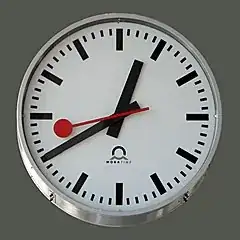
       analog clock.

When you're looking at a clock like that, it makes more sense to regard minutes until the next hour.

But, as time goes on, digital clocks are becoming more prevalent:
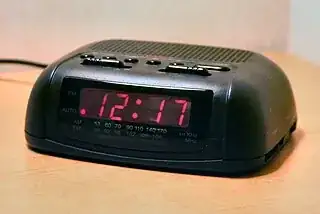
       digital clock radio.

Given this display, it's kinda weird to restate the time in terms of the distance until the next hour.

So, today, it's increasingly common to just read the time.

Time-telling precision has changed, too

Historically, it didn't make sense to give the exact minute for two big reasons:

  1. It's often difficult to tell the exact minute an analog clock intends to represent without getting a clear look at it, which often wasn't worth the effort.

  2. Historically, clocks had to be manually set and the clock's displayed time would drift until updated again. But even when recently set, the setter would tend to have another imperfectly set clock providing the set time, causing further errors.

Given these factors, it didn't make much sense for folks to work to distinguish the exact time.

Today, digital clock faces provide the exact minute without any additional effort on the viewer's part, and many digital clocks, e.g. those on computers and cell phones, auto-update their time to a central time authority. This means that it's now easy and meaningful to specify a minute, causing a reduced interest in approximation rules.


Notes

  1. A commenter has noted that they still use analog clocks, and that they still use the corresponding language. So, I guess, it's probably more precise to say that the terminology correlates to the type of clock that one is used to; folks who still use analog clocks are more likely to use the prior terminology.

  2. I've referred to analog clocks as "historical", though it's likely that many adults are old enough to remember when analog clocks were the norm. I'd speculate that there's likely a generational difference on this issue.

  3. For English learners, it's probably worth pointing out that the style of English I employ on StackExchange is intentionally informal. Here are a few things to compare/contrast:

    • I used "kinda" above, which is a slur for "kind of".

    • I used "olden" above, which is an informal term often meant in a humorous sense. Part of the joke is that the term "olden" is itself archaic, so it's self-referential humor.

    • I used "don't really" above. Use of "really" in this context is typically regarded as informal, and excessive usage of it can come off as juvenile.

    • I used "technology thing" above. Describing something as an "X thing" is typically informal.

    • I expressed a disregard for a style manual, specifically Cambridge's. This bluntness can come off as irreverent, as was the intent above. Part of the subtext there was that English is about communication; grammatical rules are things to know and understand, but not to simply conform to as laws.

    New learners are typically better advised to stick with standard grammatical rules. Once mastered, stylistic alterations can be adopted.

  4. The above answer is about the dynamics of how English is evolving as a consequence of the shifting experiences of its speakers. Personally, I find this to be fascinating — and, better, it's something that can be studied empirically if data's found.

J.R.
  • 109,547
  • 9
  • 164
  • 291
Nat
  • 618
  • 1
  • 6
  • 12
  • Thank you for the answer.1+^ It would be more efficient if you said what English you represent (such as: AmE, BrEn, CaEn AuEn etc.) since my things were brought from a British English book. – Virtuous Legend Mar 28 '18 at 06:08
  • @Archimedean_Point Definitely, I'm primarily an American English speaker, though the above answer applies to pretty much all branches of English. For example, Americans used to speak like the Cambridge dictionary described, too; it made a lot of sense when reading analog clocks. I think that pretty much everyone transitioned over to the modern pronunciation as digital clocks became popular. – Nat Mar 28 '18 at 06:31
  • 4
    "People don't really talk like that anymore" -- Yes we do!!! The examples given are exactly how I talk. – Simba Mar 28 '18 at 15:51
  • 5
    "clocks used to look like this" -- Most of the clocks in my home still do look like that, as does my wristwatch. Oh, and that digital alarm clock in your other picture looks like it fell out of the 1980s. – Simba Mar 28 '18 at 15:54
  • @Simba I pretty much agree with you. This is a smart watch: https://ng.jumia.is/nJ4lAXQbrERGTy9_vn627v3wKwk=/fit-in/500x500/filters:fill(white):sharpen(1,0,false):quality(80)/product/25/90116/1.jpg?1386 I saw many types and models of it and a lot of people use the form of digital clock hands. But I have to admit that the majority of people use the form of simple numbers. – Virtuous Legend Mar 28 '18 at 16:05
  • @Nat How would you tell the time 10:10? – Virtuous Legend Mar 28 '18 at 19:41
  • @Archimedean_Point: "Ten ten" would be fine, but I'd probably say "Ten past ten" in that case. – psmears Mar 28 '18 at 20:22
  • @Archimedean_Point I'd also say "ten ten", in most contexts. If there were potential for confusion, e.g. I were speaking to someone who might be hard-of-hearing or if it were for scheduling an important event, I might expand it to "ten past ten", or more formally, "ten after ten". In those expanded cases, I'd often qualify the time as being p.m. or a.m./24-hour-time. I usually don't bother to distinguish between a.m. and 24-hour-time, as I see the ambiguity as moot. – Nat Mar 28 '18 at 20:36
  • Had to downvote for the erroneous assertions about olden days and digital clocks. While it’s true that I have several digital clocks in my home, I have many analog clocks as well. And many of them are only a few years old. Likewise, my workplace has far more analog wall clocks than digital clocks. (You can correct or clarify all that in your “Notes,” but as long as your answer starts out the way that it does, it has my downvote.) – J.R. Mar 29 '18 at 02:47
  • @J.R. That's a good point; it'd be nice to better qualify it with a study on digital-vs.-analog adoption, though I'm having a bit of trouble finding reliable numbers. I think that time-reading behaviors would be most relevant, e.g. I'd assume that most folks probably read the time from their computer screen or/and phone more often than a wall clock even in locations were analog wall clocks are the norm, but... bah, I'll have to figure out a better wording. – Nat Mar 29 '18 at 03:06
  • 1
    @Nat: Note that the question is tagged "british-english", so worth pointing out (as others have done) that "ten after ten" is an American thing (it's not something commonly heard in the UK). – psmears Mar 29 '18 at 17:10
  • I agree with J.R. about the analog clocks. If you search images.google.com for "clocks" the vast majority of the images that come up are analog. The analog watch/clock face is not an anachronism by any stretch of the imagination. It distracts folks reading your answer if you start out with something that makes them think "Hey, that doesn't seem right". Instead of focusing on what you're saying about time-telling, they're thinking about all of the modern analog clock and watch faces they see every day. – ColleenV Mar 30 '18 at 12:30
3

Whether you express the time of 08:45 as 'eight forty-five', or 'quarter to nine', both expressions are unambiguous.

Most parts of Britain would understand the phrase 'half eight' to mean 8:30, that is 'half (past) eight'. Beware, there are parts of Britain where 'half eight' means 'half (to) eight', or 07:30.

Maryam
  • 2,375
  • 10
  • 29
  • 43
Neil_UK
  • 200
  • 1
  • 6
  • Out of curiosity, where would "half eight" be 7:30? I'm British and never encountered that until I started learning German... – Chris H Mar 29 '18 at 08:20
  • @ChrisH Yes, I didn't say exactly where, it was a long time ago I came across this, and I've forgotten the details. I'm a southerner, and it's somewhere 'oop north', before Scotland. – Neil_UK Mar 29 '18 at 08:23
  • "Half eight" meaning 7:30 is common in Dutch and German, but I've also encountered it in northern England (the Manchester area, for example). – Hobbes Mar 29 '18 at 10:18
  • Was going to mention this in a comment above - "gone half eight" apparently means "just past 8:30" in Britain. This would be said "half past 8" in the U.S., where only saying "half eight" would not be understood by most people (because "half [of] eight" is four). The German "halb acht" or Norwegian "halv åtte" for "half eight" means 7:30. This is true of most Germanic/Scandinavian languages, so for many English-speaking N. Europeans the British system is not how they would normally tell time. – mc01 Mar 30 '18 at 16:27
2

Regardless of formal grammar, actual speech is a lot more casual.

If the minutes are a multiple of 15, I'd say:

12:00: "Twelve o'clock", or just "Twelve"

12:15: "Quarter past twelve"

12:30: "Half-past twelve"

12:45: "Quarter to one"

If the minutes are less than 30, I'd say the numbers:

12:23: "Twelve twenty-three"

If the minutes are more than 30, what I'd say depends on the context. If we're asking because of a deadline, I'll subtract from the next hour:

12:39: I'd round off to the nearest 5 for this length of time, "Twenty to one"

12:48: Within 15 minutes I'd be accurate, "Twelve to one"

If it's just to know the time, I'd keep it simple:

12:39: "Twelve thirty-nine"

12:48: "Twelve forty-eight"

Hand-E-Food
  • 121
  • 2
2

I think you are simply misunderstanding what the source means. It's not saying that it's wrong to say "ten-eleven"; it's perfectly fine to say any time as [hour]-[minutes] whether or not it is a multiple of five minutes.

What the source is trying to say is that when the time is not at a multiple of five minutes, if we want to express the time relative to the hour, we say "minutes past" or "minutes to" as opposed to merely saying "past" or "to".

So for 10:11 you have the following options (in British English)

"ten-eleven" or "eleven minutes past ten",

whereas for 10:10 you would say either

"ten-ten" or "ten past ten".

Especially Lime
  • 3,107
  • 9
  • 18
  • Thank you for your opinion +1^, but It's difficult to me to accept this idea since if you read there the full article, you can see that they give examples in five minute intervals with the options of saying them and they intentionally omitted examples out of five minute intervals since they immediately explain how those out of five minute intervals should be spoken. – Virtuous Legend Mar 28 '18 at 15:46
  • @Archimedean_Point : I interpreted the article as giving examples of both possibilities in the simple (5min) case, then saying what's different in the other case, and giving examples of the difference, not bothering to repeat the [hour]-[minute] examples here because there is no difference. But certainly the article does not make this clear and perhaps I'm being rather charitable in how I interpreted it! – Especially Lime Mar 28 '18 at 15:53
0

Yes. Those Cambridge rules reflect an old manner of speaking, and they were never required. I would even describe those rules as outdated. Time is rarely spoken that way in America anymore.

I grew up with analog clocks and watches. Back then, it was normal to say "ten 'til nine", "ten of nine", or "ten minutes of nine" to indicate 8:50. Fifteen-minute intervals would be "quarter", as in "quarter of nine" for 8:45 or "quarter past nine" for 9:15. Thirty-minute intervals were designated as "half".

With digital clocks on walls, computers, and cell phones, almost everyone just reads the time numerically now. When the time is 8:50, most people simply say "eight fifty". Leading zeroes are only verbalized for minutes. For example, 8:08 is spoken as "eight oh eight"---no one says "oh eight oh eight".

Mostly, you will hear older speakers using the Cambridge style.

DoubleD
  • 164
  • 3
-1

You can definitely say it in figures. From that major literary work Quadrophenia

Inside outside, where have I been?
Out of my brain on the five fifteen

  • The question is asking about times that don't fall on five-minute intervals. Also, pop lyrics are notoriously unreliable guides to standard English. – Nathan Tuggy Apr 07 '18 at 02:00