16

In my native language we have lots of ways (some of them very funny) of saying that you, or someone else didn't understand a joke right away. That is, he/she needed some time to figure it out.

I wonder if there's any idiomatic way of expressing that in English.

ctype.h
  • 4,043
  • 1
  • 26
  • 44
Androiderson
  • 619
  • 1
  • 4
  • 13
  • 5
    One that's used often in UK and AU when someone doesn't get something at all (not restricted to a joke) is: "That went right over his/her/their head" – Deco Feb 06 '13 at 23:55
  • 1
    Some people call these joke grenades (~1:36) where you tell them, and then wait for several seconds for people to get them and start to laugh. – Jim Feb 07 '13 at 00:48
  • 2
    It's not quite the same thing, but "whoosh!" is the sound of a joke going over someone's head. –  Feb 07 '13 at 01:39
  • 6
    @snailplane: Those two are very much related. However, "whoosh!" requires the hearer to already be familiar with the idiom "over his head;" otherwise, that onomatopoeia will go, well, right over the hearer's head :^) – J.R. Feb 07 '13 at 10:23

6 Answers6

24

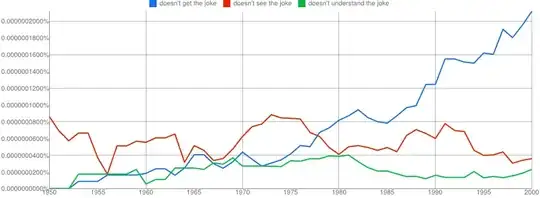
The word get is particularly used these days in the context of understanding jokes - and even more particularly in the negative, for not understanding. With no other context...

"I don't get it", "He doesn't get it!", "Don't you get it?", etc.

...are very likely to be assumed to be in reference to a joke that wasn't understood.

enter image description here

FumbleFingers
  • 70,966
  • 4
  • 97
  • 196
  • 1
    +1 For both the most universally understandable phrase (probably understood in UK and US English), and for one that, more than the others, is specific to "getting a joke". – David Hall Feb 07 '13 at 07:43
  • 1
    @David: ty. Actually, the answer itself isn't intended to be a joke, but somebody didn't "get" it (I got an anonymous downvote! :) – FumbleFingers Feb 07 '13 at 13:13
  • 1
    http://www.youtube.com/watch?v=OGzCjxvoJNI watch from 0.45 to hear the expression: "I don't get it" in its context. – Mari-Lou A Jun 02 '13 at 11:24
12

The first phrase that comes to mind is 'The penny dropped'. As with jwpat7's suggestion, this phrase is not limited to understanding a joke, but is commonly used in that sense.

Particularly in a situation where a lot of people have been laughing at a joke and I finally understand it, I would say:

"Ah, the penny just dropped!"

David Hall
  • 1,077
  • 12
  • 19
  • 4
    Nice idiomatic expression! But you don't often hear it used in the negative for when the penny hasn't dropped - except when followed by yet, with the strong implication that it soon will. – FumbleFingers Feb 07 '13 at 00:26
  • 4
    I'd not even thought of the negative usage for some reason. I feel that 'Waiting for the penny to drop' is moderately common, though perhaps that is a NZ English peculiarity - seems likely that this depends a lot on very localised culture such as television programs. – David Hall Feb 07 '13 at 07:46
  • In my language if someone doesn't get something, we say his/her penny is bent (so it's stuck and is likely to not drop). – Færd Mar 14 '16 at 16:01
10

You may hear over his/her head.

That one went over his head.

While it applies more to someone who is not familiar enough with English or the appropriate cultural/topical reference to get the joke, rather than someone who is just slow on the uptake, it's just as likely to happen in an ELL setting as the latter.

It can also be expressed by simply waving your hand over your head and making an apologetic expression.

kojiro
  • 218
  • 1
  • 6
9

The phrase slow on the uptake, often is so used. As seen from the examples at Collins Dictionary, it does not specifically refer to being slow to understand a joke, but I've often heard it used that way.

James Waldby - jwpat7
  • 7,500
  • 1
  • 22
  • 27
3

If your auditory audience are active Web users, they may be aware about an Internet meme, Slowpoke.

Slowpoke
image from here

Urban dictionary defines slowpoke as "An unnecessarily slow person, not mentally, just physically."

There's also a Pokémon with the same name.

Hence, this term is often used on Internet boards to denote a person who's too slow to get a joke.

By the way, it can be also used if someone is posting an old joke that was popular a while ago, and everyone already knows it.

Be Brave Be Like Ukraine
  • 8,085
  • 11
  • 45
  • 83
  • 1
    I do not think this is a useful word for someone learning English if they're not already encountering it. In which case they would know it, or easily be able to look it up. – FumbleFingers Feb 07 '13 at 04:28
  • 1
    @FumbleFingers The Internet memes are essential part of the language. An English learner is already exposed to memes within StackExchange network. See do you haz teh codez?. – Be Brave Be Like Ukraine Feb 07 '13 at 11:04
  • @StoneyB Audience, of course. This pair of words is hard for me all times. – Be Brave Be Like Ukraine Feb 07 '13 at 13:33
  • Like I say, if a learner encounters slowpoke in other contexts, they'll easily see what it means - either from context, or by looking it up somewhere like urbandict. But ("meme" or not) it isn't a "core" English word (I don't know any related terms except cowpoke). Sooner or later I suppose we'll have to thrash out on meta whether this sort of thing is what we want on ELL. – FumbleFingers Feb 07 '13 at 13:34
  • 2
    @bytebuster "Auditory", as a noun, is in fact the old word, and I was excited to see you revive it. – StoneyB on hiatus Feb 07 '13 at 13:37
  • 1
    @FumbleFingers I concur. It may be a large part of a scope since people already use it, but some may think it's not for the learners. Likewise any idiomatic constructs. – Be Brave Be Like Ukraine Feb 07 '13 at 13:42
  • 1
    @StoneyB In my language, auditory means group of listeners (or classroom) while audience means a formal meeting. – Be Brave Be Like Ukraine Feb 07 '13 at 13:44
  • 4
    @bytebuster: Even if the actual word auditory exists in your language, it's certainly not used by Anglophones in your context here. – FumbleFingers Feb 07 '13 at 13:51
  • Worth noting that slowpoke isn’t a new word; it’s attested back to at least 1848, according to Etymonline, and was reasonably common in my childhood (UK, 80’s/90’s). – PLL Mar 11 '15 at 02:56
3

The phrase "late to the punchline" is idiomatic, and always refers to this situation.

Taymon
  • 131
  • 2