6

Need sources of information about "Why is life expectancy growing faster than retirement age?"

Is there any literature about "why the increased quality of life and medicine in rich countries doesn’t increase the ability to work for older people?"

The Almighty Bob
  • 1,682
  • 1
  • 12
  • 26
Y.N
  • 163
  • 7
  • 2
    I think this question is primarily opinion-based and therefore not a good fit for this SE. – The Almighty Bob May 12 '15 at 07:44
  • I change my question from "why" to "Need sources of information about" – Y.N May 12 '15 at 07:58
  • To answer your second question (the non-political one):

    This just an opinion piece: http://www.theatlantic.com/features/archive/2014/09/why-i-hope-to-die-at-75/379329/ but it does reference some scientific data. Search for the part about the "National Health Interview Survey". This other one http://www.theatlantic.com/features/archive/2014/09/what-happens-when-we-all-live-to-100/379338/ is a poorly written news item with lots of references that may or may not be useful.

    – Giskard May 12 '15 at 08:17
  • 2
    There is a biological/medical partial reason -- once you are enfeebled past the capacity to work, it's easier now than ever before to stay alive for many more years. Hence to some extent life expectancy recedes from retirement age. As such the answer to "why doesn't it increase the ability to work?" is, "because a stroke's a stroke, and if you have vascular dementia then just because it doesn't kill you doesn't necessarily mean you'll still be able to work". But given the venue you've chosen I guess that's not what interests you? – Steve Jessop May 12 '15 at 11:40
  • Strong medicine should give the ability to active life. Active life of experienced people should give the economy income. Why this is not true? – Y.N May 12 '15 at 11:56
  • Of course, long life doesn't mean long active and healthy life. So I asking for links to serious studies. – Y.N May 12 '15 at 12:23
  • @YN - You seem to be assuming that having older people work longer would be a benefit to society. What happens to young people when the old people start working until 90? There are only so many jobs that are needed to satisfy a population. If old people don't retire then the middle level people don't advance into the "just-opened" positions, and those below don't advance and those at the bottom don't advance which means there's no jobs available for young people. It would be a really bad thing for society if most old people kept working until they were very old. – Dunk May 12 '15 at 17:17
  • @Dunk - To have more and more open positions, we need shrink the retirement age back to 50? Or to 40? I think, such decisions should be based on careful studies? – Y.N May 13 '15 at 05:47

2 Answers2

6

Loss-aversion and political tactics.

A lot of the elderly are no longer physical broke down - which was the original reason for retirement. But, if you can retire in good health, it is completely rational for the individual to do this, and to vote for the politicians who will provide this for you.

Or, as a danish mayor once put it:

"When you first throw something into the monky cage, it is hard to get it back again"

Aka, when you first give people major entitlements and life improvements, it is next to political impossible to take them away.

Yohann V.
  • 103
  • 2
Thorst
  • 835
  • 6
  • 16
  • That only explains socialist retirement, though. Perhaps you'd like to throw in a paragraph or two about voluntary/private retirement? – Luaan May 12 '15 at 10:59
  • socialist retirement? – Thorst May 12 '15 at 11:04
  • Well, government mandated retirement. You do realize the idea of retirement didn't come from people in the government, right? While it's getting more and more common for governments to take the "responsibility and burden", it isn't universal. And in many socialist countries, you can still improve the conditions of your retirement by saving up on your own; get more money paid out or earlier retirement. You're only looking at the political issue in socialist countries with government retirement plans. In private retirement, the original question applies as well - people retire "early". – Luaan May 12 '15 at 11:12
  • 1
    First of, you realize you come of as condescending right? Second, I am not sure what your aiming for. OP is asking why people don't work more, despite the fact that they live longer. You could probably talk about higher income, increased savings and so on, if that is what your referring to with private retirement. Albeit I don't think that means a whole lot in regards to this question. – Thorst May 12 '15 at 11:31
  • 1
    @Luaan: you don't seem to distinguish "having a government retirement plan" from "mandated retirement". The UK is currently going through a long process of raising the age at which the state pension becomes payable, so the points in this answer are relevant. However, we don't have government-mandated retirement hardly anywhere (the police do, I think, but then of course for them that's employer-mandated retirement). – Steve Jessop May 12 '15 at 11:47
  • @Soccerman A bit, sorry. I truly didn't mean it that way - it referred to your "original reason for retirement", e.g. you do know it's not just a political construct. I see, if you put it this way, it's already contained in your answer. I took it you put the "it's rational to retire early" and "vote for politicians who make you retire early" as the same thing (given how you continue the answer with the quote and all). Maybe you could make the separation between retirement itself and the political constructs a bit more clear? It's a bit mixed in at the moment, IMO. – Luaan May 12 '15 at 12:33
  • @SteveJessop Mandated doesn't mean you're forced to do it (although that used to be the case in the past), just that it's controlled by someone. But I can see how my expression could be confusing. Not that I can't imagine a country where you'd be forbidden to work after you retire (there's been a few attempts at that here in the Czech Republic - it's seen as unfair competition). And yeah, the retirement plan is mandatory - you still have to pay for it, after all, even if you don't end up using it, ever. Although this obviously varies by country. – Luaan May 12 '15 at 12:40
1

There are fixed costs of working at a job. Commuting is one important example. Often so are certain work benefits like health insurance. But there are other challenges to adding an additional employee but not additional hours like managerial attention, scheduling difficulties and deadlines when people work less per week and where to put extra workers that are less tangible. Fixed costs create an incentive to do your working in a compressed part of the life cycle. In the presence of fixed costs, as people get richer and put this wealth to work in a way that increases life expectancy they wouldn't cut back on hours per day or hours per year even, rather they'd cut back on the years (starting work older and finishing work earlier). And that's exactly what happened in Japan:
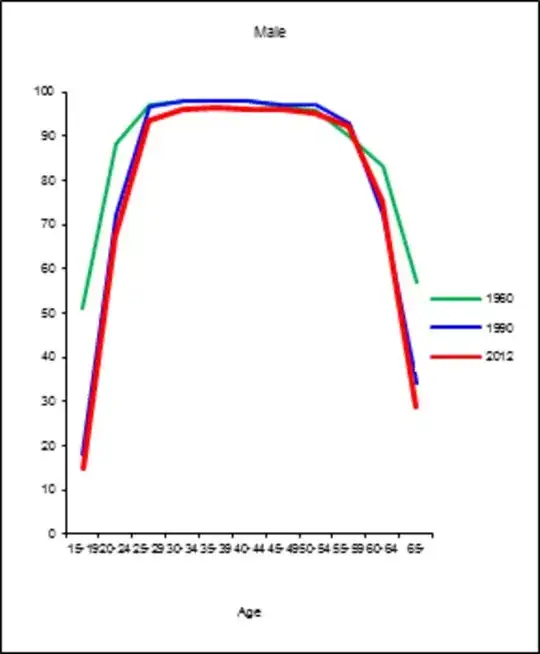
Japan’s Labour Force Participation Rate by Sex & Age: 1960-2012

Womenomics for Japan: is the Abe policy for gendered employment viable in an era of precarity?

BKay
  • 16,292
  • 2
  • 35
  • 80