10

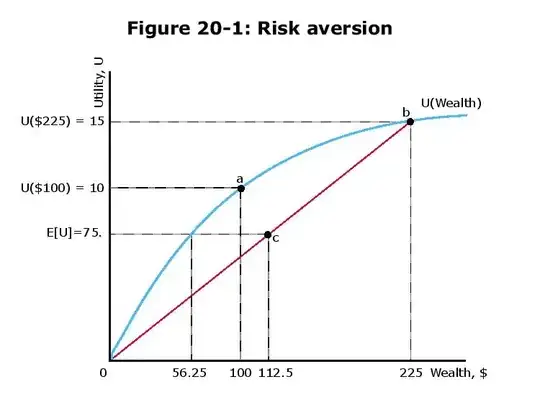
In Lecture 20 of MIT's Microeconomics course, a situation is proposed where a 50/50 bet will either result in losing \$100 or gaining \$125 with a starting wealth of \$100. It is stated that a person would be willing to insure themselves for \$43.75 (the difference between \$100 and \$56.25). What is the intuition behind this?

Thanks in advance!

From MIT

Giskard
  • 29,387
  • 11
  • 45
  • 76
Nick
  • 125
  • 1
  • 4

2 Answers2

9

The name for the amount $56.25 is certainty equivalent.

The expected utility for the individual from taking the bet is calculated as follows: $$E[U]=\frac12U(100+125)+\frac12U(100-100)=75$$ Suppose the individual can pay an amount of money $x$ so that she can avoid taking the bet (which leads to expected utility $75$). What's the maximum amount of money $x$ she's willing to pay? Well, she would pay up to a point where she's indifferent between taking and not taking the bet.

If she takes the bet, expected utility is $75$. If she pays, her utility is $U(100-x)$. We want her to be indifferent, so that $U(100-x)=75$. Reading off from the blue curve in your graph (the curve describing $U$), we see that $$U(56.25)=75$$ which means $100-x=56.25$, or $x=43.75$.

So we can interpret 43.75 as the maximum amount of money that an individual is willing to pay in order to avoid the (risky) bet.

Herr K.
  • 15,409
  • 5
  • 28
  • 52
4

There is a typo in the figure that introduces some confusion in the previous answer, which is basically wrong.

Based on the numbers and the figure, the utility is such that $$u=\sqrt{x},$$ so $$E[u]=\frac{1}{2} u(100+125) + \frac{1}{2} u(100−100)= \frac{1}{2} u(225) =\frac{1}{2} \sqrt{225} = 7.5$$.

By definition, the risk premium (R) must satisfy the following condition: $$ E(u) = u(100 - R)$$ $$ \Leftrightarrow 7.5 = \sqrt{100 - R}$$ $$ \Leftrightarrow (7.5)^2 = 100 - R$$ $$ \boxed{\Leftrightarrow R = 43.75}.$$

Notice that this bet is better than a "fair game" because the expected gain is not zero, but positive (0.5∗125+0.5∗(−100)=12.50.5∗125+0.5∗(−100)=12.5). So, despite this very good bet, the risk-averse agent characterized by her concave utility function ($u = \sqrt{x}$), is ready to pay almost half of her initial wealth to avoid risk and get the certainty equivalent amount.
emeryville
  • 6,935
  • 2
  • 22
  • 41