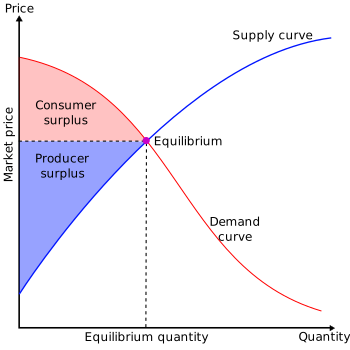
A convention is the only real justification.
It does not match the current ways of teaching economics as being the quantity supplied and demanded at given price points.
But also, at no point would it ever have been sensible to consider price the dependant variable (y-axis) and quantity the independant variable (x-axis) like the conventional supply-demand graph would falsely suggest.
Based on what the justifications I've seen, it seems like a misunderstanding of what makes a variable (in)dependant.
People argue that price is dependant because the supply and demand curves are used to find the market value, but this is a resulting intersection of two curves.
The dependant and independant variable show the relations between the variables in a single curve:
- If the quantity collectively demanded increases or decreases based on price, then demand (quantity) is the dependant variable (y-axis) and price is the independant variable (x-axis)
- If the price consumers are willing to pay changes based on the quantity they collectively demand, then price is the dependant variable (y-axis) and demand (quantity) is the the independant variable (x-axis)
Surely, the 1st is sensible whereas the 2nd is not.
The same applies to supply.
It is only when we plot both supply and demand and find their intersection that we find market quantity and market price.
But some still seem to think that curves shifting are always a change in quantity which results in a changed price at the new point of intersection compared to the old point of intersection, and therefore wrongly consider quantity the independant value and price the dependant value.
Curves can shift for all sorts of reasons, but as the curves are often fairly straight lines, it can sometimes be difficult to determine in which direction it shifts:
- are people willing to pay more for the same quantity?
- are people interested in buying more at the same prices?
both look the same on a straight downwards line, and it is easy to wrongly assume that it is all changes in quantity in that case.
So let's consider a non-linear curve.
For example the demand for food in general.
People need a certain amount of food, and as long as their basic needs aren't met, they'll be very willing to spend their money on food (and it will be one of the first things they'll spend their money on).
But once their basic needs are met, they don't really demand much more (maybe a little more, and maybe shift towards more luxurious food products, but the total amount of food demanded should be fairly inelastic at this point).
This should result in a graph which is nearly perpendicular to each of the axes with a bit of a transition in between:
When prices are too high people simply don't have the money to pay for it, but if the price drops even a little, people will want to buy as much as they can, up to a point where their needs for food are satisfied, at which point the demanded quantity stagnates and people won't buy much more at further decreases in price.
Now let's consider two situations:
- There is an influx of people into the country (e.g. birth boom, immigration crisis).
This means the quantity needed to meet the basic food needs of all people increases.
We should see a shift along the quantity axis (the intersection of the curve with the quantity axis is at a higher quantity).
But people's available funds are unchanged so we wouldn't see a significant shift along the price axis (the intersection point between the curve and the price axis remains nearly unchanged).
- A universal basic income is introduced, giving all consumers more money to spend.
As food is a basic need, people will spend their money on food as one of the first things if their needs aren't met.
This should result in a shift of the curve along the price axis (the intersection between the curve and the price axis is at a higher price).
But people don't suddenly buy a significant additional amount of food if their needs are met, so we shouldn't see any significant shift of the curve along the quantity axis (the intersection between the curve and the quantity axis remains nearly unchanged).
With these examples, we can more clearly see that the curve can shift along either the quantity or price axis, so it would be incorrect to think that only changes in quantity collectively demanded at a given price are the cause of shifting curves and the resulting changes in the intersection between supply and demand curves (which changes both the market price and market quantity).