This is a very interesting topic that in the past several years has reached the spotlight because of the work of Robert Hazen on the concept of "mineral evolution".
Minerals are basically just inorganic compounds: you take several elements, arrange them in certain ways and you get minerals. Thus, the minerals will be mostly determined by what's available to them in term of chemical elements. The solar nebula in Earth's area was composed of very few major elements: Fe, Si, Mg, Al, O, C, etc. There are not many ways you can arrange this limited number of elements, and the mineral diversity was rather small. You cite the number 60. Could be more, could be less, but it sounds about right.
With time, certain processes on Earth (magmatic, metamorphic, metasomatic, hydrothermal, you name it) preferentially move certain elements relative to others. This causes redistribution of elements in space, enriching and depleting certain elements in various areas. Elements that were previously present only in trace amounts and did not form minerals of their own may be concentrated so that they do.
This is a time dependent process, hence the name "mineral evolution". This is a nice figure that sums things up:
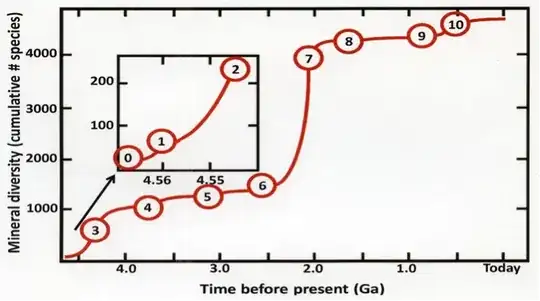
You can read more about it in Hazen's website (from which I took the above figure): http://hazen.carnegiescience.edu/research/mineral-evolution
Be careful though when searching for "mineral evolution" online - you usually get more results of pseudoscientific and creationist websites rather than actual science.



The solar nebula in Earth's area was composed of very few major elements. Doesmajorjust mean elements that are in large quantities on earth?