11

In the formula for slant stacking (tau-p transform) a substitution t=tau+d/v is made.

If we consider the substitution as a vector equation then how can vector d/v have the same length as vector t given that in most surveys the number of data points for offset(d) is less than for time (t) .

Gimelist
  • 23,122
  • 4
  • 68
  • 133
shrey
  • 1,489
  • 9
  • 25

2 Answers2

7

The $\tau$–$p$ time domain $t$ is a function of offset $d$, so the result is an array of size $n_t \times n_d$, where $n$ is the number of samples.

The inputs are a vector $\tau$ of travel time at zero offset, or $t(0)$, an array $p$ of ray parameter, which is in turn a function of velocity $V$ and angle, and a vector $d$ (usually called $x$) of offset.

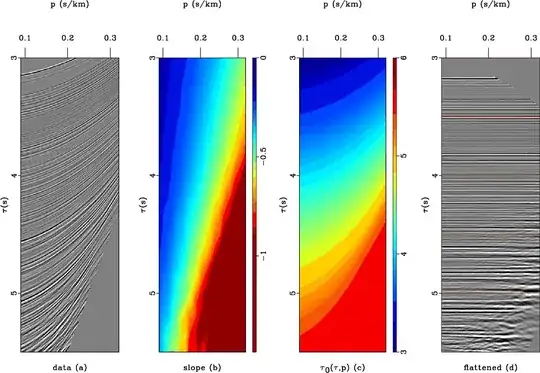
Here's an example of some visualizations of the $\tau$–$p$ domain from a paper by Sergey Fomel; they might help explain what I mean by an 'array' — you can think of them as images:

enter image description here

The resulting travel-time $t(d)$ is an array of size $n_t \times n_d$, where $n$ is the number of samples. For a given offset at a given time sample, the result is a scalar — a single value of $t$.

By the way, stevej's answer is a great explanation of how exactly to calculate the ray parameter term, given limited information. Do follow that link to Yilmaz, and maybe also read the Radon transform article.

Matt Hall
  • 11,001
  • 1
  • 44
  • 67
6

To be consistent with the references referred to in this post, I will re-write your equation of the $\tau-p$ transform as: $t = \tau + px$

Where $t$ is two-way time, $x$ is offset, $p$ is ray parameter ($\Delta x / \Delta t$ or $\sin(\theta) / velocity$), $\tau$ is the intercept time when $p=0$ (Yilmaz, 2001).

There seem to be at least two methods for overcoming the finite aperture, or limited offset and ray parameter range, problem when transforming from time-offset ($t-x$) domain to $\tau-p$ domain:

  1. Sample ray parameter $p$ such $np = nx$; i.e. number of ray parameter samples equals number of offset samples (Yilmaz, 2001).
  2. Formulate the the computation of the transform as a least-squares estimation problem (Kostov, 1990; Thorson and Claerbout, 1985).

Kostov, C., 1990. Multi-channel seismic experiment with a drill-bit source. Phd Thesis, Standford University. See Appendix C for details on least-squares solution.

Thorson, J. and Claerbout, J., 1985. Velocity-stack and slant-stack stochastic inversion. Geophysics, Vol. 50, N. 12, P. 2727-2741.

Yilmaz, Öz (2001). Seismic data analysis. Society of Exploration Geophysicists. ISBN 1-56080-094-1. See SEG Wiki page on the problem.

hichris123
  • 1,920
  • 2
  • 23
  • 38
stevej
  • 1,044
  • 8
  • 11
  • 1
    This is a really nice contribution but I think it answers a slightly different question, so I had a go at my interpretation of what the OP wants. – Matt Hall Jul 14 '15 at 14:37
  • Yeah good call; in your answer the portion in bold answers the OP nicely. – stevej Jul 15 '15 at 01:39