10

Today, Northern Russia is considered quite cold. It is not populated because it has low biological productivity: low light and cold. It can be below -50 at winter and 10 C at summer peak. It is low populated because there is basically nothing to eat. Poor reindeers dig some moss from below the snow, which grows there a little during short summer period.

I am telling all of that, because I cannot even imagine what the hell Yakutiya would have been when all north of the continent was 1 km below the ice! Siberia stays permafrost even now, when you have warm summer days +5 Celsius. Certainly, it had to be frozen at glacier time permanently. Meantime, it is curious how people managed to cross the Bering Land Bridge during that latest glacier. How was that possible at that time, was it a Polar Voyage?

Now, I read that Yakutiya was a wild life refugee during the last ice age. It had much more rich wild life than now, comparative to what we have in Africa today. People appeared there 12 000 years ago, when half of the Great Glacier was melted
enter image description here

and slaughtered mammoth. The mega-fauna extinction collapsed Siberian ecosystem, say scientists who undertake an attempt to recover it. They tell that mammoth grazed grass. Did they procure it from below the snow, like reindeer do? Ok, Beringia says that

During the ice ages, Beringia, like most of Siberia and all of north and northeast China, was not glaciated because snowfall was very light. It was a grassland steppe, including the land bridge, that stretched for hundreds of kilometres into the continents on either side.

Fine. But, the fact that all ice was concentrated over Europe and Canada does not mean that Beringia surface was not permanently frozen. If there is so cold that whole Europe is under 1 km of Ice, the cold Beringia must be frozen either, despite all ice is over Europe. We can have low temperatures without ice, right? And, if it was terribly cold in Europe, it must be at least that cold in Beringia, right? So, what could poor animals eat there, in the frozen desert?

To summarize, my question is:

How is this nonsense possible that the 'freezer' of our planet was flourishing, whereas the rest of the Planet was starving in frozen state during last glacier period?

PS! I was suggested to look at the climate zones during Last Glacier. I have seen it but I cannot believe that northern Canada and Greenland was thriving forest whereas almost whole US was under permanent ice sheet. Similarly, we see that Tundra (current Eastern Siberia state) ruled in permafrozen Beijing whereas Eastern Siberia was enjoing same thriving steppe Forest that Alaska did

enter image description here

That is unbelievable and that is what I basically ask to explain. I guess that I have just mismapped the colors. There are too few colors. On the other hand, if anomaly did exist, I want to hear that explicitly, desirably with explanation. Is it really large animals who maintained the warmth at the very north (see "Park" above) before people exterminated them or what?

PS2 I have revised the climate zones map and realized that we had Polar Desert in Siberia and Alaska rather than Forest Steppe. This makes more sense. But how did we had the large animals and thriving greenlands there anyway? Polar Desert is incompatible with green land, obviously. Polar Desert at zones map seems also to contradict the Beringia article, attributing Beringia to grassland steppe during Ice Age.

Camilo Rada
  • 17,654
  • 6
  • 64
  • 113
  • 1
    Climate is a complicated and complex field. Precipitation is the source of glaciers and changed wind patterns distributed moisture and temperatures differently. Moreover, 'whole Europe' was never under 1km of ice. This: http://eprints.uni-kiel.de/3566/1/2004_Svendsen-etal-Late_QSR-23.pdf and this: http://www.sciencedirect.com/science/article/pii/S0277379108000346 discuss some of the aspects, but I don't know any good references for eastern Siberia. – user2821 Jun 15 '15 at 23:42
  • 1
    This Wikipedia article also shows the climate zones during LGM: https://en.wikipedia.org/wiki/Last_Glacial_Maximum – user2821 Jun 16 '15 at 00:04
  • 1
    @Recognize Your question has some weird broken-off sentences around the picture. Can you [edit] and fix it? I looked, but I have no idea what you want to say there. – Jan Doggen Jun 16 '15 at 07:46
  • 1
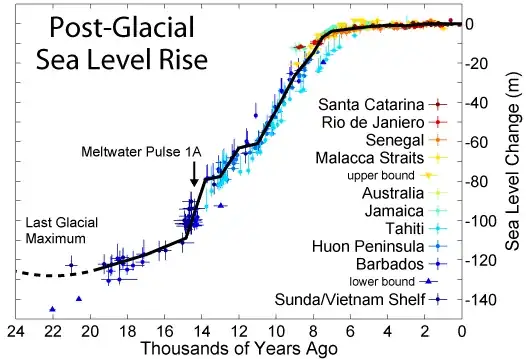
    @Recognize Also explain the use of the sea-level rise curve in the context. – user2821 Jun 16 '15 at 08:01
  • @Tbbe there are too many color zones with too few colors that makes it difficult to map territories to legend. Trying to reason myself I see that we have Forest steppe in the very north of Canada and permanent ice sheet below it, almost down the Mexico. In Asia, the article says, permafrost reached Běijīng, where we see Tundra on the map. Tundra is the current state of Eastern Siberia. I therefore cannot understand how could it happen that we have temperature rise anomaly in the northern Berigia whereas surroundings and especially southern regions are cooled. – Recognize Evil as Waste Jun 16 '15 at 08:08
  • @Tbbe The purpose of the figure was to insight the global temperature rise during last 20 000 years to suggest what could we have 12 000 years ago, when Siberia turned from a thriving forest into a tundra. You replaced it with your explanation which explains nothing and ask what is the purpose of that? – Recognize Evil as Waste Jun 16 '15 at 08:13
  • 1
    It IS a figure of sea-level rise, not regional temperature. I'm no expert in Siberian glaciation, but to help you in the right direction, you should probably look for precipitation together with temperature to understand how ice sheets are formed. – user2821 Jun 16 '15 at 08:21
  • 1
    This might also help you, it's a bit old, but explains some of the regional patterns: http://www.researchgate.net/profile/Mary_Edwards5/publication/223517860_A_framework_for_interpreting_paleoclimatic_variations_in_Eastern_Beringia/links/0a85e52f92b6cbe414000000.pdf – user2821 Jun 16 '15 at 08:22
  • @Tbbe There is no need to conceal my purpose by copy of the chart title and ask me "what is the purpose?" afterwards, screaming that it is not a temperature. I can only repeat once again that I have provided the chart to insight the temperatures since glacier retreat since I do not have the average temperature during that period. The sea level is a good indicator since temperature is proportional to it. We have got sea level rise because of global warming. We had -100 m at ice age because it was colder. I assume that there is an insightful correlation and well measured sea level. – Recognize Evil as Waste Jun 16 '15 at 10:16
  • 5
    Siberia was warmer during LGM than it is now. Look up on the work by Prof. Sergey Zimov. He's a scientist based in Cherskii at the Arctic coast of northeastern Siberia and he is an extraordinarily memorable individual and a great scientist. If I recall correctly, albedo was one aspect, biodiversity and bioproductivity was much higher before human hunting made mammoths extinct and Siberia turned from a park landscape to a dense forest. I don't recall the details, but do look up his work. – gerrit Jun 16 '15 at 10:21
  • 1
    @RecognizeEvilasWaste I'm not questioning the link between sea-level and global temperature (even if it's not proportional), but I tried to understand your question about regional climate in Yakutiya during LGM and your use of eustatic sea level to illustrate it. I think you over interpret global temperature as a direct control of regional patterns. Some temperature estimates are in the articles I suggested and probably better and more interesting research in dr. Zimov's publications, as suggested by gerrit. I can also agree that the color scheme used by Ray and Adams is a bit unfortunate. – user2821 Jun 16 '15 at 10:39

1 Answers1

1

This paper basically summarizes the thinking behind the highly-productive mammoth step theory:

Zimov, S.A., Zimov, N.S., Tikhonov, A.N., Chapin, F.S., 2012. Mammoth steppe: a high-productivity phenomenon. Quaternary Science Reviews 57, 26–45. https://doi.org/10.1016/j.quascirev.2012.10.005

The idea is basically that a large herbivore density (comparable to modern day intact African Savannah ecosystems) kept soil moisture low and reduced permafrost temperatures. This was favoring gramminoids (grass like plants) that are much more productive than the present day prevailing mosses. Plant productivity in these regions is usually limited by nitrogen (other ecosystems are carbon limited). The higher than today herbivore population provided a lot of nitrogen input from dung and urine propelled the productivity of plants, which in turn allowed for more herbivores. Low temperatures and shorter summers also limited damage to gramminoids, thus they could grow faster in the next season. The ecosystem had several positive feedback mechanisms sustaining high productivity.

When humans arrived in the region, they hunted all the herbivores. The system collapsed and lost its productivity.

mace
  • 472
  • 4
  • 11