15

A 'Fire tornado' or 'Firenado' or 'Fire whirl' are a fearful feature of forest fires world wide. Having seen one up close, I can attest that they are both awesome and utterly terrifying, but I am aware that these vortices are not strictly speaking, actual tornadoes.

An example, filmed in fires in 2012 around Alice Springs, Northern Territory, Australia, as in this YouTube Clip.

The Wikipedia page for this topic rather vaguely states

Often, fire whirls are created when a wildfire or firestorm creates its own wind, which can turn into a spinning vortex of flame.

But, the page does provide the following public domain image of a 'fire tornado':
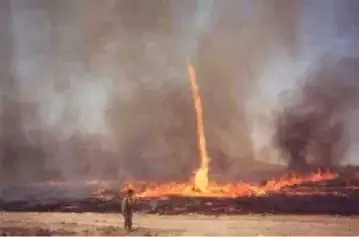
enter image description here

How does the vortex of fire in a 'fire tornado' form?

milancurcic
  • 4,983
  • 1
  • 28
  • 41

1 Answers1

3

They form due to strong convective forces, coriolis effects, local wind and weather, and local topography. The fire effectively creates an intense localized low pressure cell due to the heating of the air which can behave similar to any low pressure system. I haven't seen one on flat terrain like your picture shows but when performing slash burns for silviculture purposes you can have very large tornados form along ridges as the fire burns uphill. These tornados can extend outside the fire zone under the right conditions but generally die out soon once removed from the source of heat.

  • 4
    A firenado documented in Canberra found that the length scale of the firenado was about $L \sim 500$ m, the typical speeds were $U \sim 70$ m s $^{-1}$. If the Coriolis parameter is taken as $f \sim 10^{-4}$, then the Rossby number is $Ro = U/(fL) = 1400$. So Coriolis has negligible influence on the dynamics. – Isopycnal Oscillation Jan 07 '15 at 19:48
  • 1
    @IsopycnalOscillation sounds like a good answer through a calculated example –  Jan 07 '15 at 22:13
  • 1
    This answer would be strengthen with the inclusion of credible resources. –  Jan 07 '15 at 22:31
  • Is the question what causes the rotating motion? I expect everyone is comfortable with the updraft caused by the heat. The S hemisphere example shown in the question's video link shows a clockwise rotation. Small sample size but without Coriolis effect, what causes the rotation? – haresfur Jan 08 '15 at 02:22
  • 2
    @haresfur The rotation of a tornado is generally going to be in the same direction as the large-scale low pressure systems that spawn them. Because these systems are affected by Coriolis, one can say that it in some cases, Coriolis affects the direction of spin indirectly. However, given the right local conditions, tornados can spin in either direction, no matter which hemisphere they are in. – Isopycnal Oscillation Jan 08 '15 at 03:32