10

Does all the car pollution (from about 150 million cars at least in the U.S. and a lot more in all of North America and the rest of the world) all the smoke-stack pollution of various factories and all the Airline pollution running day after day have a deleterious and damaging effect on the general atmosphere and, over time, the climate?

Given all the observed pollution that China has caused itself and some of the resulting weird weather events there this certainly seems to be evidence of the damaging effects of car and factory pollution. Has anyone calculated how much exhaust from cars is produced in one day on average in a 'moderate' sized city?

Of course it seems with all the increased oil production in the U.S. and elsewhere we, human beings are going to keep are love-affair with gas-powered cars for the next 200 or 300 years. That is if we don't use up all the oil and gas in the ground before then.

Gimelist
  • 23,122
  • 4
  • 68
  • 133
201044
  • 587
  • 2
  • 9
  • What is defined as a 'moderate' sized city? –  Dec 24 '14 at 10:50
  • What exactly do you mean by "pollution"? In particular, does CO$_2$ count as "pollution"? – David Hammen Dec 24 '14 at 13:28
  • Do cars produce any type of pollution or emitted gases that might cause breathing problems? Can car emissions in gaseous form ever mix with precipitation and 'fall' to the ground? Is there anything even remotely dangerous to living things 'within' car emissions? – 201044 Dec 27 '14 at 03:40
  • Did the United Nations leader at a press conference about the Human impact on climate change recently say we human beings are responsible for some of the 'dramatic' changes? Car and Factory pollution seem like good candidates. – 201044 Dec 27 '14 at 03:43
  • Is there an endless supply of oil and gas ? – 201044 Jan 25 '15 at 05:40
  • IF the amount of gasoline in the entire Earth is FINITE then we Humans WILL run out of gas and oil eventually. Unless they mine asteroids or make synthetic oil ,we will run out. With 3 billion cars running on the Earth now ( an approximation) and probably more cars and factory emissions to come we will run out of oil sooner and sooner.. – 201044 Jul 23 '15 at 01:25

1 Answers1

6

As a USA resident, the EPA is the best place to start when wondering about the emissions inventory of atmospheric pollutants or pollutant precursors that affect the National Ambient Air Quality Standards (e.g. Particulate Matter, Carbon Monoxide, Sulfur Dioxide, Lead, Nitrogen Oxides, Volatile Organic Compounds). The EPA compiles a comprehensive emissions inventory of all criteria pollutants at the county level which is available in the National Emissions Inventory (compiled once every 3 years). You can see the summary of your county at http://www.epa.gov/air/emissions/where.htm. As for the effects of atmospheric pollution, it is important to consider the lifetime of said pollutants in the atmosphere in order to put their environmental impacts into perspective. For instance, the air pollutants covered by the National Ambient Air Quality Standards have immediate health effects when high concentrations are breathed in regularly. Both animals and plants are adversely affected by these irritating and sometimes toxic chemicals, but these pollutants are also reactive and do not last long in the atmosphere unless they are constantly being replenished (e.g. daily traffic). Air quality also impacts critical nitrogen loads on ecosystems and possible production of acid rain.

If you are interested in Greenhouse Gases (e.g. methane, carbon dioxide, CFCs, nitrous oxide), the EPA has a separate site for those emissions since they are not part of the same regulatory framework http://www.epa.gov/climatechange/ghgemissions/ . Greenhouse gases typically do not cause adverse health effects for plants or animals on land. However, they have long-term radiative effects (e.g. the greenhouse effect) because they stay in the atmosphere for many years and trap infrared light. These long-term radiative effects are what can change climate and consequently land cover. Furthermore, most of the excess carbon is absorbed by the ocean, which creates carbonic acid. Increased acidity of the ocean causes severe problems for marine ecosystems.

The EPA states that in 2012 the CO2 equivalent GHG emissions for the USA by sector was:

Electricity production (32% of 2012 greenhouse gas emissions) - Electricity production generates the largest share of greenhouse gas emissions. Over 70% of our electricity comes from burning fossil fuels, mostly coal and natural gas.

Transportation (28% of 2012 greenhouse gas emissions) - Greenhouse gas emissions from transportation primarily come from burning fossil fuel for our cars, trucks, ships, trains, and planes. Over 90% of the fuel used for transportation is petroleum based, which includes gasoline and diesel.

Industry (20% of 2012 greenhouse gas emissions) - Greenhouse gas emissions from industry primarily come from burning fossil fuels for energy as well as greenhouse gas emissions from certain chemical reactions necessary to produce goods from raw materials.

Commercial and Residential (10% of 2012 greenhouse gas emissions) - Greenhouse gas emissions from businesses and homes arise primarily from fossil fuels burned for heat, the use of certain products that contain greenhouse gases, and the handling of waste.

Agriculture (10% of 2012 greenhouse gas emissions) - Greenhouse gas emissions from agriculture come from livestock such as cows, agricultural soils, and rice production.

Land Use and Forestry (offset of 15% of 2012 greenhouse gas emissions) - Land areas can act as a sink (absorbing CO2 from the atmosphere) or a source of greenhouse gas emissions. In the United States, since 1990, managed forests and other lands have absorbed more CO2 from the atmosphere than they emit.

If we consider GHGs on a global level (see Global Carbon Project http://www.globalcarbonproject.org/carbonbudget/index.htm ) we can see how each sector has impacted the atmospheric concentration of CO2 over the past 143 yrs.
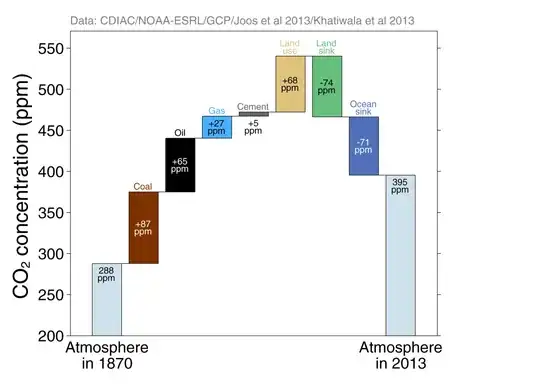
enter image description here

f.thorpe
  • 13,583
  • 2
  • 46
  • 89
  • So greenhouse gases typically do not cause adverse health effects for plants or animals. In China they have had many scenes and stories on the news about dangerous smog , people wearing masks and mention of breathing illnesses. Some stories have mentioned car pollution. I would infer from this that car pollution and factory pollution do not have green house gases 'in them'. Is this why the reduction of green-house gas emissions is talked about so much? And the actual decrease in car pollution and factory pollution is often not mentioned? – 201044 Dec 27 '14 at 03:35
  • 1
    All those sources include all pollution types in general. CO2 is a byproduct of any combustion. The problem with GHGs is that it is a global crisis in multiple biomes and climate regimes. Air quality pollution, with the exception of metals like lead, does not generally persist long enough to have any global impacts since the precursors/pollutants have long been chemically terminated or deposited on the regional landscape. Control technologies can limit air quality impacts, but you can't really "scrub" or "convert" GHG emissions, thus the importance of reducing or sequestering. – f.thorpe Dec 27 '14 at 22:51
  • Or using Electric powered cars instead of gas powered cars. How can GHGs be a 'global crisis in multiple biomes' if 'greenhouse gases typically do not cause adverse health effects for plants or animals'. As was stated above. – 201044 Dec 28 '14 at 01:39
  • 1
    GHGs are a global crisis because they stay in the atmosphere for many years and cause radiative effects (e.g. increased heat trapping) which leads to climate change (e.g. glaciers melting, sea levels rise, shifting ecosystems). Furthermore, most of the excess carbon is absorbed by the ocean, which creates carbonic acid. Increased acidity of the ocean does cause adverse health effects for plants and animals. – f.thorpe Dec 28 '14 at 02:55
  • If cars (300 million or more of them just in North America) emit GHG's every day ,year after year aren't these gas powered cars part of this Global Crisis? – 201044 Dec 28 '14 at 03:01
  • 1
    Absolutely, any combustion source or depletion of forested land causes increased GHGs. However, the largest source of GHGs from humans is CO2 from power plants (primarily coal burning). I hightly suggest you check out http://www.globalcarbonproject.org/ if you are interested in source contributions of GHGs to the atmosphere. – f.thorpe Dec 28 '14 at 03:04
  • Is gas powered cars the second largest? – 201044 Dec 28 '14 at 03:16
  • 1
    Actually I believe diesel powered freight (trucks + ships) has a higher GHG contribution than passenger cars. Thus many climate experts stress the importance of acquiring goods locally/regionally. – f.thorpe Dec 28 '14 at 03:45
  • Sorry , I don't trust the Chat Room idea. I get enough discouraging responses and disagreements in non-chat-rooms. – 201044 Dec 28 '14 at 03:50
  • Are green house gases the ONLY major type of pollution that is problematic? – 201044 Jan 20 '15 at 06:01
  • 1
    @201044 Assuming you are talking about human-caused atmospheric pollution... Lead was a major problem years ago and is still re-suspended into the air in places like Los Angeles. Lead is an element that does not go away, but is toxic and linked to criminal rates. Sulfur dioxide was also a major problem for acid rain, but controls have lessened that considerably. Also, it's important to keep in mind that stratospheric ozone killers (e.g. CFCs) are also GHGs, so they have double impact. If you are a little more specific about the "problematic pollution" of interest, I could say more. – f.thorpe Jan 20 '15 at 20:18
  • Are many types of car pollution also GHG's ? – 201044 Jan 22 '15 at 04:14
  • 1
    Other than CO2, the most important GHG related to car pollution is a secondary pollutant: ozone. Ozone is created when direct sunlight shines on an airshed with NOx (comes from all combustion engines) and VOCs (comes from many sources both natural and anthropogenic). – f.thorpe Jan 23 '15 at 00:34
  • How much ozone does one car produce in one day?? – 201044 Jul 25 '15 at 11:08
  • Ozone is not emitted by a car directly.. it is a secondary pollutant that is created in the presence of NOx, VOCs, and direct sunlight. – f.thorpe Jul 25 '15 at 19:25
  • What happens to all the carbon monoxide produced by cars? – 201044 Jul 26 '15 at 13:19
  • Does car exhaust have anything in it that if breathed in can have an effect like a carcinogen? – 201044 Jul 26 '15 at 13:20
  • You should ask that as a separate question... it is actually not so simple. – f.thorpe Jul 27 '15 at 02:08