11

Global oil reserves are, for practical purposes, limited. We're using them at a rate far exceeding the rate of deposition. At some point, we will have to spend more energy to extract remaining reserves than we get back from burning them (extraction might still be worth it, because plastics and other oil products are really useful).

When is the point at which conventional oil production peaked/will peak?

For the purposes of this question, please only consider conventional oil resources: that is, excluding shale oil, synthetic hydrocarbons, biofuels, oil sands, coal to liquids, and gas to liquids.

naught101
  • 5,425
  • 2
  • 31
  • 68
  • Circa 1996 or so I remember reading an article in the PESGB from someone at BP who said predicted it would occur within 10 years. He also excluded deep water fields from "Conventional oil". My understanding is that was about right - ie. about 10 years ago, although I don't have any references to back this up. – winwaed Dec 10 '14 at 13:53
  • 2
    The requirements for what an oil company can put on its book and call it a reserve depends on technology and economics, both of which keep changing with time so in that context peak oil is hard to define. Even in 'conventional' oil fields, most of oil is left behind, but with improvements in technology you can extract more of it. E.g., decades ago you could only extract so much oil (and that amount would have been your reserve), but then with techniques like water flooding, steam injection, detergents etc., more extraction was possible. Also, I see no reason to not include shale oil and sands. – stali Dec 10 '14 at 14:53
  • 3
    The answer is that we don't know. E.g., Current (i.e., last few months) US production levels are already close to those in mid-70s. Saudi reserves have been stable since late 80s. In some countries (e.g. Venezuela) reserves have risen. – stali Dec 10 '14 at 16:48
  • The question is about flows, not stocks; i.e. about production rates, rather than reserves. – 410 gone Dec 10 '14 at 17:12
  • And the 'flows', and 'production rates' have always kept on increasing (except for brief periods with lower demand) so peak oil will never happen. What will happen is that demand will eventually go down. – stali Dec 10 '14 at 17:32
  • 1
    I think the International Energy Agency showed data that it was 2005. The problem is all in the definition of oil, but I like the argument used here (http://resourceinsights.blogspot.com/2014/04/did-crude-oil-production-actually-peak.html) that "If what you're selling cannot be sold on the world market as crude oil, then it's not crude oil." – arkaia Dec 10 '14 at 18:40
  • I'd be happy to get an answer for all oil (including shale and sand), along side one for just conventional crude oil. EnergyNumbers: I'd be equally happy with an answer based on reserves (e.g. when are we half-way through commercially viable reserves). @stali: "peak oil will never happen"? How can that possibly work with a (practically) finite reserve and an ever increasing rate of production? – naught101 Dec 11 '14 at 02:49
  • @stali of course peak oil will happen. At some point production will peak, and then start to diminish. Whether it happens because of lack of supply or lack of demand does not change the fact that it must happen. – Semidiurnal Simon Dec 11 '14 at 09:53
  • 1
    @naught101 I think the problem with what you are suggesting is that the definition of "commercially viable" changes all the time. So, as others have noted, do all other figures for "reserves". Still, I'd love to hear about any up to date estimates. – Semidiurnal Simon Dec 11 '14 at 09:54
  • Yes, I know, there's no linear relationship here. And depending on your exact definition, the "middle" of oil production/resource consumption will be somewhat fuzzy. But I think a fuzzy probabilistic answer like "There's an 85% chance we'll have used more than half of all recoverable oil reserves before 2015" (or what ever) would still be far more useful than no answer. I'm not looking for a simplistic, cut-and-dried, absolutist answer. I'm looking for a basic synthesis of current thought on the matter. – naught101 Dec 12 '14 at 00:42

1 Answers1

7

The answer depends a lot on what you mean by "excluding shale oil". Tight oil production, commonly referred to as "shale oil" is about 4 million barrels per day currently (2014), compare to almost none in 2005.

Canadian oil sands production is at 2 millon barrels per day, compare to about 700,000 per day in 2005.

So compare to 2005, tight oil (shale oil) and oil sands production is up about 5 million barrels per day.

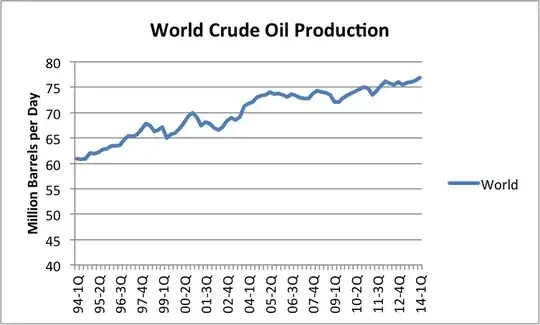
Now look at total world oil production:

enter image description here

From the graph it can been seen that subtracting out the 5 million barrels/day of unconventional production, world production is somewhat below the 2005 level. (Quantitative values were 73.9 M bbl/day in 2005; 76.9 M bbl/day in first 8 months of 2014)

With the expectation that tight oil and oil sands production will increase in share of the production, it is entirely possible that the peak in conventional production has already occurred.

DavePhD
  • 5,972
  • 20
  • 51