9

After recently visiting the Dead Sea in Israel and not getting any skin burns, I was wondering about the reasons for that. Searching the literature, it seems that the UV radiation is indeed lower in the Dead Sea (ca. -400 m) compared to Beer Sheva (a nearby city at ca. +300 m): 1 2 3. Both UVA and UVB rays are lower, but UVB rays are attenuated the most.

These sources give mostly measurements, but hardly discuss the reasons for the lower radiation. I always thought that the ozone layer blocks most of the UV radiation, but here it seems that just a few hundred meters of atmosphere can greatly reduce the amount of incident UV.

What are the reasons for that? Is it simply because there are more air molecules that absorb the radiation?

Gimelist
  • 23,122
  • 4
  • 68
  • 133

1 Answers1

8

You are almost totally correct when you asked:

What are the reasons for that? Is it simply because there are more air molecules that absorb the radiation?

The Ozone Layer blocks most of UVB, but does not affect the amount UVA entering the atmosphere (as seen in the illustration below):
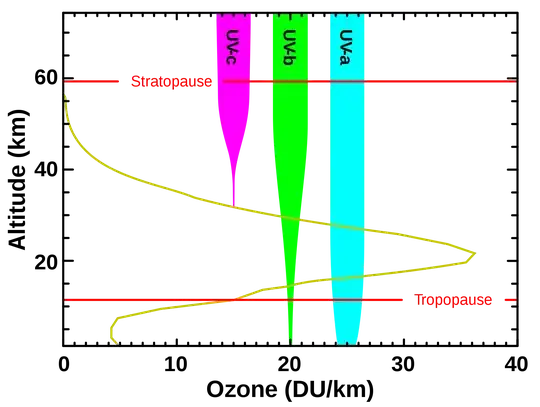
enter image description here

(Image source)

But there is a little more to it than that. From NASA's Earth Observatory's webpage What Determines How Much Ultraviolet Radiation Reaches the Earth’s Surface?, elevation's role in attenuating UVB (and by similar processes, UVA):

high elevations UV-B radiation travels through less atmosphere before it reaches the ground, and so it has fewer chances of encountering radiation-absorbing aerosols or chemical substances (such as ozone and sulfur dioxide) than it does at lower elevations.

The aerosols absorb and scatter incident UV radiation. So nearer to the surface, there is a greater concentration that the light must pass through - and as the altitude decreases, the UV radiation path is therefore increased, so the further 'down' in altitude, the more the air mass and an increased presence of aerosols absorb and scatter solar UV radiation.

In respect to the aerosols in area you have specified (the Dead Sea), according to the first link in your question, The Analysis of the Ultraviolet Radiation in the Dead Sea Basin, Israel (Kudish et al. 1997), they state

the air above the Dead Sea is characterized by a relatively high aerosol content due to the very high salt content of the Dead Sea

Their results indicate that

The relative attenuation in the ultraviolet range as a function of wavelength, i.e. site-specific spectral selectivity, decreases with increasing wavelength.

thus, indicating that the attenuation is also wavelength dependent.

  • Could it be that the Dead Sea, being a lower elevation area rimmed by mountains on both sides, also has unusually large aerosol contents in the air? – Gimelist Nov 02 '14 at 05:17
  • Quite possibly, particularly mineral dust –  Nov 02 '14 at 05:18
  • @Michael I added a bit more to my answer with respect to your comment query –  Nov 02 '14 at 05:46
  • Yea, I also read that. But it seemed this was one of the mechanisms they were offering and nothing conclusive. Also, I'm not completely sure I understood the part about wavelengths and "site specific spectral selectivity". – Gimelist Nov 02 '14 at 05:54
  • 1
    @Michael, yes, you are right, they have focused on one mechanism - that's why this is a good question. Site specific spectral selectivity is that specific wavelengths and ranges of wavelengths are attenuated by local aerosols and conditions. –  Nov 02 '14 at 05:57
  • @Omen you might also reference an image such as here: http://chriscolose.files.wordpress.com/2010/02/atmospheric_transmission.png , which shows the altitude dependence of light at the surface ... the changes around the UV region are of interest. – f.thorpe Nov 07 '14 at 17:03
  • @farrenthorpe, I don't see any altitude in there. – Gimelist Nov 07 '14 at 17:05
  • @Michael yes good point, the altitude dependence is implied in the 0% to 100% vertical axis. The altitude dependence of gases and UV extinction both vary by season and latitude, but the figure is useful for illustrative purposes. I'll try to find a specific example that shows altitude. – f.thorpe Nov 07 '14 at 17:11
  • 1
    This one of solar irradiance makes the point a little better I think. The point is that the absorption continues to occur where the atmosphere gets thicker (e.g. below sea level), which would make the differences between top of atmosphere and surface even greater http://upload.wikimedia.org/wikipedia/commons/thumb/e/e7/Solar_spectrum_en.svg/2000px-Solar_spectrum_en.svg.png – f.thorpe Nov 07 '14 at 17:20