What are the main differences between geologists and geophysicists?
Asked
Active
Viewed 2.6k times
11

-
4http://www.ualberta.ca/~unsworth/geophysicist_defn.pdf ;-) – s-m-e Apr 17 '14 at 17:25
-
8A geophysicist friend once told me that geophysicists are geologists that know math. :) – Gimelist Sep 03 '14 at 06:29
-
Interesting question, even more interesting answers. I am a meteorologist and oceanographer, and have considered myself a geophysicist in general. – milancurcic Sep 12 '14 at 19:02
3 Answers
14
It's not a healthy distinction, but in petroleum geoscience one can characterize the distinction around the sort of data people look at. Geophysicists are into seismic, sonic logs, gravity and magnetics data, electromagnetic (resistivity) data,... and anything to do with computers. Geologists meanwhile are into core, outcrop, gamma-ray and density logs, stratigraphy, tectonic reconstructions,... and anything to do with coloured pencils. Of course, they're both working towards the same thing: a model of the earth and its history.
Your question also made me think of a couple of Twitter conversations, both started by Chris Rowan at Kent State:
I'd be interested in your answers to q I'm exploring in my lecture this morning: what makes geophysics distinct from geology? Read thread.
Why I sometimes get antsy when people call me a geophysicist. Ultimately, I favour reality over fancy computer plots. Read thread.
The first one of these prompted me to draw this:
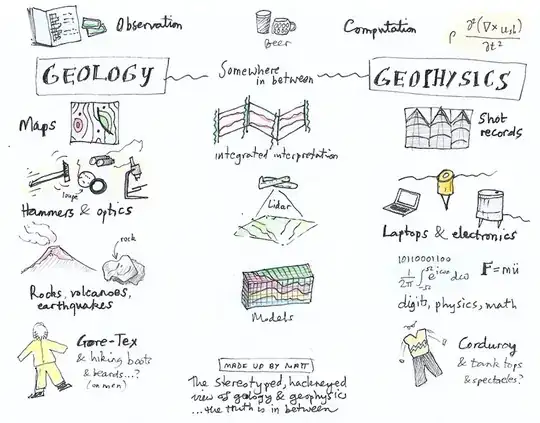
I make no claims to the accuracy or seriousness of this facile comparison.

Matt Hall
- 11,001
- 1
- 44
- 67
-
1
-
@Michael Good point... But can you really tell geols and geophs apart with them? Are they not one of the most convincing examples of convergent evolution? – Matt Hall Sep 13 '14 at 10:35
-
1By the way, do you have that drawing in higher resolution? It's pretty good :) – Gimelist Nov 29 '14 at 11:34
-
2
-
Sort of see the same patterns in synoptic/operational meteorologists versus dynamical/research meteorologists. It's a great world when both sides of the coin can contribute in a useful way :-) – JeopardyTempest Oct 31 '17 at 05:33

12
First of all you have to think about that both geology and geophysics are huge fields and even people that think of themselves as a geologist or geophysicist can have vastly different research topics.
If a geologist and a geophysicist are interested in the same topic, e.g. the lithosphere, they will have a lot in common. In this example I think the main differences would be methodology. While a geophysicist would rely on the analysis of seismic waves, numerical simulations and modelling, a geologists would work more with lithospheric scale cross sections, and geologic data that he or she can gather on the surface.
In summary I would say: The fields have much overlap, many differences, and when approaching a question more calculations and modelling will be done in geophysics and more field work and lab work (petrology, age dating, stratigraphic age, ...) will be done in geology.

tobias47n9e
- 3,956
- 22
- 41
1
Quote from: Developments in Petroleum Science, Vol. 60. dx.doi.org/10.1016/B978-0-444-50662-7.00003-2 © 2013 Elsevier B.V. All rights reserved.
Geology and geophysics are two constituent disciplines of geoscience or earth science. As we discussed in Chapter 2, geology, being an observational science, involves the study of the earth by direct analysis of rocks and formations, either from surface exposure or from boreholes, tunnels, and mines. It involves the deduction of the earth’s structure, texture, composition, or history, by the analysis of such observations. Geophysics, on the other hand, is a science that deals with the physical features of the earth’s surface and its internal structure. It applies the principles of physics to the study of the earth. Virtually all of what we know about the earth below the limited depths to which boreholes or mine shafts have penetrated has been derived from geophysical observations.

Fred
- 24,668
- 5
- 52
- 94

Stephen Kizza
- 11
- 1
-
Developments in Petroleum Science, Vol. 60. http://dx.doi.org/10.1016/B978-0-444-50662-7.00003-2 © 2013 Elsevier B.V. All rights reserved. – Stephen Kizza Oct 26 '22 at 09:18