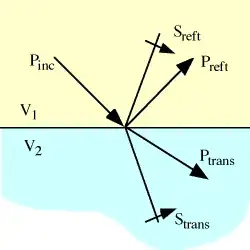
P and S waves are fundamentally different, when it comes to properties of the wave. An example might be that P waves can travel through fluids while S waves cannot. However, when it comes down to wave theory, these two are just different polarizations of a mechanical wave.
Seismology
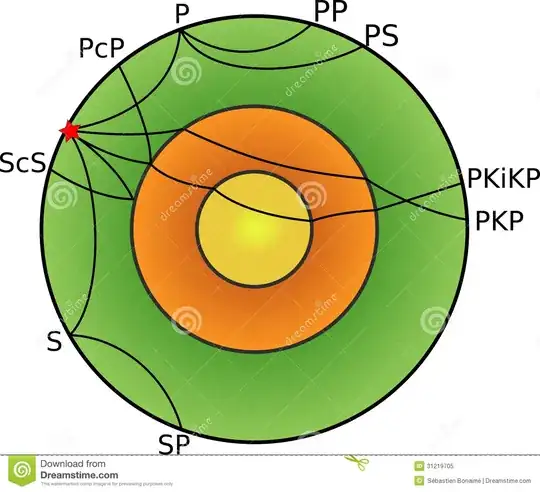
In seismics this concept may be puzzling as we make some very fundamental assumptions. However, seismologists are very well aware that these polarizations (they call them phases) usually change throughout their travelpath. When you look at the image below, you can see different travelpaths and the same source will trigger P and S waves. This P wave will travel to the point P where it can be recorded as direct P wave. Upon reflection it will be partially converted to a S wave, which you can also see on the nomination PP is the P part of the reflected P wave and PS is the S part of the reflected and converted P wave. (Actually you can go on happily converting back and forth.)
Seismics
In seismics we get this conversion on interfaces or layer boundaries (whichever name you use). So everytime a wave is reflected it may also be partially converted into a different polarization. So essentially, your statement is wrong. The wave doesn't just convert passing through a layer, it is converted upon interaction with an interface.
So while this wasn't a yes directly to your question let me elaborate why this conversion happens.
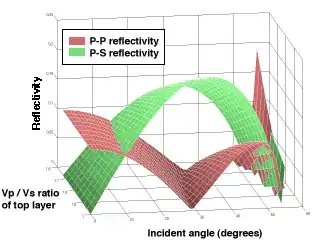
This picture basically shows the rate of conversion depending on the incident angle. At 30° the rate of conversion is maximized. (The scales are terrible to read sorry.) At this interface we can see the incident wave as excitor of a new wave package. So we have to take a detour into wave excitation.
Exctiting waves
In marine seismics we can excite pure P waves, because we're operating in a fluid. On land you will always excite a mix of P and S waves (and variations thereupon, namely surface waves). The excitation of these waves is direction dependent. Starting a P wave in one direction will always start an S wave component perpendicular to this direction. Of course we have some energy distribution so that we get something like this:

P waves in the + direction and S waves in the - direction. (This image was vor conductivity but it serves the point.)
At the interface
We have to look at the incident wave as an excitor at the interface, which will give us a P and a S wave response. In seismics, wave theory and other solutions you can usually see the S wave solution stands perpendicular on a P wave solution (except when we're dealing with anisotropy). So yes in the end your incident wave will start two P waves and two S waves that look like this: