12

In the morning, Google shows the temperature from four or five hours ago (around 2:00 a.m.). But then I update the report, and I get the temperature slightly lower than before.

Why is the temperature at 2:00 a.m. higher than the temperature at 7:00 a.m.?

User123
  • 638
  • 5
  • 12
  • Whilst User123 answer mostly covers the reason why, it would be interesting to see if the temperature difference between 2am and 7am is always the same i.e is the difference always 5° or is it higher or lower somedays? This might indicate other factors influence the difference. – Matt Bartlett May 10 '21 at 13:13
  • @Matt Barlett it is often 4-5ºC, but for example this morning it was just 1-2ºC here at the North of Spain –  May 10 '21 at 13:46
  • 1
    @MattBartlett If there is clear sky, the difference is bigger, but when clouds are present, the difference is smaller. That's why anticyclones in the winter usually bring dry and freezing cold days (as opposed to anticyclones in the summer which usually bring dry and scorching hot days). – User123 May 10 '21 at 14:18
  • Don't forget to factor in condensation. It takes out energy of the air: it gets colder before it gets warmer (similar to having a pan filled of boiling water under the tap, having condensation on the tap itself. then you open the tap the cold water is way colder than normal) – EarlGrey May 10 '21 at 18:25
  • 2
    Heat does not travel back in time. – TylerH May 10 '21 at 18:34
  • @User123. The clouds provide an insulating layer which reflects heat back down and traps it in, reducing the rate of temperature drop. – Matt Bartlett May 11 '21 at 09:53
  • @Universal_learner do you live in the North West near the Pyrenees or North Eat near the Coast? Are there any large forests or woodland near you? – Matt Bartlett May 11 '21 at 09:57
  • @Matt Bartlett I live at the west of the Pyrenees, 100 km away from Basque Country coast. There are forest close to my town Pamplona. –  May 11 '21 at 09:59
  • 2
    @Universal_Learner. I'm not entirely sure on scale of the effect, but at night plants burn the fuel reserves they make during the day. So during the day they are Endothermic and take in heat (which is why grass feels cool to lie down on) and during the they are Exothermic and give out heat. Depending on the wind and size of the forest the evening air could be warmer. – Matt Bartlett May 11 '21 at 10:31
  • 1
    You may have noticed that the sun is missing overnight. – J... May 11 '21 at 15:12
  • @EarlGrey condensing moisture from the air actually releases energy into the air; the moisture must lose energy to turn from gas to liquid, it "gives" it to the air. I don't know the effect you're talking about so maybe I misunderstand... you're saying if putting a pan of boiling water in the sink under a tap, the condensation from the tap cools the water in the faucet?? If there were any cooling effect, it'd be from the reevaporation of the droplets (condensing warms the air it's in, reevaporating would cool the surface it was on). But the steam's warmth should heat the faucet more anyways. – JeopardyTempest May 11 '21 at 21:24
  • @EarlGrey... if you're saying "why doesn't the water come out hot"... it'd be because the water comes from down in the pipes, spending very little time in contact with the heated up faucet (and water heats "slowly"). Otherwise I'm not visualizing your scenario well! If you have a question about the effect you see, perhaps ask it as a separate question with more details of what you experience? – JeopardyTempest May 11 '21 at 21:27

2 Answers2

30

The Earth is always radiating heat to the space. But in the day the Sun delivers some heat. The net heat flux is then defined as the sum of those two factors. If the energy delivered by the Sun is bigger than the cooling rate, the Earth is net warming (positive net flux – we can imagine it like heat is travelling "to us"), as opposed to the opposite case (cooling; negative net flux – heat is travelling "away").

In the day, the Sun warms the ground until the evening. The Sun's heating rate is higher than the cooling rate, so the temperature is rising until it gets to a point where the heating rate is same as cooling rate. This happens in the evening, so the temperature is steady at that point. But the Sun goes even lower, so the net flux becomes negative. In the night there is only cooling of Earth, so the temperature is falling steadily until the Sun is high enough that it balances the cooling. This happens at a point of a minimum temperature.

Of course, this is valid for most of the days, but we can have some other effects that can change the time of the minimum temperature (clouds, fronts or advection, for example).

On graph:
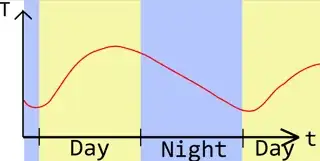
T(t)

So, the temperature is falling over night after the sunset, but rises again after the sunrise. Thus, the temperature is at its lowest point in the morning.


Appendix for all you loving calculations:

Note: Simplified to toy model, no atmosphere

The cooling rate of the Earth is approximatelly given by the Stefan-Boltzmann equation:

$$j_E=\sigma\cdot T^4=5.670 \cdot 10^{-8} \frac{W}{m^2 K^4} \cdot (288.15 K)^4 = 390 \frac{W}{m^2}$$

The maximum heating rate of Sun in the zenith is $j_{\text{S max}}=1361 \frac{W}{m^2}$. So, the heating rate of Sun at altitude $\alpha$ is: $$j_S=j_{\text{S max}}\cdot \sin{\alpha}=1361 \frac{W}{m^2}\cdot \sin{\alpha}$$

When is the heating rate equal to zero?

$$0=j_S-j_E=1361 \frac{W}{m^2}\cdot \sin{\alpha} - 390 \frac{W}{m^2}$$ $$1361 \frac{W}{m^2}\cdot \sin{\alpha} = 390 \frac{W}{m^2}$$ $$\alpha = 17 °$$

So, with our calculations, the minimum temperature is at the time when the altitude is equal to 17°.

User123
  • 638
  • 5
  • 12
  • 8
    I would argue that the concept of "warmed by the ground" is almost correct, but i think that the main point is not the interaction between the gound and the atmosphere, but, rather, the distinction between heat rate (positive in the day and negative in the night() and internal energy (temperature) of the system. Ths system keeps cooling while the heat rate is negative (night) and reached the coolest point when the heat rate becomes positive again. – Grigoris L. May 10 '21 at 09:31
  • 8
    This is nitpicky; I upvoted your answer. However, with regard to your statement the lowest temperature is right at the sunrise: I suggest changing that to "the lowest temperature is typically very close to sunrise". Your own graph shows the lowest temperature occurring shortly after sunrise. In addition, there are times (e.g., a warm front that arrives in the evening) when the lowest temperature of the day occurs before sunset. – David Hammen May 10 '21 at 11:01
  • @GrigorisL. I just think the concept of flux isn't so clear to a beginner, so I said it equivalently with warming and cooling. But I couldn't say that the Sun warms the air, so I mentioned heat exchange between ground and air. – User123 May 10 '21 at 14:12
  • The first two sentences seem unnecessary/out of place. What's important here is how long it has been since the sun has been shining in the surface. The time since sunset is far more impactful than the difference between whether the air is warmed directly or by the ground. – TylerH May 10 '21 at 18:38
  • In general correct, effects of wind (moving warm air to a colder area), large bodies of water, mounains, etc will give different results. – Paul Palmpje May 10 '21 at 18:49
  • 2
    I was just going to say "it's been cooling off since the sun went down, the sun has been set longer at 7:00am than it has at 2:00am" - glad you gave a 'real' answer! – TCooper May 11 '21 at 00:16
  • 2
    Can this also explain why June gets the most irradiance but August is the warmest month, in many places in the northern hemisphere? – Eric Duminil May 11 '21 at 10:57
  • 2
    @EricDuminil Yes, in the August, the mean cooling rate is equal to the mean warming rate, so the temperature is at its maximum. – User123 May 11 '21 at 14:55
-1

Your question is a bit ill-formed. There are more precise statements that we might take you as asking, for instance you might be claiming that the low takes place after sunrise, and be asking why that is. A very basic model of the temperature is that it is a sinusoidal function of time, and it is driven by the intensity of solar energy, also modelled as a sinusoidal function of time (that is, the net power, when the heat radiating from the Earth is subtracted from the heat coming from the Sun, is modelled as a sin function). If we had that the solar power is $P(t) = -\cos(t)$ where midnight is considered to be both $0$ and $2\pi$, and temperature is $T(t)$ where $T'(t) = P(t)$, then we would actually have $T$ and $P$ being $\pi/2$ (that is, six hours) out of phase with each other. That is, solving for $T(t)$ gives us $\sin$, and $\sin(t)$ is the same as $P(t-\pi/2)$.

The actual equation will be much more complicated: solar power isn't a sine wave, there are heat reservoir effects, radiative cooling depends on the current temperature, etc. The actual displacement between the minima will depend on all of those factors, but the general principle that the forcing function and the response function tend to be out of phase holds.

Acccumulation
  • 217
  • 1
  • 3
  • 1
    Is solar power really maximum at $\frac{\pi}{2}$? (= 6:00 a.m.) Think about this again. – User123 May 11 '21 at 20:22
  • 1
    And of course it's not nearly a sin function because solar energy itself is never negative... – JeopardyTempest May 11 '21 at 21:18
  • 1
    @JeopardyTempest Maybe he wanted to give the approximate function of heat flux. If he wanted to do that, it would be $P(t)=-\cos{t}$ and thus the integral $T(t)=-\sin{t}+T_0$. With this function we can see the minimum temperature at $\frac{\pi}{2}$ (= 6.00 a.m.) Otherwise, I think he has just overcomplicated the situation without making it better. – User123 May 12 '21 at 14:12