20

I have recently fallen into fallacy, considering pole s=1 as there is infinite response at frequency 1. Yet, response was only 1. Now, can you derive the frequency response, given the poles?

Secondly, the theory says that a system is stable when poles are in left s-plane and, thus, decay in time. But, wait. Does'n "pole" mean the infinite response -- the growth in time?

Finally, is it right question in DSP? IMO, D stands for digital whereas s-domain is analog. I do not find s-plane or Laplace transform tags to label my post.

update Thanks for the answers. It seems that I have got it except the one minor but fundamental thing -- the relationship of poles (and zeroes) with frequency. Basically, why are eigenvalues (or, how do you call the $s$ operator/variable) related with frequency? It should be somehow related with exponential growth and Laplace transform. I quite understand that poles happen to be eigenvalues (especially for discrete recurrences). But, how is this related with frequency?

Matt L.
  • 89,963
  • 9
  • 79
  • 179
Val
  • 1
  • 2
  • 6
  • 17
  • 1
    It's "Signal Processing stack exchange", not "DSP stack exchange". :) – endolith Jun 12 '13 at 21:57
  • 4
    Yep, as endoith mentioned, analog signal processing is on topic. DSP.SE was an expedient name for the initial launch, but http://signals.stackexchange.com now links here as well. – datageist Jun 12 '13 at 23:13
  • What exactly do you mean when you ask for the relationship between Poles and Frequencies? – Sudarsan Aug 04 '13 at 18:07
  • 1
    Obviously, it is how and why the poles determine the frequency response. – Val Aug 04 '13 at 18:39
  • The answer has already been given I guess. The frequency response is the Magnitude of the system response as you move along the $j\omega$ axis. If you've factored the System Transfer Function $H(s)$ into Product of $1/(s-p_{i})$ and $(s-z_{i})$, all you need to do is to find the magnitude at $s=j\omega$ for the Transfer Function and this obviously is determined by the Location of Poles and Zeros since they will be the ones that appear in the factored system response. – Sudarsan Aug 04 '13 at 20:05
  • It does not explain WHY. It says like if I press that button, I'll get the magnitude plot, like magic. This is a bad exposition of mechanics. I want to know WHY poles determine the frequency this way! Why not some function of poles, why not zeroes? Do you understand? – Val Aug 05 '13 at 06:23
  • Er. Transfer Function is some function of Poles and Zeros right? What do you think $H(S)$ is then? – Sudarsan Aug 05 '13 at 07:54

3 Answers3

19

One thing that really helped me understand poles and zeros is to visualize them as amplitude surfaces. Several of these plots can be found in A Filter Primer. Some notes:

  • It's probably easier to learn the analog S plane first, and after you understand it, then learn how the digital Z plane works.
  • A zero is a point at which the gain of the transfer function is zero.
  • A pole is a point at which the gain of the transfer function is infinite.
  • Often there are zeros or poles at infinity, which aren't always included in descriptions of the transfer function, but are necessary to understand it.
  • The frequency response in the S plane happens along the jω axis only.
    • The origin is 0 Hz, or DC, and the cutoff frequency of filters increases radially away from the origin. Putting a pole at any point along a circle at a certain distance from the origin will produce the same cutoff frequency.
    • To increase the cutoff frequency of a filter, move the poles radially outward.
    • To increase the Q of a biquad filter, move the poles along the circle towards the jω axis, which keeps the cutoff frequency constant, but increases the effect that the pole has on the frequency response, making it more "peaky".
    • Moving poles along a circle keeps cutoff frequency constant but changes Q
  • If a zero appears on the jω axis, then the frequency response will drop to zero at that frequency; if you input a sine wave at that frequency, the output will be 0.
  • If a pole appears on the jω axis, then the impulse response is an oscillator; any impulse will cause it to ring forever at that frequency. Impulses have finite energy, but the response of the filter has infinite energy, so it has infinite gain.

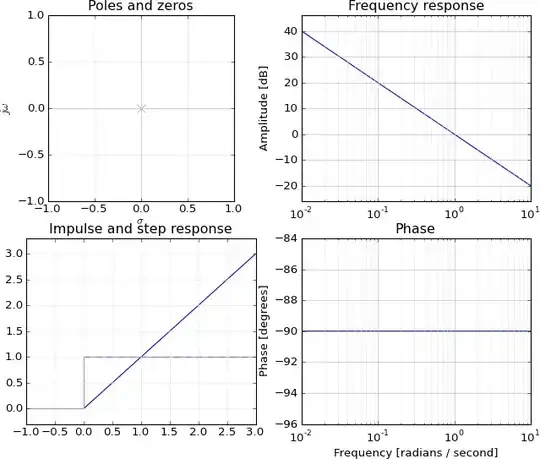
A simple example is an integrator H(s) = 1/s:

  • This function equals 0 when s is infinite, so it has a zero at infinity.
  • This function equals infinity when s is zero, so it has a pole at zero.

In other words, it has infinite gain at DC (the step response of an integrator is forever-increasing), and the gain decreases as frequency increases:

Bode plot of integrator

Moving the pole away from the origin, along the imaginary axis into the left hand of the S plane, makes the gain at 0 Hz on the jw axis finite again, and now you have a low-pass filter:

enter image description here

endolith
  • 15,759
  • 8
  • 67
  • 118
  • +1, nice answer. But I don't understand what you mean by "Any point along a circle at a certain distance from the origin has the same frequency." Curves of constant frequency in the $s$-plane are lines parallel to the real axis. For circles with origin at $s=0$ you get $\sigma^2+\omega^2=const$, where $s=\sigma+j\omega$. – Matt L. Jun 13 '13 at 08:21
  • He seems to confuse s-plane with z-plane – Val Jun 13 '13 at 13:16
  • @MattL.: Hmmm. I'm thinking of the poles of a Nth-order Butterworth filter being along a circle equidistant from the origin, for instance, or the poles of a biquad moving along a circle equidistant from the origin as you adjust the Q of the filter while keeping the frequency constant, or changing the cutoff of a filter by moving the poles closer to or away from the origin in a radial direction, or converting lowpass to highpass by inverting the poles about the unit circle. How should I reword this? – endolith Jun 13 '13 at 13:35
  • @Val: Cutoff frequency. I've already edited the post to correct it. – endolith Jun 13 '13 at 15:57
  • 6
    Val, No need for a douchy snarky comment to @endolith. – Spacey Jun 13 '13 at 16:30
  • At first, I do not understand why you have a pole at 0. Secondly, can you say that cutoff frequency of filters = distance from the origin (or from the poles)? – Val Jun 13 '13 at 16:38
  • @Val: Do you mean the pole at 0 for the integrator? If you put DC into an integrator, the output increases to infinity, no? Yes, I mean cutoff frequency of filter ≈ distance between poles and origin. I think it's only proportionally true for things like Bessel/Chebyshev filters, though, since there are different definitions for the cutoff frequency. – endolith Jun 13 '13 at 17:27
  • Ok, I did not realize that it is true indeed that placing poles at the circle results in the same cutoff. On the other hand, it is contradictory that gain is constant at the circle poles but infinite when poles are purely imaginary and how statement that The frequency response in the S plane happens along the jω axis only is related with circular poles -> same response. – Val Jun 13 '13 at 18:34
  • @Val: Yes, those are related. When the pole falls exactly on the jω axis, then the frequency response reaches infinity at that point. When the pole is near the jω axis, then the frequency response is affected only by the "skirt" of the pole. See in the diagram above? The thick red line is the frequency response of the transfer function, and the pole is not on the line, so the gain is "pulled up" by the pole, but remains finite. The pole is like a tent post, and the frequency response is a slice of the tent. Animations would show this more clearly. – endolith Jun 13 '13 at 19:32
  • But then it is not true that you have the same response for the poles at the circle around because, since, as you move the tent pole along it, the slice morphs also. But I accept because the red slice is what I was asking for. – Val Jun 13 '13 at 19:37
  • @Val: Yes, but the slice morphs in such a way that the frequency at which the log-log plot's asymptotes meet is constant if the distance from the pole to the origin is constant. – endolith Jun 13 '13 at 19:39
  • Do you see where I compute that pole s=1 results in response 1/2 at freq w=1 whereas pole s=j responds with 1/0 = ∞ at the same frequency 1. Hardly log scale can mitigate that. The scale should not change the values that you tell are the same and it is especially difficult to say that some finite value is equal to infinity. Ok, it is much clear now with the last picture you've added. We may have absolutely different responses at the same, cutoff frequency. – Val Jun 13 '13 at 21:45
  • and someday I intend to make animations of all of these, but others are welcome to beat me to it – endolith Apr 22 '16 at 21:14
13

I think there are actually 3 questions in your question:

Q1: Can I derive the frequency response given the poles of a (linear time-invariant) system?

Yes, you can, up to a constant. If $s_{\infty,i}$, $i=1,\ldots,N,$ are the poles of the transfer function, you can write the transfer function as

$$H(s)=\frac{k}{(s-s_{\infty,1})(s-s_{\infty,2})\ldots (s-s_{\infty,N})}\tag{1}$$

Note that $s$ is a complex variable $s=\sigma+j\omega$, and the frequency variable $\omega$ corresponds to the imaginary axis of the complex $s$-plane. Now we need to get the frequency response from the transfer function. For stable systems this can simply be done by evaluating the transfer function $H(s)$ for $s=j\omega$. So you replace $s$ by $j\omega$ in (1) and you're done. Note, however, that this is only true for stable systems (i.e. if the region of convergence of $H(s)$ includes the $j\omega$-axis).

Q2: How can a stable system have poles?

As you already know, for causal and stable systems, all poles must lie in the left half-plane of the complex $s$-plane. Indeed, the value of the transfer function $H(s)$ will go to infinity at a pole $s=s_{\infty}$, but the frequency response will be OK, because if all poles are in the left half-plane, there are no poles on the $j\omega$-axis (or to the right of it). If you look at it in the time-domain, then each (simple) pole has a contribution of $e^{s_{\infty}t}$ to the system's impulse response. If the pole is located in the left half-plane, this means that $s_{\infty}=\sigma_{\infty}+j\omega_{\infty}$ has a negative real part $\sigma_{\infty}<0$. So

$$e^{s_{\infty}t}=e^{\sigma_{\infty}}e^{j\omega_{\infty}}$$

is an exponentially damped function and does not grow but decays, because $\sigma_{\infty}<0$.

Q3: Does this question belong here?

Other community members have to judge whether this question belongs here. I think that it does. It is obviously not directly related to pure DSP, but DSP engineers very often also have to deal with analog signals and systems before AD conversion, so they also know about continuous system theory. Second, almost all DSP people (at least the ones with traditional training) got quite some exposure to general signals and systems theory, including continuous-time and discrete-time systems.

By the way, for discrete-time systems you get the $\mathcal{Z}$-transform instead of the Laplace-transform, and your complex variable is now called $z$ instead of $s$. The variable $D$ that you've mentioned is defined as $D=z^{-1}$ and is mainly used in the coding literature. By its definition, it denotes a delay element, so $D$ stands for "delay" (not "digital").

If you know that the left half-plane of the complex $s$-plane maps to the region inside the unit circle of the complex $z$-plane (i.e. $|z|<1$), and the $j\omega$-axis maps to the unit circle $|z|=1$, then almost everything you know about one of the two domains will easily carry over to the other domain.

Matt L.
  • 89,963
  • 9
  • 79
  • 179
  • I think that frequency response involves complex conjugation in addition s in H(s) for s=jω. – Val Aug 03 '13 at 21:55
1

I won't tell the full mapping from poles(1)/zeroes(0) to the frequency response but I think I can explain the connection between frequency and zero/infinite response, why do you have infinite/zero response at $e^{-jw}=z_\text{zero/pole},$ i.e. what $e^{-jw}$ has to do with $z$.

The general form of the linear system is $$y_n+a_1y_{n-1}+a_2y_{n-2}+\cdots = b_0 x_n + b_1x_{n-1}+b_2x_{n-2}+\cdots, $$ which can be solved in z-from as $$Y(z) = {(b_0 + b_1 z + b_2 z^2+\cdots)\over(1+a_1z+a_2z^2+\cdots)}X(z) = H(z)X(z) = {(1-z_0z)(1-z_1z)\cdots \over(1-p_0z)(1-p_1z)\cdots}X(z).$$

In the end, the series of binomial products $(1-z_0 z)\cdots{1\over 1-p_0 z}$ can be considered as a series of systems, where first output, is the input for another.

I would like to analyze the effect of single pole and zero. Let's single out the first zero, considering it the transfer function so that the rest of $H(z)X(z)$ is the input signal, $Y(z)=(1-z_0z)Χ(z),$ which corresponds to some $y_n = b_0x_n + b_1x_{n-1}.$ Let's take $b_0=b_1=1$ for simplicity. I mean that $y_n = x_n + x_{n-1}$.

What we want to determine the effect of the system H(z) upon harmonic signal. That is, the input is going to be test signal $$x_n = e^{jwn}\overset{z}{\leftrightarrow} 1 + e^{jw}z + e^{2jw} z^2 + \cdots = 1/(1-e^{jw})= X(z).$$ The response is going to be $$y_n = x_n + x_{n-1}|_{x_n = e^{jwn}} = e^{jwn} + e^{jw(n-1)} = e^{jwn}(1+e^{-jw})$$ that is, $1+e^{-jw}$ is the transfer function or $Y(z) = {(1+z)\over (1-e^{jw}z)} =(1+z)X(z)$.

Please note that $1+z$ basically says that output is sum of input signal plus shifted signal, since single $z$ stands for single clock delay in time domain.

Now, as explained in, $H(jw) = 1 + e^{-jw} = e^{-jw/2}(e^{jw/2}+e^{-jw/2}) =e^{-jw/2}2\cos(w/2)$. Cosine makes it to behave like low-pass filter $$ \begin{cases} w=0 & \Rightarrow &H(j0) = 1\cdot 2 \cos (0) = 2\\ w=\pi & \Rightarrow & H(j\pi) = e^{j\pi/2}2\cos(\pi/2) = 0 \end{cases}$$

It is also a good lesson that you get $2 cos \alpha = e^{i\alpha} + e^{-i\alpha}$ because you will supply the real signals rather than complex imaginary ones in real life.

LTI with impulse response = {1,-1} is $y_n=x_n -x_n|_{x_n=e^{jwn}} =e^{jwn}(1-e^{-jw})$ has transfer function of $H(jw) = (1-e^{-jw}) = e^{-jw/2}(e^{jw/2}-e^{-jw/2})=e^{-jw}2\sin(w/2)$, which has zero at $w=0$ since $sin(0)=0$ but it can be found from the frequency response $$H(jw)=1-e^{-jw} = 0 \Rightarrow e^{-jw} = 1 = e^0 \Rightarrow w = 0.$$

After the textbooks, I can spot the surprising coincidence between transfer function $H(z) = 1\pm z$ and frequency response $H(jw)=1\pm e^{-jw}$. That is, z somehow corresponds to $e^{-jw}$, which is important for zero/pole analysis. I read it like

sine z-factor stands for a clock shift and $y_n = x_n \pm x_{n-1}=0$ means that next sample is $\pm$ previous one to get zero response, we need to have $1\pm z=0$ in front of X(z). But, the frequency domain basis functions $e^{jwn}$ evolve by multiplying current value $e^{jw(n-1)}$ with $e^{jw}$ every clock. Therefore, we have $e^{jwn}(1 \pm e^{-jw}) =0$ as condition for constant zero output. The latter $1\pm e^{-jw}$ matches perfectly with zero transfer function $1\pm z=0$.

In general, single-zero LTI is given by $y_n = b_0 x_n + b_1 x_{n-1}$ or $$Y(z) = (b_0 + b_1 z)X(z) = (b_0+ b_1z)(1+x_1z+x_2z^2+\cdots) = b_0 + (b_0 x_1 + b_1 x_0)z + (b_0 x_2 + b_1 x_1)z^2 + \cdots. $$ When $b_0+b_1 z = 0$, i.e. when $z=-b_0/b_1,$ whereas frequency response is, $$y_n(x_n = e^{jwn}) = b_0 e^{jwn} + b_1 e^{jw(n-1)} = e^{jwn}(b_0+b_1 e^{-jw})= e^{jwn}b_0(1-z_0 e^{-jw}),$$

which goes to zero when $1-z_0 e^{-jw} = 0$ or $e^{-jw} = 1/z_0$, which matches the computation for $z$ if $z=e^{-jw}$. The only thing that bothers me is that fixed-amplitude complex exponential is not enough for the frequency (harmonic) basis. You cannot obtain arbitrary ratio $1/z_0= e^{-jw}$ by choosing appropriate frequency $w$, a decaying harmonic signal is needed for that. That is weird because I have heard that any signal can be represented as sum of (constant amplitude) sines and cosines. But, anyway, we see that system zero stands for relationship between adjacent samples of input signal. When they are right, the output is identically 0 and we can choose such such frequency $w$ so that zero $z = 1/z_0 = e^{-jw}.$

Now, what about the poles? Let's single out a single pole $a$. The system has a from of $y_n = a y_{n-1} + (x_n + x_{n-1} + \cdots)$, under assumption $y_0 = 0$, has z-transform of $Y(z) = X(z)/(1-az)$.

The feedback $a$ is equivalent to infinite impulse response ${1,a,a^2,\ldots} \overset{z}{\leftrightarrow} 1 + az + a^2z^2 + \cdots = 1/(1-az)$. It says that response is infinite when $z=1/a$. What does it mean if we apply the test signal $$x_n=e^{jwn}\overset{z}{\leftrightarrow} X(z) = 1+e^{jw}z+e^{2jw}z^2+\cdots = 1/(1-e^{jw}z)$$ to our system? We'll get $Y(z)={1\over 1-az}{1\over 1-e^{jw}z},$ or $$y_n = e^{jwn} + ae^{jw(n-1)} +a^2e^{jw(n-2)} +\cdots = e^{jwn}(1+ae^{-jw} + a^2e^{-2jw} + \cdots) ={e^{jwn}\over 1-ae^{-jw}}.$$ That is, frequency response is $1/(1-ae^{-jw}),$ which goes to infinity when $e^{-jw}=1/a,$ the same as $z_{pole}$ above, $e^{-jw}=z_{pole}=1/a$. But again, you can not always arrive at the pole $1/a$ adjusting the frequency $w$ alone. The frequency basis functions must be decaying amplitude in general and look like $(ke^{jw})^n$.

That is, zeroes or poles of the transfer function $H(z)$ happen to match the zeroes and poles of frequency response $H(jw)$, which is really amazing. I noticed that this is related to the relation between adjacent samples, $e^{jwn}/e^{jw(n-1)} = e^{jw} = 1/z_{zero}$ in case of zeroes. The fact that $e^{jwn}$ scales exponentially over time, along with the system with feedback $a$, also seems to be the key for matching between $e^{jw}$ and $z_{poles}$. It also seems important that you cannot simply look for the appropriate frequency of $e^{jwn}$, the basis function must also have adjustable amplitude factor $k^n$.

I would be happy if anybody could explain the same more condensely or more crisply.