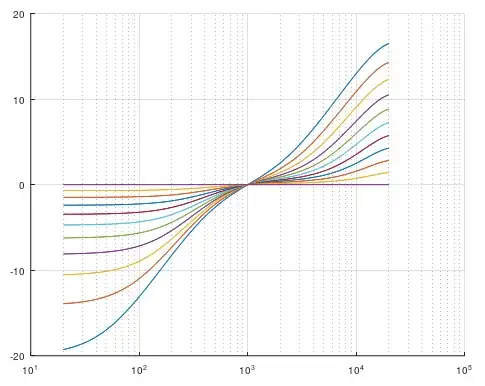
I have too few points for to comment so I try give you at least a partial answer.
You can't change those b coefficients using equal multiplier with a's.
As those final coefficients comes from transformation there might be some ratios you loose in that process. In my MZT based example below, you get the final coefficients from equations
b1 = -(pole1 + pole2)
b2 = pole1 * pole2
So, you can't restore the original ratio from b1 nor from b2 --> remember also that when swap the a's and b's to get pre-emphasis filter from de-emphasis filter (or vice versa) you need to do it using those coefficients having a0 and b0 = 1.0 (i.e. not tose normalized to have 0dB at 1kHz).
So, I would suggest you to manipulate coefficients before transformation. You'll find needed coefficients for that filter mentioned in your post here from.
Here's an example based on MZT transfer (you'll find the missing info through my posts here).
pole1 = 0.99289462847423215
pole2 = 0.73908439754585875
zero1 = 0.93117565229670540
zero2 = 0.0;
To get flat response in range 20Hz-20kHz you decrease the value of pole1 to around 0.93289462847523175 and pole2 to 0.0. In this example zero1 and zero2 remains untouched.
Note: These are not exact values especially for those coefficients from my nor Orban's posts but you get the idea.
Juha
EDIT: Here's Octave code to demonstrate post:
pkg load signal;
pkg load control;
%clear all;
%clf;
Fs = 44100;
minF=20;
maxF=20000; %Fs/2;
sweepF=logspace(log10(minF), log10(maxF),1024);
%% poles for RIAA de-emphasis filter @ 44100
p1 = 0.992894628474;
p2 = 0.739084397546;
z1 = 0.931175652297;
z2 = 0;
%% --------------------------------------------------
RIAApercent = 100                  %% 100 = RIAA, 0 = ~FLAT
%% --------------------------------------------------
RIAApercent = (100-RIAApercent)/100;
k1 = RIAApercent * -0.061718976177;
k2 = RIAApercent * -0.739084397546;
p1 = p1 + k1;
p2 = p2 + k2;
b(1) = 1.0
b(2) = -(p1 + p2)
b(3) = p1 * p2
a(1)= 1.0
a(2)= -(z1 + z2)
a(3)= z1 * z2
%% normalize 0dB @ 1kHz
w = 2.0pi(1000/Fs);
num = b(1)b(1)+b(2)b(2)+b(3)b(3)+2.0(b(1)b(2)+b(2)b(3))cos(w)+2.0b(1)b(3)cos(2.0w);
den = 1.0+a(2)a(2)+a(3)a(3)+2.0(a(2)+a(2)a(3))cos(w)+2.0a(3)cos(2.0*w);
G = sqrt(num/den);
b(1) = b(1)/G;
b(2) = b(2)/G;
b(3) = b(3)/G;
%% plot
hold on;
[h, w] = freqz(a,b, sweepF, Fs);
semilogx(w, 20*log10(h));
grid on;
results:

Reverse the curve by swapping b and a coefficients: