1

Is there any DBMS that can be installed as an OS instead of as an app on a OS? I wasn't able to find any.

Later edit, just to clarify: I'm used to installing a DBMS (MySQL, MSSQL) as a server(ice) onto an OS(Windows, Ubuntu, etc.). I was trying to find out if there are some DBMS' that do NOT require an underlying OS and are 'installed' as the OS directly on hardware. I was asking here because googling didn't help. Thanks for the answers I got, it seems that the answer is close to 'NO'

  • Unless you can narrow this question down a lot, it'll likely be closed since it is a shopping list style question. Questions about which tool, library, product or resource you should use are off-topic here because they quickly become obsolete and often are just about the preferences of the answerer. If you have an issue with or a question about a specific tool, please revise your question to conform to that scope. – Hannah Vernon Jan 15 '19 at 18:03
  • Over 20 years ago, I was asked to develop an application that used Novell Netware like a database. It wasn't a particularly good idea. – RDFozz Jan 15 '19 at 20:36
  • I disagree that it's a shopping list question. I think it should be reworded to something more concrete. Ask if any database currently runs it's back end in kernel space (ring0). That's much more concrete. – Evan Carroll Jan 15 '19 at 22:47
  • Maybe you should look at filesystems as a database rather than an OS as a db? Oracle has (had?) RAW tablespaces (not a good idea). – Vérace Jan 16 '19 at 21:54

2 Answers2

5

Yes. IBM i, formerly known as AS/400, is a platform with the operating system that has a relational DBMS as its integral part. Indeed, Db2 for i is in a way an alternative access method to the IBM i file system.

mustaccio
  • 25,896
  • 22
  • 57
  • 72
3

Googling a bit I found another operating system called TabulaROSA.

Designed by MIT it works on 32k core supercomputers, if you or your company can afford a system like that, it could be a good option.
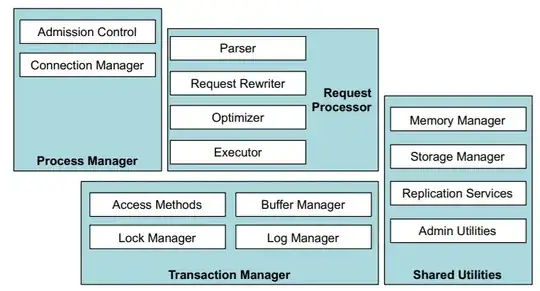
enter image description here Many overlaps between database systems and the functions required for an OS on a cluster, In the case of TabulaROSA, however, the functions are managed within database tables instead.

Quoted from the article:

The team defines key OS functions in terms of “rigorous mathematical semantics (associative array algebra) that are directly translatable into database operations. Because the math of database table operations are based on a linear system over the union and intersection semiring, these operations possess a number of mathematical properties that are ideal for parallel operating systems by guaranteeing correctness over a wide range of parallel operations.

Simulations of forking in TabularROSA are performed by using an associative array implementation and are compared to Linux on a 32,000+ core supercomputer. Using over 262,000 forkers managing over 68,000,000,000 processes, the simulations show that TabulaROSA has the potential to perform operating system functions on a massively parallel scale. The TabulaROSA simulations show 20x higher performance compared to Linux, while managing 2000x more processes in fully searchable tables

You can get more information about it on:

or in this PDF paper:

McNets
  • 23,749
  • 10
  • 48
  • 88
  • Interesting reading, but it doesn't look like a true operating system that you can install, and there isn't much of a database there either; they simply simulated one of the Unix syscalls by multiplying some hash tables. – mustaccio Jan 15 '19 at 23:29