1

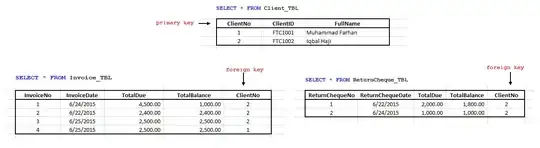
There are there tables the below image.

enter image description here

My question is retrieve from each customers and get the sum of Invoice total due, Invoice Total balance in invoice table and return cheque total due and return cheque total balance in return cheque table...

I wanted the answer like below image from the above 3 table using inner join

Please help me thank you.

enter image description here

M.I.M.F
  • 329
  • 1
  • 7
  • 19
  • Can you post create table .. with some data at http://sqlfiddle.com/#!6. This will help us help you out – Kin Shah Jun 24 '15 at 20:33

2 Answers2

5

This may not be the best way to do this but it will work.

SELECT c.ClientNo, c.ClientId, c.FullName, i.InvoiceTotalDue, i.InvoiceTotalBalance, r.ReturnChequeTotalDue, r.ReturnChequeTotalBalance, (i.InvoiceTotalBalance + r.ReturnChequeTotalBalance) AS TotalBalance
FROM Client_TBL c
LEFT JOIN (
SELECT ClientNo, SUM(TotalDue) AS InvoiceTotalDue, SUM(TotalBalance) AS InvoiceTotalBalance
FROM Invoice_TBL
GROUP BY ClientNo
) AS i ON c.ClientNo = i.ClientNo
LEFT JOIN (
SELECT ClientNo, SUM(TotalDue) AS ReturnChequeTotalDue, SUM(TotalBalance) AS ReturnChequeTotalBalance
FROM ReturnCheque_TBL
GROUP BY ClientNo
) AS r ON c.ClientNo = r.ClientNo

And of course you could change the subqueries into CTEs. But basically you are going to collect the data pre join since otherwise you are probably going to get bad data (Client 2 for example will have Invoice info that is twice as large and ReturnCheque that is 3 times as large.)

M.I.M.F
  • 329
  • 1
  • 7
  • 19
Kenneth Fisher
  • 24,127
  • 12
  • 61
  • 114
  • Thanks for the answer but answer is incorrect.. only display one person account value... i wanted to display the answer like the above 2nd image.. – M.I.M.F Jun 24 '15 at 20:27
  • 1
    Kenneth has it basically right. To fix the missing clients use LEFT JOIN instead of JOIN to avoid removing clients for whom there are no returned checks. – Chris Jun 24 '15 at 20:43
  • YES Kenneths Answer is correct instead of using JOIN for LEFT JOIN.. and thanks Chris.. Any good solutions instead of this answer... and please explain the answer how answer came. – M.I.M.F Jun 24 '15 at 20:59
  • 1
    LEFT JOIN is absolutely correct. Sorry about that. I read JOIN in the question and was going to mention the LEFT JOIN in the text but got in a hurry and forgot. Thanks for the catch @Chris ! – Kenneth Fisher Jun 24 '15 at 21:02
  • @user1663855: There may be other ways to solve this query, but they aren't going to be "better" or much more compact than the answer Kenneth has given. – Chris Jun 24 '15 at 21:08
  • Chris can you show me other way to solve this solution.. – M.I.M.F Jun 24 '15 at 21:10
  • Why do you need another way? This is perfectly good, if not the best. – ypercubeᵀᴹ Jun 24 '15 at 21:11
  • I am curious @ypercube is this possible to do with window functions? It didn't seem like an obvious way to do it for me. – Kenneth Fisher Jun 24 '15 at 21:40
  • I don't think so. With inline subqueries, yes. With window function, I can't think of a way that would use them and avoid the derived tables, like your query. – ypercubeᵀᴹ Jun 24 '15 at 21:45
  • @user1663855 check my answer in a similar problem here: Help with this query. Kenneth's answer is like my "option 3" (my favourite!) and inline subqueries is "option 1". Option 2 is unusable in your case because SUM() is different than COUNT(). – ypercubeᵀᴹ Jun 24 '15 at 21:47
  • @ypercube That's what I thought. And it would need 4 inline subqueries. Although I suppose you could use CROSS APPLY. – Kenneth Fisher Jun 24 '15 at 21:48
  • Yeah, CROSS or OUTER APLY would work fine. – ypercubeᵀᴹ Jun 24 '15 at 21:49
0

I was trying another way, and here what I got:

    SELECT 
        ClientNo,
        ClientID,
        FullName,
        SUM(InvoiceTotalDue) as InvoiceTotalDue,
        sum(InvoiceTotalBalance) as InvoiceTotalBalance,
        sum(ReturnChequeTotalDue) as ReturnChequeTotalDue,
        sum(ReturnChequeTotalBalance) as ReturnChequeTotalBalance
    FROM (SELECT 
                CT.ClientNo,
                CT.ClientID,
                CT.FullName, #IT.*,RCT.* 
                IT.TotalDue as InvoiceTotalDue,
                IT.TotalBalance as InvoiceTotalBalance,
                0.00 as ReturnChequeTotalDue,
                0.00 as ReturnChequeTotalBalance  
            FROM Client_TBL as CT
            JOIN Invoice_TBL as IT on (IT.ClientNo=CT.ClientNo)

            UNION
            SELECT 
                CT.ClientNo,
                CT.ClientID,
                CT.FullName, #IT.*,RCT.* 
                0.00 as InvoiceTotalDue,
                0.00 as InvoiceTotalBalance,
                IFNULL((RCT.TotalDue),0.00) as ReturnChequeTotalDue,
                IFNULL((RCT.TotalBalance),0.00) as ReturnChequeTotalBalance   
            FROM Client_TBL as CT
            JOIN ReturnCheque_TBL as RCT on (RCT.ClientNo=CT.ClientNo)) AS ResultSet
    GROUP BY ClientNo;

enter image description here

If you want you can create a stored procedure to filter any information that you want.
marc_s
  • 8,932
  • 6
  • 45
  • 51
oNare
  • 3,181
  • 2
  • 20
  • 35
  • Thanks for the answer oNre.. but getting error... Incorrect syntax near 'IT'. AND Incorrect syntax near '0.00'. i'm using SQL Server 2008 – M.I.M.F Jun 25 '15 at 06:40
