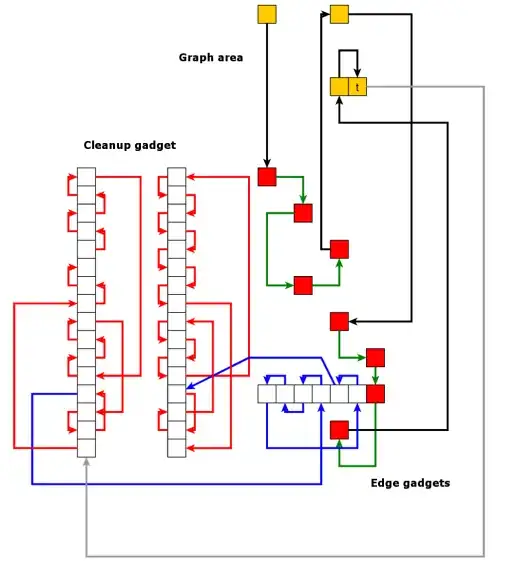
While formalizing the gadgets for the proposed reduction of the question Efficient algorithm for existence of permutation with differences sequence? the following problems came to my mind:
Problem 1 (I call it the "crazy frog problem" :-))
Given a $n \times n$ partially filled board (some cells are empty, some are already filled), a starting cell $c_0 = (x_0,y_0)$ and a list of jump distances $(\Delta x_1,\Delta y_1),(\Delta x_2,\Delta y_2),...,(\Delta x_m, \Delta y_m),\; -n < \Delta x_i, \Delta y_i < n$; is there a sequence $(s_1,s_2,...,s_m), s_i \in \{+1,-1\}$ such that the sequence of jumps: $$c_j = ( x_{j-1} + \Delta x_j * s_j, \quad y_{j-1} + \Delta y_j * s_j ) $$
makes the frog visit every empty cell of the board exactly once? (every jump must be within the boundaries of the board, at every jump the target cell must be empty, after the jump the cell becomes filled)

Figure 1. An instance of the CFP on the left and its solution on the right.
Problem 2
What is the complexity of the Hamiltonian path problem on grid graphs with holes, if we force the path to be an alternating sequence of horizontal/vertical moves (i.e. two consecutive horizontal/vertical moves along the path are forbidden).
Are these problems already known and what is their complexity?
Notes: there is an immediate reduction from problem 2 to problem 1; probably there is a reduction from problem 1 to the problem of finding a valid permutation from a difference sequence (which I'm trying to prove NPC).