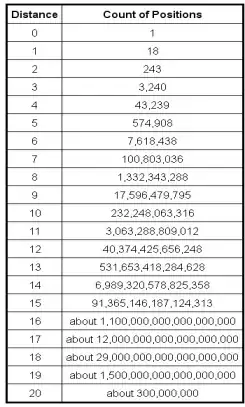
I saw a previous question about local maxima for the number of moves in a Rubik's cube solution, and I wondered what is known about the distribution of shortest paths when randomly scrambling a Rubik's cube.
- If I were to pick a (solvable) configuration at random, how far is it to the solved state?
- How many random moves does it take to sufficiently scramble the cube?
For the second question, I'm thinking of it as the mixing time, like for the Diaconis 7 shuffle result for a deck of cards. (Perhaps this is the wrong terminology?)
This is related to another question of mine about adversarially scrambling a Rubik's cube.
Edit: I accepted Marzio's answer, though I still wonder about the mixing time. Google revealed some results for particular finite groups, but I didn't see anything about Rubik's cube. Maybe one of these is applicable / can be ported over?