4

I am asking this question because the entire comment thread in which I asked the question appears to have gone missing, including references to Aquinas (Summa Theologica q. 35 a. 6), Ludwig Ott (Fundamentals of Catholic Dogma bk. 3, pt. 3, ch. 2, §5, 2.), Pohle (Mariology pt. 2, ch. 1, §3, Theses II), and others.

Wikipedia lists St. Lucia of Syracuse (283-304) as the patron saint of of the blind within Roman Catholicism. She is venerated, along with St. Agnes (patron saint of virgins) among Roman Catholics, Anglican, Lutheran, and Eastern Orthodox churches. She is one of only 8 women explicitly commemorated by Roman Catholics in the Canon of the Mass.

There is, within the tradition regarding St. Lucia, the possibility that she was assigned to defilement within a brothel by the Governor of Syracuse. Paschasius ordered her to burn a sacrifice to the emperor's image. When she refused, Paschasius sentenced her to be defiled in a brothel; a particularly heinous crime against someone who had dedicated her chastity to God.

In a question regarding the Catholic tradition that Mary (Jesus' mother) did not suffer pain in childbirth (Where does the Catholic tradition that Mary did not have pain giving birth to Jesus come from?), included in the comments of a particular answer, came the assertion that, even if Lucia was raped and even if she had survived and produced a child from this violation, she would still be honored by name in the Catholic Mass as a martyred virgin even though her bodily integrity was ruined. This was explained as because an intact hymen is accidental to virginity while the commitment of the will is essential to virginity. In other words the taking of sexual liberty by force and against one's will does nothing to impinge upon one's state of virginity even though it may change the state of one's bodily integrity. Therefore the state of one's bodily integrity has nothing to say, directly, to one's virginal condition.

The reference to St. Lucia came about as the bodily integrity of Mary (i.e. no ruptured hymen in childbirth) was indicated as integral to her "perpetual virginity" which is in turn linked to her sinlessness which is in turn linked to her painless childbirth. It seems to me, however, that if an intact hymen is accidental to virginity then a ruptured hymen must surely be accidental to the birth of a virginally conceived child.

If St. Lucia would still retain her virginal status in the eyes of the Catholic Church regardless of the state of her bodily integrity following rape, why is it so important for Mary's bodily integrity to remain intact as regards her "perpetual" virginity during childbirth?

Geremia
  • 39,167
  • 4
  • 47
  • 103
Mike Borden
  • 16,820
  • 2
  • 18
  • 50
  • @BrianMcCutchon That's definitely not true. "Catholic" Answers isn't orthodox. The de fide dogma on her virginitas in partu (virginity during parturition) refers primarily to her bodily (physiological) virginity. How can they honestly claim "the Church has no official teaching on the physiological aspects of Jesus’ birth"? – Geremia Apr 19 '21 at 21:49
  • The hymen has nothing to do with virginity. Many times sex does not tear it, cause bleeding, or pain. It can be damaged through riding a horse, and it can heal later on. Obviously giving birth is going to stretch it, but that also has no relevance to the definition of virginity. – curiousdannii Apr 20 '21 at 00:09
  • @curiousdannii The hymen to do with virginity of the body (virginitas corporis). – Geremia Apr 20 '21 at 00:38
  • 1
    @curiousdannii That's not how the Fathers considered her hymen when they likened Christ's birth to His resurrected body passing through the sealed tomb or walking through doors/walls. – Geremia Apr 20 '21 at 02:01
  • 1
    @BrianMcCutchon When the Church speaks of virginity during birth, she primarily means virginity of the body. – Geremia Apr 20 '21 at 02:02
  • @BrianMcCutchon "Would you agree with that statement?" No. The Fathers have determined "more closely how this is to be physiologically explained" by saying that it is miraculous (like how His resurrected body passed through the sealed tomb or walked through doors/walls). – Geremia Apr 20 '21 at 03:10
  • To be completely honest, I'm new to the in partu virginity doctrine myself. In my preliminary findings when researching for an answer, I have a feeling that this doctrine was developed to further bolster the eschatological "first fruit" aspect of salvation of the whole human race, analogous to Jesus's bodily resurrection being the "first fruit" of bodily life after death. It is to show further reversal of original sin by giving birth without pain, and thus leaving the hymen intact. It probably signifies how before the fall God intended women to give birth without pain. – GratefulDisciple Jun 08 '21 at 18:38
  • 1
    @GratefulDisciple But God said He would "greatly increase" her pain in childbearing not institute it. I've seen no scriptural evidence that childbirth, pre-fall, would have been without discomfort. – Mike Borden Jun 09 '21 at 12:09
  • @MikeBorden Arguably the "greatly increase" post-fall only applies to pregnancy, not with the giving birth itself, if we go with NLT translation. At any rate, the main logic is reversal of the curse. This article is a good summary. – GratefulDisciple Jun 09 '21 at 15:57

3 Answers3

2

The answer is simply at that time that was the sole measure of virginity, regardless of how some came to think about it centuries later. Basically, it is important because it was the proof of virginity.

This is shown in scripture and in a very early tradition.

And give occasions of speech against her, and bring up an evil name upon her, and say, I took this woman, and when I came to her, I found her not a maid: Then shall the father of the damsel, and her mother, take and bring forth the tokens of the damsel's virginity unto the elders of the city in the gate: Deut 22:14-15

The tokens of virginity included blood and breakage.

We find this same integrity idea in the Infancy Gospel of James.

[19]Then said Salome: As the Lord my God liveth, unless I thrust in my finger, and search the parts, I will not believe that a virgin has brought forth. 20. And the midwife went in, and said to Mary: Show thyself; for no small controversy has arisen about thee. And Salome put in her finger, and cried out, and said: Woe is me for mine iniquity and mine unbelief, because I have tempted the living God; and, behold, my hand is dropping off as if burned with fire. source

This absolutely necessary physical integrity found its way into the Catholic Dogma (de fide).

  1. This union of the mother with the Son in the work of salvation is made manifest from the time of Christ's virginal conception up to his death; first when Mary, arising in haste to go to visit Elizabeth, is greeted by her as blessed because of her belief in the promise of salvation and the precursor leaped with joy in the womb of his mother (cf. Lk. 1:41-45); then also at the birth of Our Lord, who did not diminish his mother's virginal integrity but sanctified it, source

Conceived without blood or breakage. Birthed without blood or breakage. Mary's physical virginity remained intact as proof she was and remained a virgin they believe.

SLM
  • 13,666
  • 1
  • 10
  • 44
  • St. Lucy is considered a virgin though she may have been raped and, I have been told, would be considered such even if her rape was an established fact. It seems that bodily integrity is only important sometimes. – Mike Borden Apr 20 '21 at 11:28
  • @MikeBorden, to my knowledge rape doesn't need to involve an actual intercourse. And to be honest with all these virgins I have doubts the actual intercourse was possible if you understand biology and how hard is to have intercourse with virgins. – Grasper Apr 20 '21 at 14:00
  • @MikeBorden I understand their idea that "intent to be a virgin" qualifies one as a virgin, but as mentioned this theory was centuries after the facts of scripture and Infancy Gospel of James. – SLM Apr 20 '21 at 15:27
  • @Grasper "rape doesn't need to involve an actual intercourse" That's abduction (inchoate seduction), not rape; "sometimes" rape "coincides with seduction; sometimes there is rape without seduction, and sometimes seduction without rape." (II-II q. 154 a. 7 co.). – Geremia Apr 20 '21 at 18:14
  • "The tokens of virginity included blood and breakage."‽ Breakage implies a defect. Virginity means pristine, unbroken, uncorrupted. – Geremia Apr 20 '21 at 18:18
  • @Geremia The quote from Deut 22 was the allegation from a husband that the wife was "broken" (not a virgin) prior to marriage. Her parents were to present the proof the tokens that at marriage consummation, she was a virgin, pristine. Thereafter, it was normal to have children. The idea of pristine and no breakage applying only to ever-virgins may be found with Origen and others as they argued for the water through a tube type of birth or through her side, leaving the virgin intact. See John of Damascus.Exposition of Orthodox Faith IV XIV – SLM Apr 20 '21 at 22:04
  • @SLM "it was normal to have children" Yes. God created human nature good (Gen. 1:31: "And God saw all the things that he had made, and they were very good."); childbirth is part of human nature, so it too is "very good". Pain and discomfort are evils. Evil (lack of good) is due to sin. – Geremia Apr 20 '21 at 22:31
  • @SLM Deut. 22:14-21: Don't you mean to say: "tokens of [loss of] virginity included blood and breakage."? – Geremia Apr 20 '21 at 22:39
  • @Geremia far be it from me to change God's words. – SLM Apr 21 '21 at 15:29
  • @SLM Sounds like the heretic Origen was trying to find a natural explanation, deny that it's a miracle. – Geremia Apr 21 '21 at 18:30
  • 1
    @Geremia Origen understood the conflict of a natural birth versus an ever-virgin. He chose to believe it miraculous. He agreed with the virginity is next to godliness idea.. "Now those who say [virgin during/after birth] so wish to preserve the honour of Mary in virginity to the end, ... And I [Origen] think it in harmony with reason that Jesus was the first-fruit among men of the purity which consists in chastity, and Mary among women; for it were not pious to ascribe to any other than to her the first-fruit of virginity." – SLM Apr 21 '21 at 18:49
  • @MikeBorden physical integrity does not make virginity in an absolute sense and never has, that is correct. However, in Jewish culture and law, it was relevant. Hence, if Mary was to be a Jewish virgin, it is fitting that her physical integrity be preserved. – jaredad7 Sep 21 '21 at 20:19
  • @jaredad7 The issue at hand is Mary's physical integrity remaining even after childbirth. – Mike Borden Sep 22 '21 at 11:41
  • @MikeBorden correct, and it is fitting that she remain so as a Jewish woman who was set aside to be a virgin. Virgins don't lose their virginity because physical virginity is corrupted in an absolute sense (you only stop being a virgin once you engage in sexual activity). However, as stated above, it is fitting in Jewish society and culture that Mary's physical virginity remain intake eternally, because that is what Jewish law uses as the measure of virginity in case there is a question. – jaredad7 Sep 23 '21 at 15:25
1

... why is it so important for Mary's bodily integrity to remain intact as regards her "perpetual" virginity during childbirth?


Many of those who, like me, were educated in the Catholic Church, have always felt uneasy about the teaching of the triple virginitas (ante partum, in partu and post partum).

To affirm that the Virgin Mary didn't undergo a rupture of her hymen during childbirth means to affirm that not only her conception was miraculous (which is clearly affirmed in the NT, in particular Matthew 1:18 and Luke 1:35), but even that childbirth was miraculous, which is nowhere affirmed in the NT.

Besides, the other possible explanation of the virginitas in partu is Docetism, which turns the humanity of Jesus into delusional appearance.

One of the firmest opposers of the doctrine of the virginitas in partu was Tretullian, in his On the Flesh of Christ (transl. Evans, 1956).

Conclusion

The doctrine of the "perpetual" virginity during childbirth is very confusing for the faithful, because it goes against the real humanity of Jesus.

Miguel de Servet
  • 496
  • 2
  • 10
  • To be completely honest, I'm new to the in partu virginity myself. In my preliminary findings when researching for an answer, I have a feeling that this doctrine was developed to further bolster the eschatological "first fruit" aspect of salvation of the whole human race, in addition to Jesus's bodily resurrection being the "first fruit" of bodily life after death. It is to show further reversal of original sin in addition to being another miraculous aspect of Jesus's birth. The bodily integrity part is analogous to resurrection of the body. – GratefulDisciple Jun 08 '21 at 18:27
  • 1
  • 1
    This 2012 dissertation Natus ex Maria Virgine: Contemporary Controversies Surrounding the Virgin Birth of Christ provides a good scholarly background on this doctrine as well, including the biological material aspect (chapter 3). Quote from page 81-82: He claims that the birth of Christ was both “natural” and “miraculous” and that it left the physical seal of virginity, the hymen, intact. He argues that pain in childbirth is the result of the birth canal opening forcefully and that before sin ... – GratefulDisciple Jun 08 '21 at 19:31
  • ... the opening of the channels would not have been forceful. It is most likely then that Mary, who was born without original sin and with grace, enjoyed this privilege that would have belonged to all women. – GratefulDisciple Jun 08 '21 at 19:35
  • 1
    Normally, I'd say an answer needs to reflect the faith tradition asked about, but I think this is sourced enough to just let it stew. I think your conclusion misses the mark. The perpetual virginity of Mary does nothing but make sense for us who continue to venerate her anything less would be confusing. – Peter Turner Jun 08 '21 at 20:12
  • @PeterTurner I also venerate the Virgin Mary. Not at the cost of putting in doubt the real, full humanity of Jesus, though, not resorting to an entirely unwarranted “miracle” simply because this is the “traditional doctrine” of the Church. – Miguel de Servet Jun 08 '21 at 20:42
  • Regarding the notion of "reversal of original sin" the position also requires that God created pain in childbirth as a consequence of the fall rather than greatly increased it, as the scripture says. – Mike Borden Jun 09 '21 at 12:18
  • @MikeBorden Many women, even nowadays, enjoy totally painless childbirths. – Miguel de Servet Jun 09 '21 at 12:57
  • Possibly ... https://evidencebasedbirth.com/painless-birth-pain-perception-childbirth/ If so, it's hard to imagine why the effects of "original sin" are reversed for these select few. – Mike Borden Jun 10 '21 at 11:28
  • @MikeBorden Has it ever occurred to you that Genesis 3:16 (and more …) should be taken with more than a pinch of salt? – Miguel de Servet Jun 10 '21 at 14:57
  • Of course it has, but when I look at how little "salt" Jesus sprinkled around in Genesis, I do not feel qualified to start pinching. – Mike Borden Jun 11 '21 at 12:39
  • @MikeBorden In in his parable of The Rich Man and Lazarus, Jesus spoke of “Abraham’s bosom” (Luke 16:19-31). Has it ever occurred to you that it was, on the part of Jesus, a concession to folk beliefs? – Miguel de Servet Jun 11 '21 at 14:27
  • Acknowledging the fact that Abraham's bosom was a known metaphor for peace and rest from life's struggles, Jesus spent considerable time and energy correcting people's erroneous beliefs (Matthew 22:23-33 for example). He would not have made a concession that perpetuated "consciousness after death" if it were false. – Mike Borden Jun 13 '21 at 16:40
  • @MikeBorden Jesus spent considerable time and energy correcting people's erroneous beliefs (Matthew 22:23-33 for example). Really? So what did Jesus mean by, "in the resurrection they neither marry nor are given in marriage, but are like angels in heaven" (Matt 22:30)? That in the resurrection there will be no sex difference at all? Or what? – Miguel de Servet Jun 13 '21 at 17:13
  • They neither marry nor are given in marriage. – Mike Borden Jun 14 '21 at 11:36
  • @MikeBorden You're being evasive. I didn't ask what Jesus said (I can read ...), but "what did Jesus mean". Again, in the resurrection, will there be no sex difference at all? Or what? – Miguel de Servet Jun 14 '21 at 13:35
  • 1
    He didn't say anything about physical gender, he said there will be no marriage. I am not trying to be evasive. Perhaps marriage will be no longer necessary? If no one dies anymore, why procreate? IDK. – Mike Borden Jun 15 '21 at 11:56
  • How about sex just for fun? IDK either ;) – Miguel de Servet Jun 15 '21 at 12:55
  • So is the argument here that God certainly is capable of having Mary conceive a child without intercourse, but not breaking her hymen during childbirth, that's just a bit too miraculous? – jaredad7 Sep 21 '21 at 20:10
  • @jaredad7 The point is NOT whether God "is capable of breaking her hymen during childbirth". Of course He is! But that would have been an ad hoc (and totally unwarranted) miracle. As Tertullian rightly saw in his De Carne Christi, to affirm that the newborn Jesus popped out of Mary's womb without breaking the hymen leads straight to docetism. – Miguel de Servet Sep 24 '21 at 07:40
  • @MigueldeServet why? Presumably, the reason is that you don't think God is capable of causing Mary's virginity to remain in tact during childbirth despite her childbirth being real. Mary's childbirth was presumably as it should be, rather than the painful and destructive fallen birth every other woman experiences. Furthermore, as I've explained elsewhere, Mary is a Jewish virgin, which means it is fitting that her physical virginity remain intact as that is the Jewish measure of virginity, culturally and legally. There is not real reason to suppose God would not keep her intact. – jaredad7 Sep 27 '21 at 18:14
0

It's important because her beauty and miraculous, virginal childbirth manifest God's omnipotence. Her bodily integrity is a sign that she is sinless, immaculate.

Bodily beauty and integrity

Not just one of her body parts (her hymen), but her entire body (Merkelbach, O.P., Mariologia pp. 215)

113. […] always remained integral: immune from all corruption, especially illness, affliction, infirmity resulting from dishonorable and infamous sins arising from the rebellion of the organs, and from all blemish. This integrity can generally be called incorruption; and it can be viewed in particular in the end or immortal state of glory, or in the present and mortal life, in the wayfaring state: perpetual virginity especially serves integrity.


§113. […] perfectum mansit semper integrum : immune ab omni corruptione, præsertim morbi, ægritudinis, infirmitatis ex sequela inhonoranti aut infamanti peccati ortæ et organorum rebellione, et ab omni maculatione. Hæc integritas generali nomine vocari potest incorruptio; at speciatim spectari potest, tum post hanc vitam, in statu termini seu immortalis gloriæ, tum in vita præsenti et mortali, in statu viæ : integritas viæ præcipue est perpetuo servata virginitas.

It is important because her body was very beautiful (ibid. p. 214):

112. The body of Blessed Virgin was of a perfect complexion and beautiful.


112. Corpori B. Virginis perfecta erat complexio ac pulchritudo.

She didn't experience bodily pain (not even in childbirth), though she could be and was at times sorrowful (sorrow being of the intellect, pain being bodily; Our Lady of Sorrows is one of her titles).

Virginity in childbirth

One manifestation of the integrity of her body is her virginitas in partu (that she remained an inviolate virgin during parturition). This de fide dogma, an article of faith, is attested by Scripture (e.g., Song 4:12, Ezechiel 42:2) and the Fathers of the Church. The Catechism of the Council of Trent, describing Article 3 of the Creed (that Jesus was "born of the Virgin Mary"), says:

The nativity of Christ transcends the order of nature

But as the Conception itself transcends the order of nature, so also the birth of Our Lord presents to our contemplation nothing but what is divine.

Besides, what is admirable beyond the power of thoughts or words to express, He is born of His Mother without any diminution of her maternal virginity, just as He afterwards went forth from the sepulchre while it was closed and sealed, and entered the room in which His disciples were assembled, the doors being shut (John 20:19); or, not to depart from everyday examples, just as the rays of the sun penetrate without breaking or injuring in the least the solid substance of glass, so after a like but more exalted manner did Jesus Christ come forth from His Mother’s womb without injury to her maternal virginity. This immaculate and perpetual virginity forms, therefore, the just theme of our eulogy. Such was the work of the Holy Ghost, who at the Conception and birth of the Son so favored the Virgin Mother as to impart to her fecundity while preserving inviolate her perpetual virginity. [On the Nativity of Christ see Summa Theol. III a. 35, a. 36.]

3 types of virginity

There are three types of virginity (Ott, Fundamentals of Catholic Dogma bk. 3, pt. 3, ch. 2, §5):

  1. "virginitas mentis [of the mind], that is, a constant virginal disposition"
  2. "virginitas sensus [of the sense], that is, freedom from inordinate motions of sexual desire"
  3. "virginitas corporis, that is, physical integrity."

"The Church doctrine refers primarily to Her bodily integrity."

Relation between "virginity of the body" and "virginity of the mind"

Even if St. Lucy was violated and conceived (Summa Theologica suppl. q. 96 a. 5 ad 4),

she would not have for that reason forfeit[ed] her virginity: nor would she be equal to Christ's mother, in whom there was integrity of the flesh together with integrity of the mind.

St. Thomas's explanation for why the Church doesn't consecrate violated virgins helps explain why an intact virgin is a more perfect virgin than a violated one (Super Sent. lib. 4 d. 38 q. 1 a. 5 ad 4; transl. Stegman p. 53):

Those women who are corrupted through violence, if they do not consent in any way, do not lose the glory of virginity in the sight of God. But since it is extremely difficult that in such pleasure some impulse of enjoyment does not surge forth, therefore the Church, which cannot judge interior matters, does not veil a woman among virgins when she has been externally corrupted. For which reason Pope Leo says: Those servants of God who have lost the integrity of their chastity by barbaric oppression will be more greatly praiseworthy in their humility and modesty, if they do not dare to unite themselves with uncontaminated virgins.


illæ quæ per violentiam corrumpuntur, si nullo modo consentiant, virginitatis gloriam quo ad Deum non perdunt. Sed quia valde est difficile quod in tali delectatione aliquis placentiæ motus non insurgat, ideo Ecclesia quæ de interioribus judicare non potest, cum exterius corrupta sit, eam inter virgines non velat; unde Leo Papa dicit: illæ famulæ Dei quæ integritatem pudoris oppressione barbarica perdiderunt, laudabiliores erunt in humilitate et verecundia, si se incontaminatis non audeant copulare virginibus.

Virginity consists in perpetually vowing to forgo such pleasure, irrespective of whether that pleasure actually arises in in a partuclar act of violent rape.

Discussing whether God can restore lost virginity, St. Thomas writes (Quodlibet V q. 2 a. 1 co.; English transl.):

There are two things to consider about virginity. One is the integrity of mind and body. In that respect, God can restore a virgin after falling. For God can renew the mind by grace and repair the body by a miracle. The other thing to consider is the reason for that integrity, viz. the fact that a virgin woman has not been known by a man. In that respect, God cannot restore a virgin after falling.


in virginitate duo possumus considerare. Quorum unum est ipsa integritas mentis et corporis; et sic Deus virginem potest reparare post ruinam: potest enim mentem reintegrare per gratiam, et corpus consolidare per miraculum. Alia autem est causa integritatis praedictæ, quia scilicet mulier virgo non fuisset cognita a viro; et quantum ad hoc Deus non potest virginem post ruinam reparare

A non-violated virgin is greater because she has "has not been known by a man".


Artistic portrayals

cites William Blake's Nativity
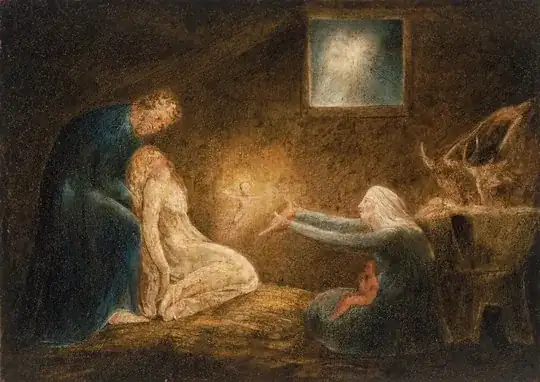
William Blake's Nativity

as "one of the greatest but possibly least appreciated treasures of the Philadelphia Museum of Art" (p. 266), saying that "Blake painted that Nativity as if guided by" "these words of Jerome" (p. 267), from Perpetual Virginity of Blessed Mary: Against Helvidius c. 4 (Jaki's translation of Migne PL 23:201):

Should the woman giving birth be overtaken by pain, midwives pick up the crying infant and the husband will hold the exhausted wife. … But in no way should this be thought of the Saviour's mother and of that just man, Joseph. Here is no midwife; no need here for women to be fussing about. His mother herself wrapped him in the swaddling clothes, herself mother and midwife.

Geremia
  • 39,167
  • 4
  • 47
  • 103
  • 1
    St. Thomas is supposing that a woman has great difficulty resisting some impulse of physical enjoyment during rape!!!! Come on! – Mike Borden Apr 20 '21 at 11:35
  • 1
    @MikeBorden How's that untrue? – Geremia Apr 20 '21 at 15:08
  • I am not a woman and have never been raped but I do know a fair few (statistically the numbers are high) and I have yet to find one who said they enjoyed it a little. So far it appears unanimously horrific physically, mentally, and emotionally. This statement of Aquinas is on a par with Clement thinking the Phoenix was a real bird. – Mike Borden Apr 21 '21 at 12:15
  • 1
    @MikeBorden St. Thomas describes a violent act ("corruption [loss of virginity] by violence"), so he's not denying the woman experiences pain, too, in such an act. – Geremia Apr 21 '21 at 17:56
  • But he is saying that a woman undergoing such violence has extreme difficulty suppressing some impulse of enjoyment surging forth and that, because she enjoys it a little, her virginity is less perfect than those whose bodily integrity was not forcibly taken. Because a woman has great difficulty not enjoying the rape at least a little bit!! – Mike Borden Apr 22 '21 at 12:18
  • My view is that if Mary was given an option to suffer the pangs of delivery, she would have gladly accepted it, since she would know 33 years in advance what kind of suffering was awaiting her son. – Kadalikatt Joseph Sibichan Apr 27 '21 at 09:58
  • Biologically speaking, human females have to undergo delivery pain for the reason that their pelvis got contracted with the success in standing up on two feet during the process of evolution . The pain is irrespective of the fact that human babies are born sort-of-immature in comparison with other beings, say a giraffe calf which falls six feet down and stands up immediately . Imagine the plight of a woman who gives birth to a baby with a firmed up skull ! Mary, in all humility, would have accepted the pangs of delivery which for her was a biological necessity. – Kadalikatt Joseph Sibichan Apr 27 '21 at 10:15
  • @KadalikattJosephSibichan So you deny the miraculous nature of her birth of Jesus, that "just as He afterwards went forth from the sepulchre while it was closed and sealed, and entered the room in which His disciples were assembled, the doors being shut (John 20:19); […] just as the rays of the sun penetrate without breaking or injuring in the least the solid substance of glass, so after a like but more exalted manner did Jesus Christ come forth from His Mother’s womb without injury to her maternal virginity." – Geremia Apr 27 '21 at 17:23
  • The question is how far we can think beyond what is written in the scriptures.Adam and Eve had been ordained to multiply and fill the earth even before they sinned. Delivery pangs came with the sin. If the curse on Eve exempted Blessed Mother, it would have been somewhere there in the scriptures. By the way, do we have any idea of the part of prepuce of Jesus which got separated during his circumcision ? – Kadalikatt Joseph Sibichan Apr 28 '21 at 03:19
  • @KadalikattJosephSibichan By the way, do we have any idea of the part of prepuce of Jesus which got separated during his circumcision? I am afraid the Scripture doesn’t say, but … is it relevant? – Miguel de Servet Jun 11 '21 at 15:29
  • @KadalikattJosephSibichan His was a brit milah circumcision. – Geremia Jun 11 '21 at 19:42